2. From good intentions to helpful interactions
Give an interaction a reason to matter to the person receiving it.
Industry perspective
“ask what matters, listen to what matters, do what matters.”*
“Ask What Matters” movement tagline, described by Michael Barry
Ask “What Matters to You?” When It Matters Most · Institute for Healthcare Improvement · September 17, 2019
Barry describes a shared decision-making movement and the importance of acting on what people say matters.
When another message is not the answer
Imagine a team that has sent Maya the same preparation reminder three times. The message is accurate. The link works. The team can see that it has been delivered. Yet Maya has not completed the step. It would be easy to decide that she needs more encouragement. It would be more useful to ask what is making the step difficult.
Perhaps the instructions assume that someone will be available to help. Perhaps she cannot find the information requested. Perhaps the step does not seem connected to what she needs today. The same pattern of non-completion can have very different explanations. A system that simply increases the frequency of reminders may add effort without addressing any of them.
carePhysics brings human understanding and practical design questions into that moment. It connects principles of care with research, communication methods, and improvement approaches. Its value is in helping a team ask better questions and design a more useful response. It does not turn a person into a category or make every intervention effective by association with a model.
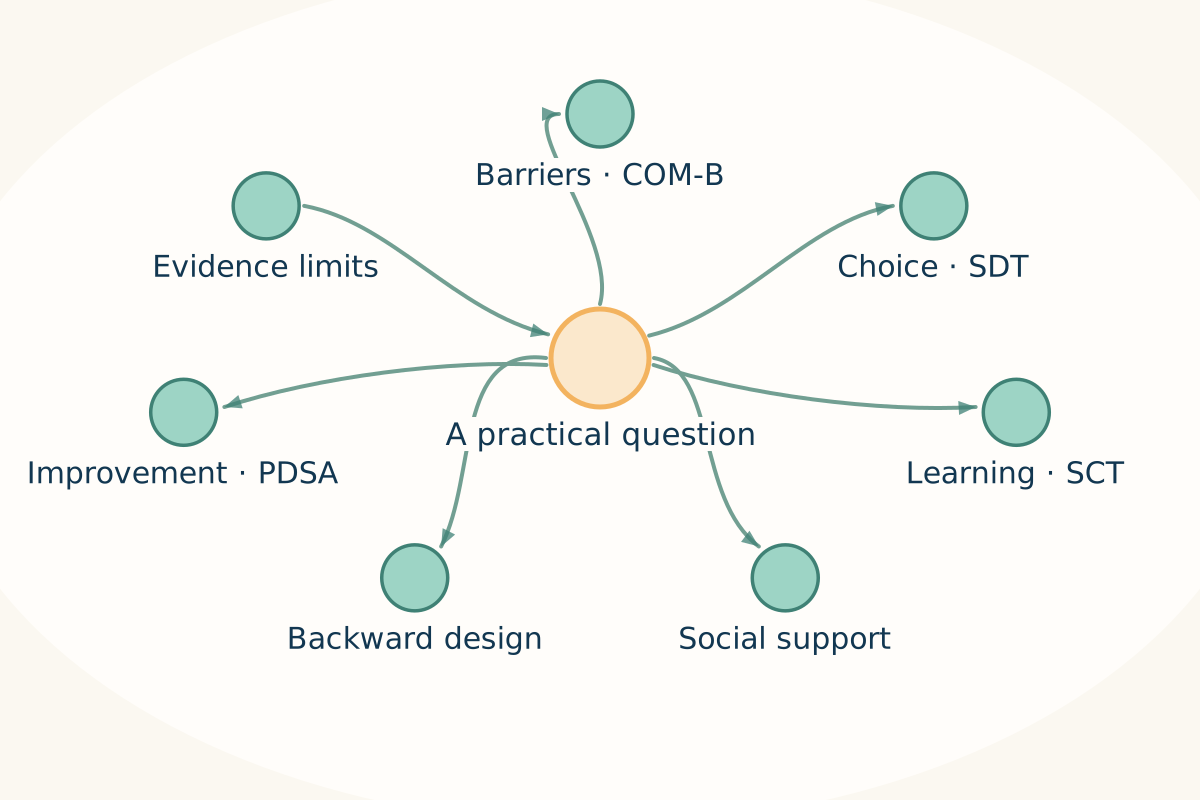
Connection map reproduced from carePhysics 3.7, Reference R2. Each model offers a lens for a practical question; none describes the whole person.
- COM-B examines capability, opportunity, and motivation. Self-determination theory examines autonomy, competence, and relatedness.
- Social cognitive theory directs attention to learning through the person, behavior, and environment. Social support asks what someone can rely on.
- Backward design begins with the intended outcome; Plan–Do–Study–Act supports a small test. Choose a model with its evidence limits in view.
What the models help us notice
COM-B examines capability, opportunity, and motivation in relation to a particular behavior. In a partner discussion, it can help separate a missing resource from a confusing explanation or an unwanted request. Begin with a specific action and circumstance rather than a judgment about the whole person. The original framework is described by Michie, van Stralen, and West.
Self-Determination Theory draws attention to autonomy, competence, and relatedness. For an experience designer, those ideas encourage questions about meaningful choice, feeling able to participate, and connection with others. A resource can be easy to click while still leaving someone feeling pressured or alone. Read the theory’s basic psychological needs overview.
Social-support ideas ask what someone can actually rely on. Social Cognitive Theory helps teams consider examples, practice, and the interplay between a person and their environment. Communication methods such as motivational interviewing and teach-back support different kinds of conversation. They are not interchangeable labels for being friendly, and using a phrase from a method is not the same as delivering the full approach.
The carePhysics reference companion, The Models Behind carePhysics — Ideas We Can Put to Work, provides fuller explanations and references. A partner does not need to put every model into every pathway. Choose the question first, then the model or method that can help examine it.
Turn understanding into an experience
Suppose the team learns that Maya wants to prepare but cannot identify which part of the form applies to her. A useful response might be a shorter explanation, a relevant example, and a way to ask a person for help. The team can then check whether its explanation worked. Another reminder to the unchanged form would not address the problem it has discovered.
This is how evidence can influence features. The model suggests a question; the conversation supplies context; the team changes an interaction; people try it; and the team reviews what happened. The feature might be a branching question, a different content format, a clearer handoff, or a choice to speak with someone. The important connection is between the need and the response.
Keep the distinction between a design rationale and a demonstrated outcome. An approach can be informed by research without having been evaluated in your setting. A local trial can produce useful learning without proving that the same result will occur elsewhere. Describe the audience, circumstances, and limitations alongside the result when sharing it.
Where AI helps
AI can help prepare several versions of an invitation or organize a design brief around a selected model. Give it approved information, the intended audience, the desired next step, and the boundaries of its task. Ask it to identify assumptions that a person should check. The draft then becomes material for a conversation, not a decision already made.
Review whether the output actually supports the chosen purpose. A draft that names autonomy but offers no meaningful choice has not solved the design problem. A draft that offers help unavailable in the program creates another problem. Frontline staff and participants can often identify those gaps quickly when they see the proposed experience in context.
Human reviewers remain responsible for the meaning, evidence, and use of the result. Avoid asking an assistant to infer a person’s motivation, capacity, or emotional state from a single response. A missing answer may tell you that the interaction needs attention; it does not tell you the person’s story.
Bring your knowledge
Choose an interaction your team finds frustrating. Describe what you want the person to do, why it would help them, and what the interaction asks of them. Then ask what you actually know about the barrier. Separate observed facts from explanations you have assumed. Invite someone who receives the interaction to help you reconsider it.
Explore further — Evidence-informed does not mean guaranteed
A model helps organize thinking. A communication method helps guide a practice. An improvement method helps a team test a change. A study can provide evidence about a defined intervention, population, and outcome. These contributions are valuable for different reasons. Treating them as identical makes it harder to know what a design is relying on.
In this guide, carePhysics connections explain why a feature or interaction may be worth considering. They are not claims of endorsement by the model’s authors, certification by a research organization, or proof of clinical benefit from genus. Keep the source attached to the idea and keep learning from the people who use it.