6. Many circles, different roles
The same person can need support in one place and offer it in another.
A person is more than one role
Lena helps her sister Maya prepare for a return home. She also checks in with her own father and volunteers with a neighborhood reading group. In one circle, she is coordinating practical support. In another, she is a daughter learning what her father wants. In a third, she has something to give. These fictional situations illustrate a familiar reality: people do not organize their lives around a single service or label.
The care app includes community membership and switching, so someone can participate in more than one community. That structure matters because each community has a different purpose. The people, information, and responsibilities appropriate to one circle may not belong in another. A useful experience makes the current community clear before someone reads, responds, or shares.
For a partner, this changes the design question. Instead of asking how to keep everyone inside one program, ask how the program can become a helpful part of a person’s wider life. The relationship may be important without needing to become the center of everything.
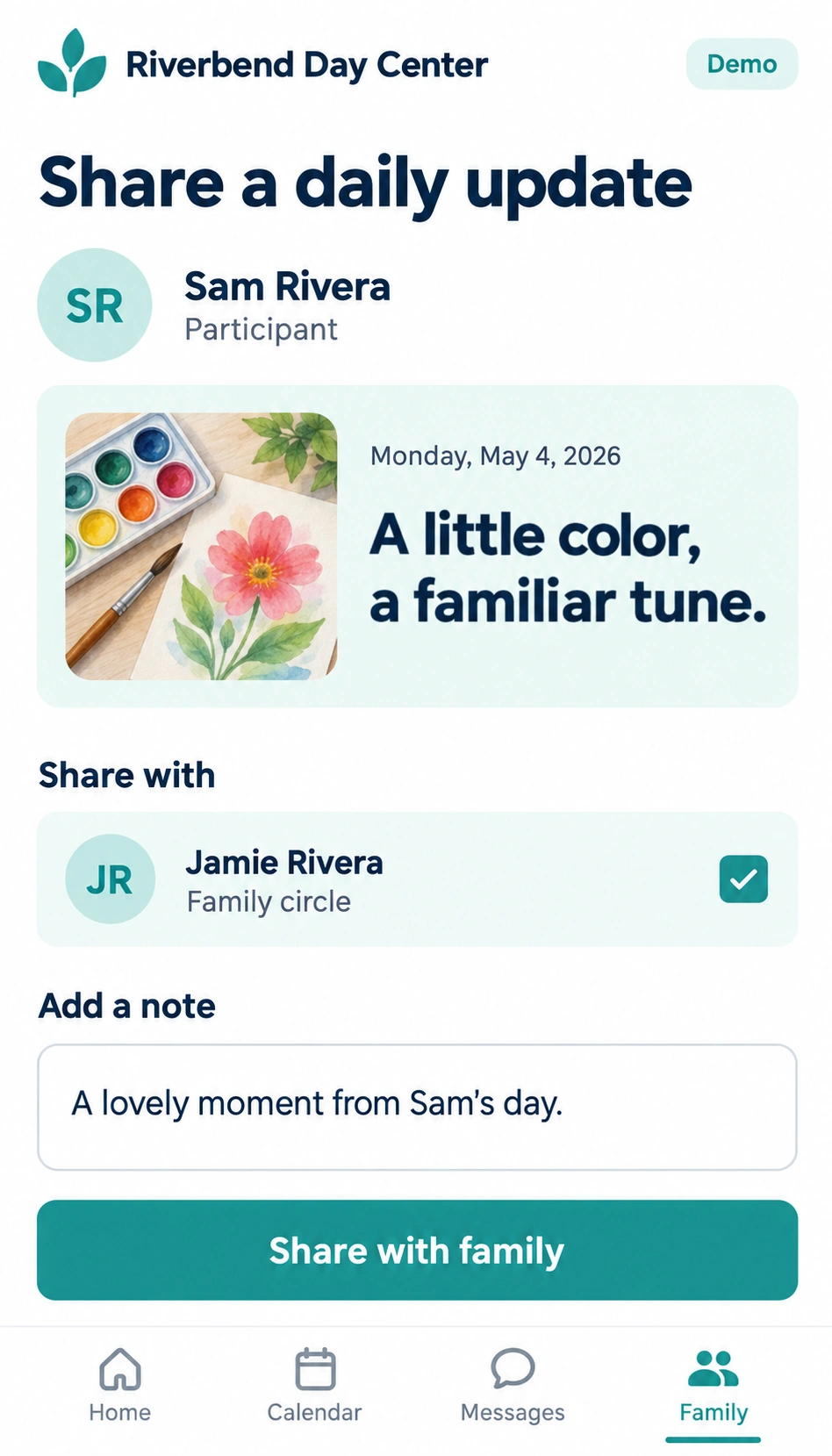
Existing public demonstration screen using fictional names and information. It illustrates an interaction to discuss, not a customer record or a guarantee of every deployment’s interface.
- The update identifies whose day is being shared and gives the moment a human context.
- The named recipient makes the intended audience visible before sharing.
- The note and final action create a moment to review what is being contributed.
Participation should be understandable
A person joining a community needs to know what it is for, who is there, what can be shared, and what participation is expected. A family member may be comfortable offering transport but unable to coordinate appointments. A volunteer may want to contribute to a public activity without entering a private care circle. A participant may prefer direct contact with staff and choose not to invite relatives.
Those differences should influence the arrangement. Invitation and membership tools support joining communities, while the partner’s roles and permissions define the available access. An invitation is an opportunity to explain the relationship. It should not quietly become agreement to every future use of information.
Public groups need a similarly clear purpose. If your program intends to offer publicly discoverable groups, confirm the supported participation and moderation arrangements separately from private care communities. Discoverability, membership, and permission to see someone’s personal information are different questions.
The app’s community structure provides a foundation for these experiences. The partner still needs to decide which kinds of groups it will support, who will welcome new members, and how concerns will be handled. A visible group with nobody responsible for it can leave people less confident than an honest invitation to a smaller, well-supported circle.
Give without turning care into a contest
A community may benefit from knowing that someone has checked in, shared a useful resource, or offered a ride. That visibility can help people avoid duplicated work and notice an unmet need. It can also become uncomfortable if the experience appears to rank who has done the most.
The useful question is what the group needs to coordinate. A count of calls may say little about the effort involved, the quality of a conversation, or the support happening elsewhere. Some people contribute quietly. Some carry responsibilities the app cannot see. Design should leave room for that reality.
Partners can help by choosing language and measures that encourage support rather than competition. Ask whether a display helps the person receiving care, whether it respects the people contributing, and whether participants can explain what the display misses. Feedback from families and frontline teams belongs in those decisions.
The carePhysics connection
Community — Make Belonging Practical and Support the People Who Care help connect participation with belonging and capacity. A community becomes useful through the relationships it supports, not simply through its membership count.
Social-support thinking also encourages a broader view of contribution. Practical help, information, encouragement, and companionship are different forms of support. A partner can make several forms possible without expecting every person to provide all of them.
Where AI helps
AI assistance can help a team draft a welcoming explanation, suggest clearer participation instructions, or prepare different versions of a resource for review. An assistant working within an authorized context may also help organize questions that a human coordinator needs to address.
Community boundaries still apply. Information available in one context should not become material for another simply because an assistant can summarize it. The system and the people operating it need to preserve the relevant access, purpose, and sharing conditions.
Bring your knowledge
Map the roles your audience already holds outside your organization. Then choose one place where your program could make those relationships easier: a clearer invitation, a resource that supporters can understand, or a way to identify who can help with a specific task.
Ask participants what they want others to know and what they would prefer to keep separate. Test the language with people who have different family structures and levels of available support. The aim is an experience in which people recognize themselves, including when their capacity changes.
Explore further — A community check-in
Before opening a new circle, agree on its purpose, who may invite people, who can see each kind of information, and who will respond when something needs attention. Explain how a member can ask for a change or leave. Revisit those choices when the purpose or membership changes. This is ordinary relationship work supported by technology, and it deserves a place in the ongoing service rather than only in the setup process.