12. Trust beneath the experience
People should be able to understand what they are being asked to trust.
Trust is felt in ordinary moments
A participant wants to know whether a message is visible to a relative. A staff member wants to know whether an assistant may use a private document. A partner leader wants to understand what happens if a service arrangement changes. These questions belong in the design of the experience.
Trust includes technical protection, clear responsibilities, and understandable choices. An encrypted database does not explain who should be allowed to read a record. A privacy notice does not resolve an unclear invitation. The infrastructure and the human arrangement need to support each other.
For a partner leader, the useful starting point is a concrete experience. Identify the people involved, the information required, the reason for using it, and the responsibilities at each step. That gives the technical and governance review something specific to assess.
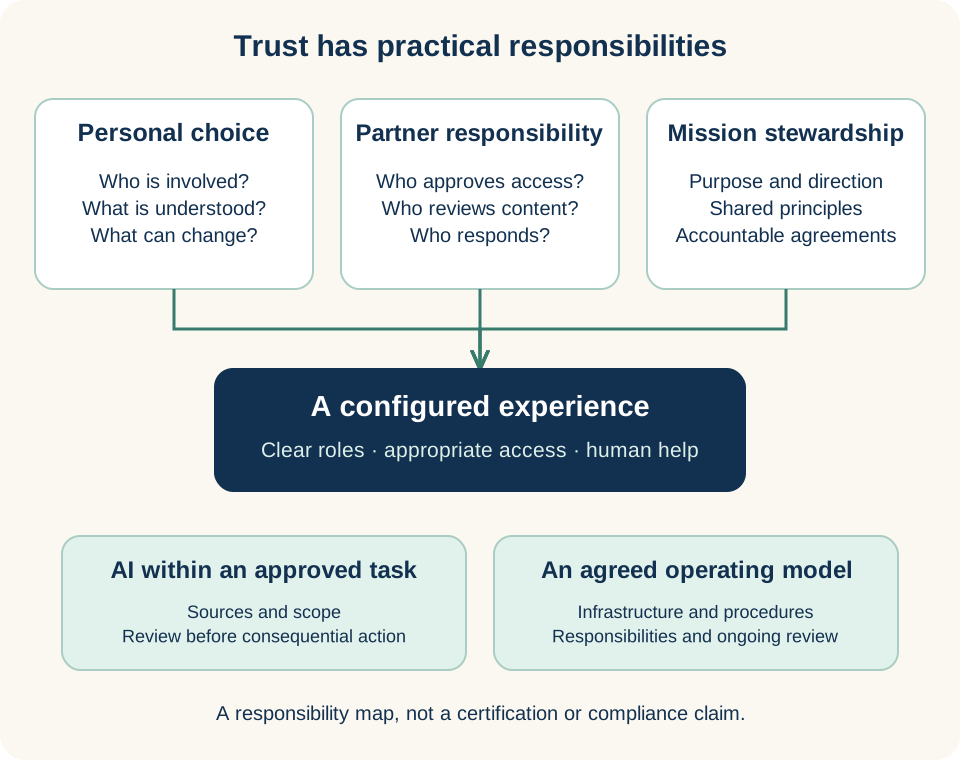
Responsibility map. Personal choices, organizational operations, and mission stewardship need practical agreements. This is not a certification or compliance claim.
- Clarify whom the person wants involved and what authority applies to each role.
- Name the people responsible for access, content, follow-through, and review.
- Agree AI scope and the operating arrangement. Infrastructure supports that work; it does not replace contracts, procedures, or ongoing review.
AWS and the operating arrangement
The genus architecture uses AWS cloud services. For your deployment, agree how storage is protected, how long information is retained, and who operates and monitors the environment. Ask how backups, service interruptions, access changes, and updates will be handled in the arrangement you are considering.
AWS provides HIPAA-eligible services and a Business Associate Addendum for covered uses. Its HIPAA guidance explains that customers share responsibility for protecting health information and must meet the applicable service and agreement requirements. Using AWS does not, by itself, make an application or partner workflow HIPAA compliant.
A proposed health-information deployment needs review of the actual configuration, contracts, access, monitoring, operations, and uses of data. The book provides a way to ask those questions; it is not a compliance determination for a particular organization or environment.
Personal, organizational, and shared responsibilities
At the personal level, people need understandable information about participation, invitations, and sharing. The arrangement should account for who has authority to make decisions and how that authority is represented. Different relationships may require different processes.
At the organizational level, the partner needs defined roles, maintained policies, appropriate training, and an operating process for questions or incidents. It should know which responsibilities it retains and which are carried by genus or another provider. A contract and a working procedure serve related but different purposes.
At the ecosystem level, shared learning needs a clear purpose and limits. A useful lesson may come from a local experience, but that does not automatically make the underlying personal information available for wider use. The team should establish what can be shared, with whose permission, and in what form.
Continuity deserves a direct conversation
Partners may have different hosting, licensing, or code-access requirements. Those arrangements need to be discussed for the particular audience and service. Questions about long-term availability, support, updates, and exit planning should be answered in the relevant agreement and operational plan.
genusCommunity Foundation expresses our commitment to keeping people, families, and community benefit central as the ecosystem grows. The practical rights and responsibilities of a partner need to be stated explicitly, including what continues if an arrangement changes.
Avoid asking a broad word such as “ownership” or “immutable” to carry more meaning than the actual arrangement supports. Ask which information or record is involved, who controls access, what may change, and how corrections, retention, and deletion are handled. Clear answers are more useful than a sweeping promise.
The carePhysics connection
Shared Tools, Local Wisdom connects common capabilities with local responsibility. Governance helps preserve the purpose of an interaction as it moves through content, communication, AI assistance, and learning.
Trust also depends on the experience of being heard. Give people a practical way to ask what a feature does, correct a misunderstanding, or raise a concern. The response should reach someone who can act, and the organization should learn from patterns in those questions.
Where AI helps
AI can assist a team in organizing a configuration review, comparing a draft workflow with approved policies, or identifying questions that require an owner. It can help make a complex discussion easier to navigate.
An assistant does not establish compliance or replace accountable review. Keep the decision and its rationale with the people responsible for the arrangement. Where a request involves sensitive information, use only the approved tools and channels for that information.
Bring your knowledge
Before beginning a pilot, agree on the scope of information, access, human support, and review. Identify the questions that must be resolved before real participant information is used. Then revisit the arrangement when the audience, capabilities, or data flows change.
Explore further — Make the agreement usable
Turn the important responsibilities into language the operating team can use. Who receives an access question? Who can change a role? Who reviews a new integration? Who handles a service interruption? Where is the current policy? The answers should be easy to find and kept current. An agreement supports trust when the people doing the work can put it into practice.