
genus perspective
The alert that did not arrive
A connected experience depends on the route carrying its information. An FCC outage report prompts a planned, nonclinical reminder demonstration: what does a missing update mean, and what useful alternative is available?
What we found in the news
In July 2024, the Federal Communications Commission (opens in a new tab) reported on the nationwide AT&T wireless outage of February 22. The announcement described an interruption that:
“prevented customers from using voice and data services”
— Federal Communications Commission
This was a telecommunications investigation, not a test of home-support devices or genus services. Its practical relevance is the dependency underneath a connected experience: a message can be useful only if the route carrying it is working.
Why this matters to us
Connected equipment can make information easier to share. It can also make an interrupted connection less visible than a disconnected telephone used to be.
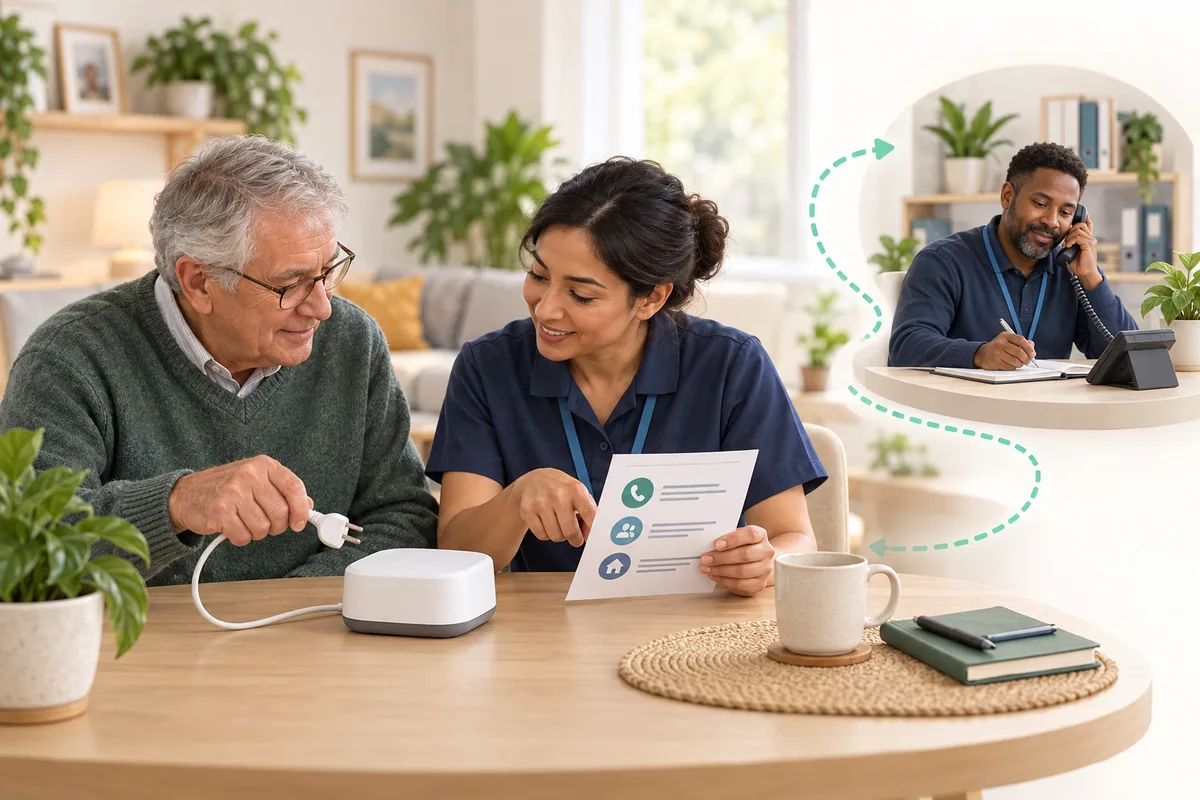
Imagine a community service demonstrating a simple home hub that receives routine activity reminders. A participant and colleague agree to rehearse what happens when the demonstration unit loses its connection.
They use fictional information and equipment set aside for the exercise. Anyone’s working support equipment stays untouched.
The expected reminder does not appear. That leaves a useful question for the team: how would someone know that the route had failed, and what would they do next?
Decide what silence can actually tell you
An empty screen is ambiguous. Perhaps no message was due. Perhaps the hub is disconnected. Perhaps a message exists elsewhere but has not reached this device.
For the demonstration, write down what the team expects to happen and which parts they can actually observe. A sent message, a delivered notification, and a person reading it are different events.
Avoid asking a status indicator to carry more meaning than the system can establish. If the service cannot confirm receipt, explain that limitation in the plan.
Ask the participant how they would interpret the screen. Their explanation may reveal an assumption that staff have missed, such as believing that no visible reminder means an activity has been cancelled.
Rehearse the alternate route
Agree on a practical way to check the routine information while the demonstration connection is unavailable. It might involve an accessible printed schedule or a known contact using a route that still works.
Consider the dependency of the alternative too. A second app on the same disconnected network may provide little help. The person preparing the exercise should know what the proposed route relies on.
Have another colleague try the plan without coaching from its author. Can they find the relevant contact, understand their role, and explain the next step to the participant?
Keep the exercise proportionate to the service. Emergency and safety-critical arrangements require their own qualified planning; an activity-reminder rehearsal does not validate them.
Explain what happens after the connection returns
Restoring a connection can leave another question: is the information now current?
In our imagined example, an old reminder could arrive after the activity time has changed. The team should understand how the actual service handles delayed information and how people can check the latest version.
Give someone responsibility for reviewing the exercise findings with the supplier or service owner. Record the uncertainty that needs an answer, rather than filling the gap with an assumption.
Share the useful result with the participant. They helped the team notice how the experience could be misunderstood, and they should know which part of the guidance will change.
A short rehearsal is worthwhile when it improves the next real explanation. It should leave staff with a clearer plan and people with a more accurate idea of what the device does.
What this means for the people you serve
People can help define what a missing update means in daily life. They deserve an explanation of the device’s role, its limits, and the available way to check information. A quiet screen should not leave them guessing whether a service has changed or a connection has failed.
The genus connection
Today, genus devices and integrations distinguish device information from the arrangements needed for an actual connection. Data flow, permissions, update frequency, and operating responsibilities need confirmation for the intended setup.
We would include missing or delayed information in that conversation. The team and supplier should agree what can be observed, who investigates a problem, and how the person receives useful guidance while it is being resolved.
One question to take away
If the expected update does not arrive, what will the person and the responsible colleague each do next?
Supporting references
- FCC Issues Report on Nationwide AT&T Wireless Outage (opens reference preview; direct link opens in a new tab)
Federal Communications Commission · 2024-07-22
The FCC’s July 2024 announcement reports on a wireless-network outage. The article applies a limited dependency lesson to an original, nonclinical device demonstration.


