
genus perspective
Enjoyment belongs in the design conversation
Usable does not always mean enjoyable. A small co-design study prompts a community activity conversation about personal interests, pace, company, and the freedom to stop.
What we found in the news
A January 2026 npj Digital Medicine study (opens in a new tab) described a staged co-design process with nursing-home residents using an interactive virtual-environment prototype. Its proposed design guidelines emphasized:
“playfulness and happiness”
— Mandi Tang, Mingming Fan, and Ge Lin Kan
The study involved a small sample and a particular intervention, with limits on generalization and long-term effects. It does not establish benefits for every digital activity. It does remind us that enjoyment is a legitimate part of asking whether an experience is worth someone’s time.
Why this matters to us
A tool can be usable without being interesting. Someone may understand the instructions and still have no wish to continue.
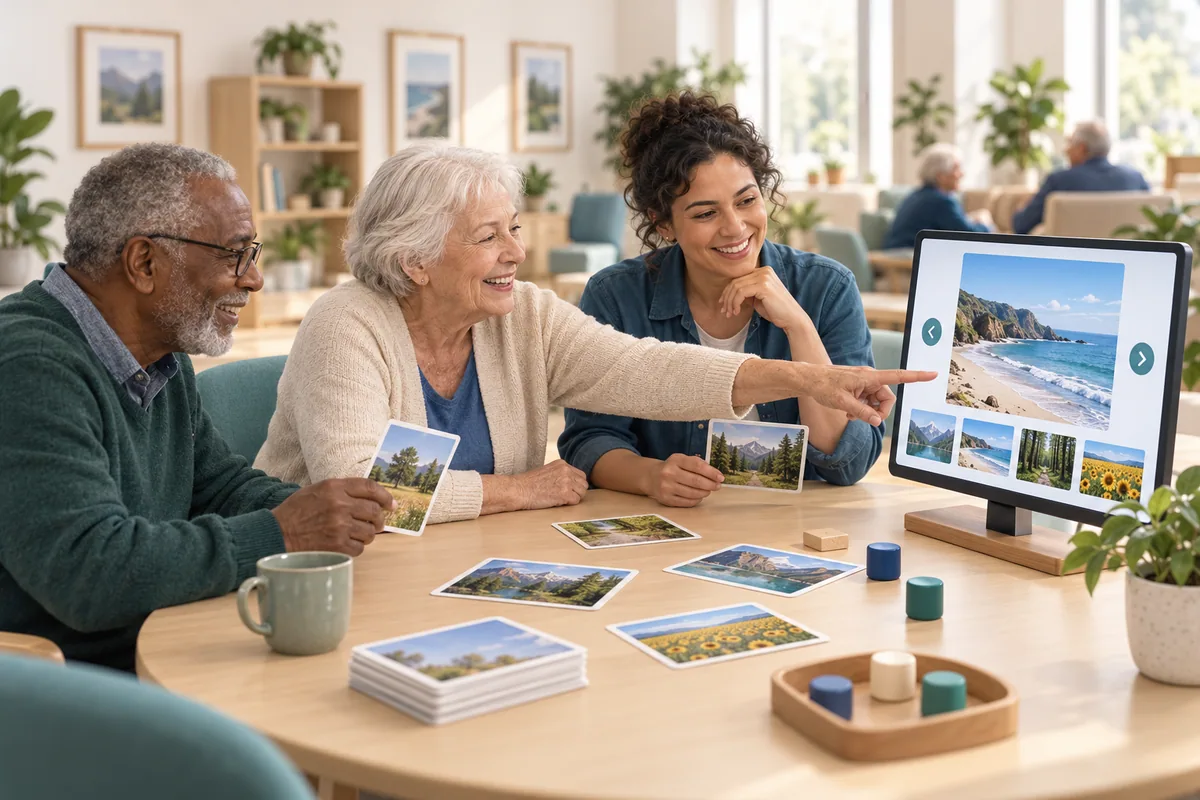
Imagine two older adults helping an activity designer choose pictures for a simple community game. One points to a seaside scene; the other prefers a familiar street market. They try a few game pieces and explain what they would like to explore.
Their preferences give the design something more useful than an assumption about what older adults enjoy.
At genus, we want room for curiosity, pleasure, and a little play. Those qualities should come from the people and the activity, with no obligation to perform enthusiasm for the technology.
Ask what makes the activity inviting
Begin with the person’s interests and the kind of experience they want. A familiar place may invite a story for one person and hold little interest for another.
Offer a few possibilities without forcing a narrow choice. People can suggest a different scene, change the topic, or decide that the activity is not for them.
In our imagined game, a picture card is a conversation starter. The designer can ask which detail caught someone’s attention and what they would like to do with it.
Avoid treating every contribution as a test of memory or performance. A person can enjoy an image, invent a story, or simply look for a while. The purpose of the activity should be clear.
Let people shape the pace and company
Consider how the activity feels during use. Can someone pause, repeat a moment, change the sound, or hand a turn to another person within the supported setup?
Ask whether they want company. A shared game can create an opening for conversation, while another participant may prefer to explore quietly before joining in.
Notice when the interface competes with the experience. Unclear controls or rushed transitions can interrupt the interesting part, even if a facilitator knows how to work around them.
Try adjustments with people rather than deciding that longer participation must be better. The person’s wish to stop belongs in the design alongside their wish to continue.
Keep enjoyment separate from a health claim
An enjoyable session has value on its own. It does not need to be presented as proof of improved cognition, reduced loneliness, or another clinical outcome.
For the community game, useful feedback might concern the pictures, the pace, the opportunity to contribute, and whether people would choose it again. That helps the team plan the next session.
If the activity has a therapeutic or physical purpose, appropriate professional assessment and evidence are separate requirements. A general design reflection should not become exercise advice.
Review the experience after the first novelty has passed. People may develop new ideas, tire of a feature, or prefer a different format. Keep their choices available as the activity evolves.
What this means for the people you serve
People can help define what makes an activity pleasant, interesting, or simply not their cup of tea. They can join in, watch, suggest a change, or stop. Their enjoyment should be understood through their own contribution, rather than inferred from time spent with a device.
The genus connection
Today, genus coaching and Mingle experiences can bring prepared activities, media, and human facilitation into supported live formats. The content and enabled interaction depend on the agreed setup.
We would begin with a meaningful invitation and try the activity with the people expected to enjoy it. Let their interests shape the material, confirm the available controls, and prepare a facilitator who can adjust the experience. The technology should help the shared moment happen.
One question to take away
What would make someone choose this activity again—and have we asked them?
Supporting references
- Co-designing with frail nursing home residents to gamify a VR-based physio-cognitive intervention (opens reference preview; direct link opens in a new tab)
npj Digital Medicine · 2026-01-24
A small co-design study examines playfulness in a specific virtual-environment intervention. It informs an everyday activity-design question, not a health-outcome promise.


