
genus perspective
Help a new team meet the person behind the record
A new care team needs more than a list of needs. An Alzheimer's Society account of its This is me resource prompts us to ask how people can share the preferences, interests and everyday details they want a new team to understand.
What we found in the news
In an April 2020 article about This is me (opens in a new tab), Alzheimer's Society describes a resource for sharing personal context with care professionals. Liz Yaxley, a dementia services manager quoted in the article, calls it:
“It’s a window into their likes, dislikes and wishes”
— Liz Yaxley, quoted by Alzheimer's Society
The article reports experience from a hospital and families. It is not a controlled evaluation, and those accounts are not genus customer stories. We are revisiting the resource's practical purpose when someone meets a new care team.
Why this matters to us
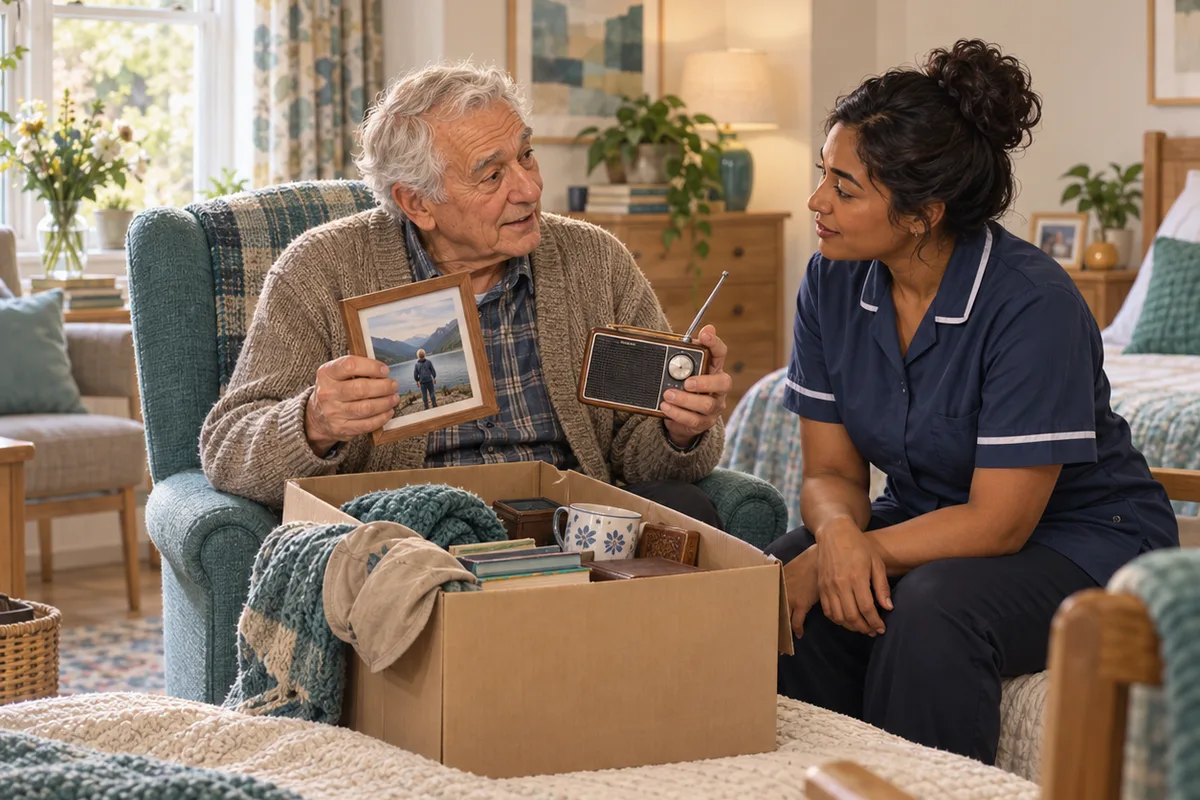
An illustrative person moving into a care home brings a small box of belongings: a favorite radio, photographs they have chosen and a notebook of places they enjoy.
The professional record has important work to do. These everyday details offer another route into understanding the person, if they want to share them.
At genus, we want transitions to leave room for that introduction. A person should not have to earn individual attention by telling a remarkable life story. A preferred name, a disliked noise or a favorite way to begin the morning may be enough to change how a worker approaches the day.
Let the person choose what to share
A personal profile should begin with the person as far as possible, using the communication support they need. Invite the details they want staff to know.
A chosen supporter can contribute where appropriate, but the account should not become solely someone else's description. Distinguish the person's stated preference from a supporter's observation or recollection.
Privacy matters. A profile does not need every difficult event, family relationship or health detail to be useful. Explain who will see it and how it will be used, following the organization's information-sharing process.
In our illustrative move, the person might want staff to know that they enjoy listening to the morning news quietly. They may prefer to keep the photographs for their room rather than include them in a shared profile.
Use the detail in a real introduction
Reading a profile is a beginning. Staff still need to meet the person, listen and see whether the information fits today.
A worker might ask whether the person would like the radio on or would prefer a quieter morning. That offers choice without making the old preference a rule.
Avoid treating personal history as a script for every interaction. Someone who once loved a particular activity may no longer want it. Someone who rarely joined groups may decide to try one.
The professional team remains responsible for assessment and care. A personal profile complements that work; it does not replace clinical records, consent processes or an individualized care plan.
Keep the account open to correction
New staff may discover that a detail is outdated or has been misunderstood. Give the person and appropriate supporters a clear way to request a correction.
Record changes through the service's process so an old copy does not continue circulating as the current account. If staff disagree about an interpretation, preserve the uncertainty rather than turning it into a fact.
Managers can ask whether the profile is actually available to the workers who need it and whether it helps them offer a more suitable introduction. A completed form that nobody reads has little practical value.
Use appropriate feedback to understand the experience. Do not assume that including a photograph or a favorite hobby proves the person felt recognized. Their response may tell the team something different.
The genus connection
Today, configured genus care-community and staff tools can support recorded context, activities and reviewed observations. Organizations can decide which information belongs in their workflows and who should have access.
Those capabilities do not turn every personal account into an authoritative or permanent description. Staff review, appropriate permissions and the person's opportunity to correct information remain important.
The useful role we see is helping relevant context reach the next conversation. The record can make an introduction easier; the person still gets to tell the new team who they are today.
One question to take away
What would this person choose to tell a new team about themselves—and how will the team make use of it respectfully?
Supporting references
- See the person: Improving care for hospital patients with dementia (opens reference preview; direct link opens in a new tab)
Alzheimer's Society · 2020-04-01
Reported hospital and family experience of the This is me resource, by Gareth Bracken. The short quote is attributed to Liz Yaxley. These are source accounts, not genus testimonials or controlled outcome evidence.


