
genus perspective
Test the person-and-tool journey together
A study of people using language models prompts a broader design question: does a useful answer lead to a clear next step? Test the whole community resource journey with intended participants.
What we found in the news
A randomized study in Nature Medicine (opens in a new tab), published in February 2026, compared how people handled medical scenarios with and without help from three language models. The models' performance on their own did not translate into equivalent performance when people used them. The authors recommend:
“systematic human user testing”
The study involved 1,298 participants and simulated situations, not outcomes from actual care. It concerns medical advice. Our interest here is a different, everyday application: how to test a community resource tool with the people who will try to use it.
Why this matters to us
A correct paragraph can still leave someone unsure what to do. A resource may be accurately described but have no clear contact route. An answer may contain the right opening time somewhere in the third paragraph, while the reader takes away a different impression.
We want technology to help people move toward something useful. That means paying attention to the exchange between person and tool, including what happens after the answer appears. A demonstration in which the presenter already knows the next step can miss quite a lot.
Watch a real task unfold
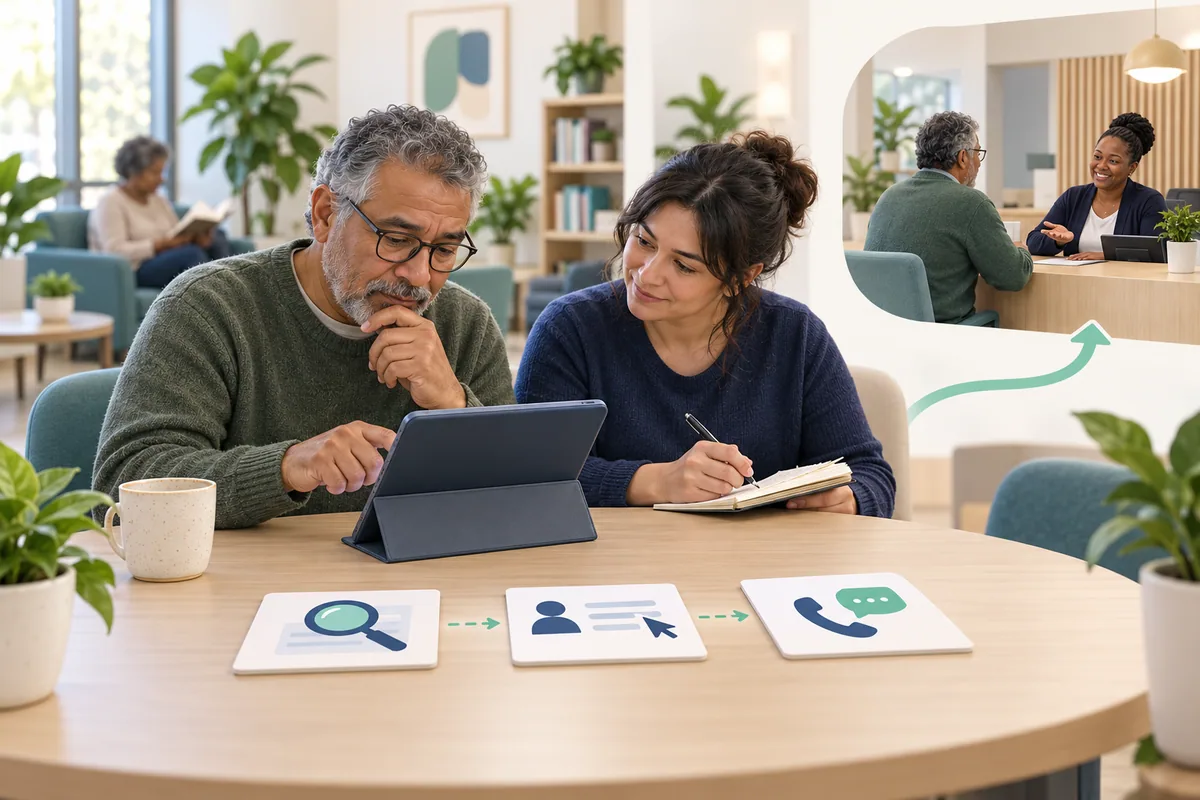
Imagine a community team inviting several people to try a resource finder before introducing it more widely. One participant wants to find a suitable afternoon activity. An observer sits nearby with a notebook and three picture cards: finding information, choosing an option and making contact.
The participant controls the tablet. The observer gives the task, then allows enough space to see what happens. Where does the person pause? What do they think a button will do? Which information shapes their choice?
This is an invitation to learn about the service. Explain that the tool is being tested, and that asking for help, stopping or choosing another route are all useful responses.
Ask what the answer meant
A screen can be technically complete while leaving an important detail uncertain. After a person reads a resource description, ask them to explain the next step in their own way. They might point, speak, write or show what they would do.
Listen for differences between what the team intended and what the person understood. An activity listed as available might sound like a confirmed place. A general enquiry form might look like a booking.
Those differences can become specific changes: a clearer label, a shorter explanation or a more direct contact option. Avoid treating every hesitation as a need for more training. The design may be asking someone to infer too much.
Include the last step
Follow the journey far enough to establish whether the proposed next step works. In a planned test, that may mean checking the published contact details with the service rather than sending a real request.
Does the destination team recognize the activity name? Can they explain what happens next? If an answer is uncertain, is there an obvious way to ask a person?
Try the revised journey again with people who were not involved in designing it. Include different devices, ways of reading and levels of familiarity. A helpful experience with one participant is a promising observation, not a guarantee for everyone.
What this means for the people you serve
People have a chance to shape the route before being expected to rely on it. Their pauses, questions and choices become design evidence. Staff can see which problems belong to the resource information, which belong to the interface and which require a better connection with the destination service.
The genus connection
The current care app and public wall (opens in a new tab) support configured community content and resources. That creates an opportunity to review the complete path from a visible resource to an appropriate next action.
For a genus setup, confirm the actual content, permissions, links and available assistance. Then try those arrangements with intended participants, including people who prefer help or another route. Their experience can guide both the content and the way the organization introduces it. The goal is a resource people can understand and use with confidence appropriate to the situation.
One question to take away
If someone found the right information today, could they show us what they would do next?
Supporting references
- Reliability of LLMs as medical assistants for the general public: a randomized preregistered study (opens reference preview; direct link opens in a new tab)
Nature Medicine · 2026-02-09
Controlled study of 1,298 people using language models in medical scenarios; supports attention to real human interaction rather than benchmark performance alone.


