
genus perspective
A state care model needs a local place to begin
The first AHEAD model selections connect state health-system ambitions with local communities. The useful starting point is a shared understanding of what people need to reach and use.
A state-level announcement with local implications
In July 2024, CMS announced the first selections for its AHEAD model. The contemporaneous announcement (opens in a new tab) described a model in which participants would:
“work collaboratively to curb health care cost growth”
— Centers for Medicare & Medicaid Services, July 2024
Maryland, Vermont, and Connecticut were selected, with Hawaii selected conditionally. These were early model decisions, not evidence of results or a new benefit available everywhere. These selections describe the model’s first announced cohort; later participation and design changes need to be considered on their own dates.
For community partners, a large announcement can open a smaller and useful question: where could a local relationship make support easier to use?
Walk the journey before drawing the program
Imagine a hypothetical small-town partnership involving a clinic, a community center, and residents. The first proposal is a monthly information event.
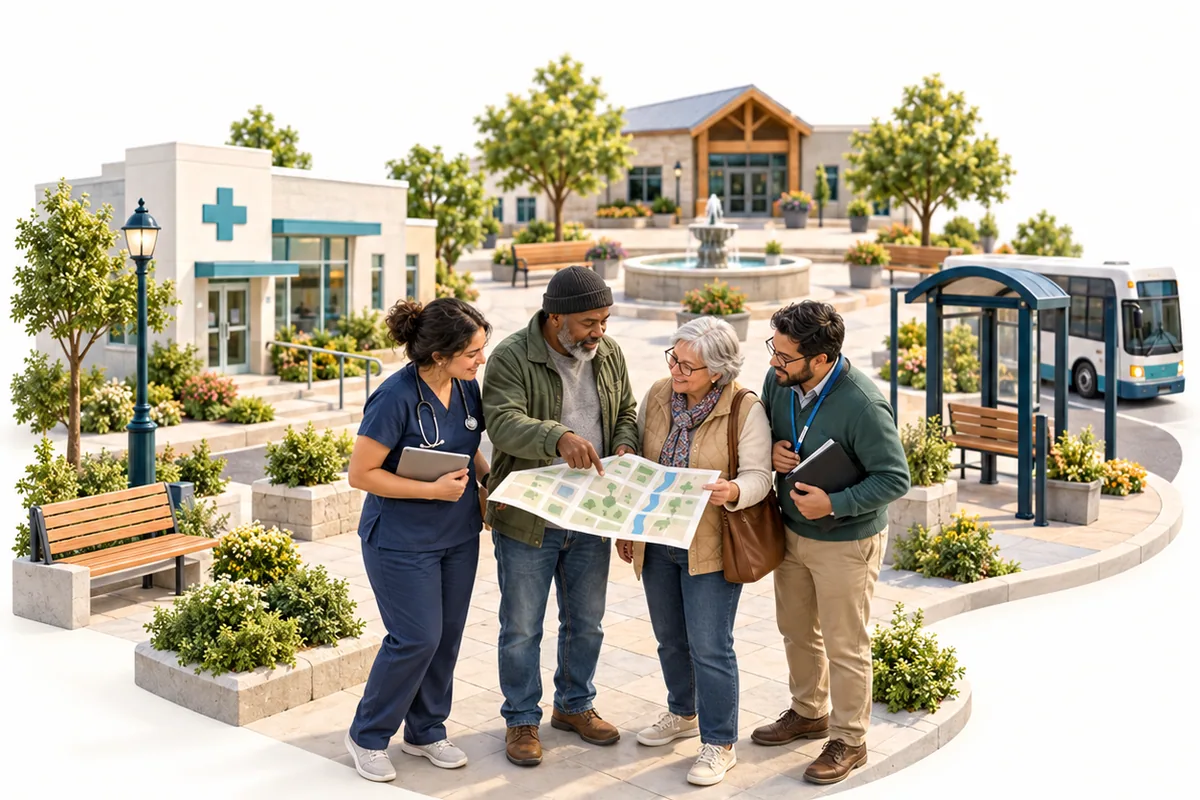
During a walk around the neighborhood, a resident points out that the bus serving the clinic leaves before the community center opens. Another person explains that they already receive plenty of information but struggle to find a contact who can explain which service fits.
Those observations do not settle the design. They do suggest that the first proposal may be answering a different question from the one residents are asking.
Choose one problem you can describe together
A partnership needs a shared account of the difficulty it intends to address. “Improve coordination” is broad enough for every organization to interpret differently.
Try describing one journey, the people involved, and the point where it becomes difficult. Check that description with residents and frontline colleagues before treating it as settled.
The question might concern transport, introductions, understandable information, or a gap between existing services. Keep the distinction clear between what the partnership can change and what requires a larger funding or policy decision.
Bring local capacity into the conversation early
An organization can support an ambition and still lack time to take on another role. Ask what the proposed work would require from each partner, including preparation, contact, follow-up, and maintenance.
Do not assume that a community organization has spare capacity because its contribution is less clinical or less visible in a budget. Relationships and local knowledge are supported by people whose time matters.
Agree which responsibilities can be resourced now and which remain proposals. It is better to offer a modest, dependable arrangement than a broad promise that relies on colleagues absorbing new work indefinitely.
Decide what you would learn from a first attempt
A local starting point should produce information that helps the next decision. Ask whether participants understood the offer, reached the intended contact, and found the arrangement suitable.
These observations are useful without being described as proof of reduced costs or improved health. Wider model outcomes require appropriate evaluation.
If the first approach does not fit, examine why. Perhaps the location was wrong, the invitation was unclear, or people wanted a different kind of support. A partnership that can revise its assumptions has more to learn than one that counts attendance alone.
Keep residents in the shaping role
Invite people to contribute before the choices have narrowed to details such as the event date or leaflet color. Ask which questions deserve attention and what participation would feel worthwhile.
Some residents may want a continuing role; others may prefer a single conversation or no involvement. Explain how their input will be used and what the partnership can realistically change.
Include people receiving support alongside families, staff, and organizational representatives. A professional meeting can be useful, but it cannot stand in for the people whose daily journeys the partnership hopes to improve.
A current contribution from genus
Configured genus care apps and care walls can bring selected program information, events, conversations, and resources into a shared experience. Organizations can use those capabilities around a defined local purpose and audience.
genus does not establish participation in AHEAD or demonstrate a model’s financial or clinical outcomes. The useful connection is more practical: making an agreed opportunity easier to understand and helping people keep the next conversation in view.
The partnership still needs accountable leaders, appropriate permissions, and time to respond to what participants say.
A local agreement can start small enough to explain in one conversation, while remaining connected to the broader purpose that brought the partners together.
A starting question for local partners
What is one journey people find difficult here—and who needs to help us understand it before we choose a response?
Supporting references
- CMS Announces First Awards in the AHEAD Model (opens reference preview; direct link opens in a new tab)
Centers for Medicare & Medicaid Services / Medicaid.gov bulletin · 2024-07-03
CMS’s July 2024 bulletin announces the first state selections for AHEAD, a care and payment model. Selection begins planning and implementation work; it does not establish achieved results.


