Chapter 2
Awareness — Make Understanding Possible
At a Glance
The central idea: Information only helps when someone can understand what it means for them.
What you’ll explore: How to explain what is known, what remains uncertain, what happens next, and who can help. Follow Pat’s family as they compare different interpretations without requiring everyone to agree. Learn to check the explanation rather than test the person, and adapt language, depth, format, and timing without changing the facts.
Design and AI: Build articles, videos, and conversations around one useful idea, a visible example, and a dependable route to questions. Explore how an approved AI assistant could explain reviewed information, prepare questions, and help people reach human support—without adding certainty or taking over professional decisions.
Put it to work: Build an Awareness Plan and redesign one article or video using familiar headings and clear next steps.
Evidence and evaluation: Examine health literacy, teach-back, COM-B, Self-Determination Theory, and Social Physics alongside supporting studies and limitations. Check understanding, unresolved questions, access, and workload—not merely whether content was delivered or opened.
“Communication should be consistent; always tell people what we know, what we don't know and what we're doing to find out more.”
— Rima Rudd, health-literacy researcher, in an interview with Governing, August 23, 2021.20
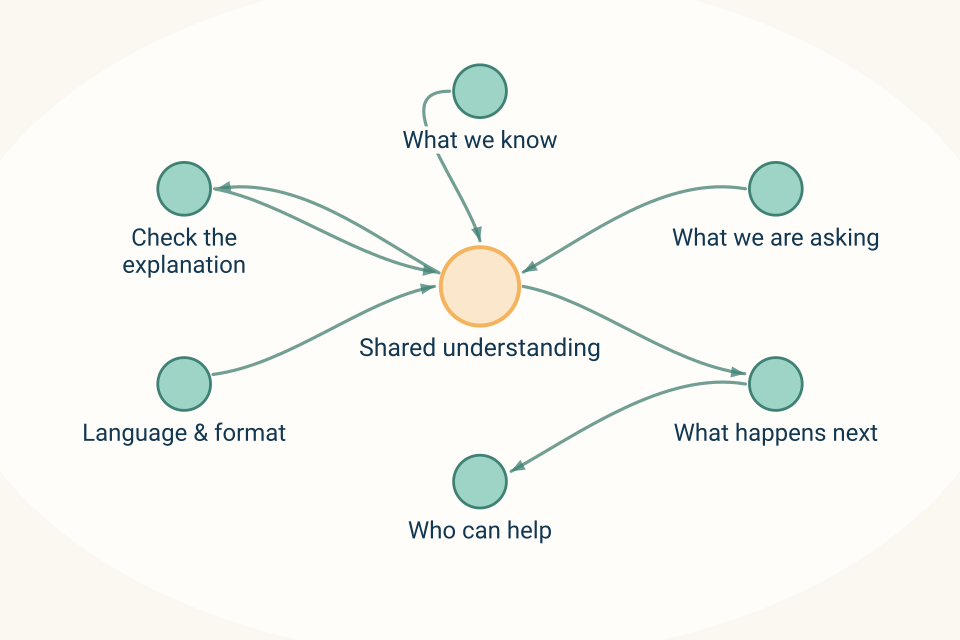
Explain what is known to build shared understanding. Make unanswered questions and uncertainty visible within that understanding. Understanding includes a clear account of what happens next. The next step names who can help. Adapt language and format without changing the facts. Check whether the explanation was understandable. Revise the explanation in response to what the person understood and still wants to ask. Checking the explanation is not testing the person, and shared understanding does not require agreement.
What we know Pat was assessed after a fall. Family observations remain attributed observations, not a diagnosis. | What we are asking What are the clinicians assessing? What does Pat want explained? What support would help at home? |
What happens next Follow the clinician-approved plan. Confirm the next appointment’s purpose. Prepare questions and discuss support with Sam. | Who can help The clinical team addresses medical questions. Sam helps with community support and family planning within his role. |
In context
In Context — Different questions, one family
When Maya joined the next conversation with Sam, she had a page of questions.
Daniel had one.
“Are we sure we need all this?”
He was sitting beside Ellen. Maya had joined by phone, with Pat and Ellen’s agreement. Sam had the shared summary from their first meeting in front of him.
“Dad seemed like himself when I stopped by,” Daniel continued. “We talked for nearly an hour.”
“We had a good visit,” Pat said. “I’d like another one that isn’t a meeting.”
“I’m not saying we shouldn’t talk,” Daniel replied. “I just don’t know what we’re talking about yet.”
Maya had been trying to understand what the family’s observations might mean. She wanted to prepare for what could come next.
“Have the doctors actually said this is dementia?”
Ellen looked at the papers.
“They said we need follow-up. I’m not sure what that means for everything we’re doing at home.”
Sam paused before answering.
“In the clinical information we have here, a diagnosis hasn’t been established. There are questions for the healthcare team. There are also things we can discuss now about what would help at home.”
“So those are different conversations?” Daniel asked.
“Connected, but different,” Sam said. “The clinicians assess the health concerns. We can work together on support and on preparing the questions you want to bring.”
Pat leaned forward.
“I’d like to know what the next appointment is for. And I’d like someone to explain it to me before everyone decides what it means.”
Sam turned the summary so Pat could see it.
“Let’s begin there.”
They were working from some of the same information, but they had arrived with different interpretations.
Maya was looking ahead. Daniel was comparing the concern with a familiar visit. Ellen was trying to understand what she was expected to do. Pat wanted an explanation addressed to him.
Nobody needed another stack of information before those differences were acknowledged.
They needed a way to understand what the information meant.
Information is the beginning, not the result
Information only helps when someone can understand what it means for them.
CarePhysics describes Awareness through practical questions: what is happening, why it matters, how and when something needs to happen, where support is available, and who can help. It includes education about care as well as knowledge of community resources and other assistance.
In practice, Awareness asks us to move beyond delivering an explanation to checking whether it has become usable.
Sending a document establishes that it was sent. Opening a video establishes that it was opened. Neither tells us whether a person understood the distinction between a concern and a diagnosis, a referral and an appointment, or an available service and one they can actually receive.
For Pat and Ellen, the first principle helped the people around them understand their priorities and circumstances. The second principle turns that understanding into an explanation they can work with.
That does not mean making everyone think alike.
Maya and Daniel may understand the same facts and still feel differently about them. Pat and Ellen may agree that support is available while disagreeing about which option to explore. A person can understand a recommendation and choose not to follow it.
Our task is to make the facts, uncertainties, choices, and responsibilities clear enough for those differences to be discussed honestly.
Shared understanding is not the same as agreement.
Start with the question the person is carrying
Sam could begin with a general explanation of care planning. But Pat has already identified a more useful starting point: what the next appointment is for.
Ellen’s immediate question is different: what does she need to do between now and then?
The explanation should address those questions before introducing everything else the organization knows.
This is one reason health literacy should be treated as a responsibility of the organization, not simply a characteristic of the person. AHRQ’s Health Literacy Universal Precautions Toolkit recommends making information and services easier for everyone to understand and use. It notes that even people who usually manage health information well can struggle when tired, ill, anxious, or overwhelmed.21
Pat’s teaching career does not tell Sam how clear this particular explanation will be. Maya’s research does not mean she has found information applicable to her father. Ellen’s familiarity with the household does not mean she knows how the healthcare and community systems divide responsibility.
The appropriate response is not to decide who needs the “simple version.” It is to make the starting explanation clear, invite questions, and offer more detail where it helps.
Purpose gives us a way to choose that starting point. Pat wants to remain involved in his own life. Ellen wants a manageable week. The explanation should help them see how the next conversation relates to those aims, without promising that an appointment or service will resolve every concern.
Culture and beliefs deserve the same attention. AHRQ’s cultural guidance emphasizes asking about the individual rather than assuming preferences from appearance, identity, or group membership.13
In another household, a person might want a trusted friend present before discussing a difficult subject. Someone else may prefer to hear the information privately before sharing it. A family may want a faith leader involved in considering its choices. Those preferences should shape the conversation without changing the underlying facts.
Language requires a separate question. Ask what language someone prefers for speaking and for written information. Arrange qualified interpretation and appropriate translated materials rather than expecting a relative—especially a child—to carry that responsibility.14
Knowing the audience helps us choose the explanation. Listening tells us whether we chose well.
What research helps us understand
Research gives this approach both encouragement and limits.
A randomized study of drug-safety messages found that clearer content improved comprehension without improving every other measured response.22 A systematic review of single-encounter teach-back found no clear pattern of benefit for knowledge acquisition, alongside low- or very-low-certainty findings for other outcomes.23
The practical lesson is to design for understanding, check what happens, and avoid assuming that comprehension automatically produces action or better health.
The fuller Models and Evidence Behind This Chapter section appears toward the end. It connects these findings—and the behavioral and social-learning models informing the chapter—to specific choices in the family’s experience.
First, let us see what those choices look like.
Give uncertainty a place on the page
Sam draws four headings on a fresh sheet:
What we know. What we are asking. What happens next. Who can help.
These headings form the chapter’s practical output: an Awareness Plan. They organize the family’s questions without implying that every question already has an answer. The structure carries forward the continuing storyline’s distinction between reliable information, uncertainty, next steps, and responsible contacts.
For this family, the first version could look like this:
Heading | What belongs here |
|---|---|
What we know | Pat was assessed after a fall. His current discharge instructions and follow-up information come from the clinical team. Ellen, Maya, and Daniel have described observations; those remain attributed observations, not a diagnosis. |
What we are asking | What are the clinicians assessing? What does Pat want explained? What support would make daily life more manageable for Ellen and Pat? Where do family members have different understandings? |
What happens next | Follow the current clinician-approved plan. Confirm the purpose and arrangements for the next appointment with the clinical office. Prepare the questions Pat wants to bring. Continue discussing practical support with Sam. |
Who can help | The clinical team addresses medical questions. Sam helps with community support and family planning within his role. The working plan includes actual contact routes, expected response times, and an alternative when the usual contact is unavailable. |
A real plan would include confirmed appointment details, relevant names and telephone numbers, a review date, and the instructions the clinical team has approved. A generic handout cannot supply those facts.
The distinction between the first two headings is particularly important.
“Maya is worried about dementia” belongs among concerns and questions. It must not become “Pat has dementia” through repeated retelling or a shortened summary.
Likewise, “Daniel had a reassuring visit” does not cancel Ellen’s account of difficulties at other times. Both can remain visible without asking Sam—or an AI assistant—to decide which family member is right.
In context
Sam asks Pat whether the page answers his first question.
“Not quite,” Pat says. “It says follow-up again. What are they following up?”
“That needs a clearer explanation from the clinical office,” Sam replies. “Let’s put your wording in the question.”
The page has done something useful. It has revealed what is still missing.
Check the explanation, not the person
In context
Later in the conversation, Sam explains the difference between preparing clinical questions and arranging community support.
Then he checks his explanation.
“I want to make sure I’ve separated those clearly. How would you describe what we’re doing next?”
Ellen looks at the sheet.
“We speak with you about help at home. And then you tell us what the memory changes mean?”
Sam does not repeat the same explanation more loudly.
“I haven’t made that clear enough. The clinical team answers the medical questions. My part is helping you explore support and organize the conversations around it. We can do that work alongside the clinical follow-up.”
He adds the clinical office beside the medical question and his own name beside the support discussion.
Ellen studies the page.
“So we don’t have to settle the medical question before talking about what would make the week easier.”
“That’s the distinction I wanted to make.”
Pat points to the contact section.
“And we know who gets which question.”
The correction is not a failure of the meeting. It is part of the work.
AHRQ’s teach-back guidance recommends explaining in manageable portions, asking people to describe the information in their own words, and trying a different explanation when needed. People may refer to written materials; the method is not intended as a test of memory.24
That matters in this story. Pat should not be made to feel that every conversation is an examination. Nor should Ellen’s uncertainty become evidence that she is unable to help.
A useful check might be an explanation in someone’s own words, a demonstration of where to find a contact, or a supported discussion using an accessible format. The purpose is to discover what assistance is needed—not to award a pass mark.
When understanding remains difficult, change the support. Consider pace, language, hearing or vision needs, the amount of information, the timing, and whether another appropriate person should help. Do not keep asking the same question until someone gives the answer that ends the encounter.
Design the explanation around one useful idea
The Awareness Plan helps Sam see what the family needs. It also gives a content team a focused assignment.
Not: Produce an educational package about aging.
Instead: Help this family prepare for a care conversation without asking them to establish a diagnosis themselves.
That is one organizing idea. Additional information can remain available without competing for attention at the beginning.
The CDC’s Clear Communication Index asks whether material has an identifiable main message, familiar language, useful headings, a clear action, and an explanation of what authoritative sources know and do not know. It is guidance for designing and assessing communication—not evidence that a particular handout has worked.25
For Pat’s family, a reviewed article could begin this way:
Preparing for the next care conversation
You do not have to work out the explanation yourself before asking for help.
Begin with what you want to understand. Your questions, the experiences you choose to describe, and what matters in your daily life can help shape the conversation.
What this means
Keep what a professional has told you separate from what you have noticed and what you are wondering about. All three can be discussed, but they are not the same kind of information.
A way to begin
“I want to understand what you are assessing, what I need to do next, and whom to contact when I have a question.”
You can bring a short note, ask someone you choose to help prepare it, or raise your question during the conversation.
What happens next
Use your current care plan for the appointment arrangements and contact details. Ask the responsible professional to explain anything that is unclear. Questions about everyday support can also be brought to Sam.
Before the conversation ends, check that you know which questions were answered, which remain open, and who is following up.
This illustrative article is not a replacement for discharge instructions or individualized clinical advice. Its job is preparation.
A companion video should do more than read the article aloud.
It could show a person looking at an appointment letter and saying, “I know where I’m going, but I’m not sure what we’re discussing.” A staff member then demonstrates finding the appropriate contact and helping the person prepare a question. The closing scene shows the person receiving confirmation—not merely pressing a button labeled “Send.”
That demonstration makes the process visible. It also reveals the human work behind it.
The article and video should use recognizable headings and the same contact language. They should preserve the same facts, even when their wording and length differ. This follows CarePhysics’s proposed pattern of purpose, main idea, demonstration, chosen next step, questions, and follow-through. The pattern remains flexible: urgent instructions lead with the urgent action, and an enjoyable activity need not end with an assigned task.
We are not trying to make every communication identical. We are giving people a familiar way to find what matters.
Different routes into the same understanding
Pat may prefer to read the page after a conversation. Ellen may want the immediate arrangements highlighted. Maya may want access to more detailed, approved background information. Daniel may need a concise explanation of what has—and has not—been established.
These are choices to confirm with them, not permanent learning styles to assign.
AHRQ recommends evaluating whether materials are understandable and actionable, gathering feedback from intended readers, and looking beyond readability scores. A page can contain short words and still leave its meaning unclear.26
Offer routes that fit the person and situation: print, conversation, audio, captioned video, a demonstration, or help reviewing the information together. A person who uses one route today may prefer another tomorrow.
Adaptation should change the route into the information, not quietly change the information itself.
A reassuring tone must not turn uncertainty into certainty. A concise summary must not omit a critical condition. A translated explanation needs an appropriate review process. Clinical instructions and validated questionnaires should not be casually rewritten to make them sound friendlier.
The same care applies to sharing. Pat and Ellen can agree that a summary will help Maya and Daniel participate. That does not mean every private concern belongs in that summary. Emma and Noah need age-appropriate support for enjoying time with their grandfather—not access to adult clinical discussions.
Love is visible in these choices: making the explanation available, speaking directly to the person, allowing time for a question, and respecting what they do not wish to share.
Let AI help carry the guidance forward
Maya’s questions do not necessarily arrive while Sam is available. Ellen may remember something she wanted to ask after the conversation has ended.
This is one place where properly configured AI assistance could extend support.
In a proposed organizational workflow, an assistant could work from the reviewed Awareness Plan, approved educational resources, current service information, and only the personal context it is permitted to use. It could explain a term, help someone locate an instruction, prepare questions, or offer a shorter version of an approved explanation.
The opportunity is useful, personalized help between human conversations—not an automated substitute for them.
Suppose Maya asks:
“Does the fact that they’re arranging follow-up mean Dad has dementia?”
An appropriately bounded response could say:
“The approved summary available here does not establish that diagnosis. It records concerns being assessed and a clinical follow-up plan. A question you could bring to the clinical team is: ‘What have you established so far, and what are you still assessing?’”
The response should identify the source it used. It should not turn family observations into a diagnosis or manufacture certainty because Maya asked a direct question.
Ellen might ask something different:
“What should I ask Sam about getting help without giving up all our routines?”
The assistant could help her prepare questions:
“Which parts of our week could receive support?” “What choices would Pat and I keep?” “What would the arrangements require from us?”
Ellen chooses what to bring. Her questions should not automatically become a message to her children.
The organization must define which approved routine answers may be delivered directly and which drafts require review before sharing. Sam reviews personalized support summaries within his role; clinical content requires the appropriate clinical authority. When the available sources cannot answer a question, the assistant should make that limit clear and provide a route to a person.
CarePhysics proposes a workflow of retrieving relevant approved knowledge, adding verified local context, preparing options, reviewing with responsible people, and testing the result with the intended audience. Sources, permissions, ownership, and corrections remain visible.
The same approach could help staff prepare an article, a video outline, and a conversation aid from one approved source set. The reviewer checks that the versions retain the same meaning and direct questions to the correct people.
With reliable knowledge, guidelines, rules, and accountable review, this assistance can become a gift to the organization: less repetitive preparation and more room for human attention. Whether it actually returns time must be measured after checking, corrections, and follow-up—not assumed from the speed of the first draft.
Around-the-clock access needs an honest boundary too. An assistant may be available at any hour while the human service is not. The organization must state when people respond, provide the appropriate urgent route, and assign responsibility for requests.
A request recorded is not help received.
Clarity is organizational work
A clear message cannot compensate for an unclear service.
Before promising that someone will call, the organization must know who will call, when they can reasonably do so, and what happens when the person cannot be reached. Before saying an appointment is confirmed, someone must verify that it is.
The design work therefore reaches beyond editing.
A health system needs ownership of clinical explanations and updates. A community organization needs current service descriptions and realistic response expectations. A Day Center needs to explain what its team provides, what it does not provide, and what families should expect before and after a visit.
Staff need access to the current version and a straightforward way to flag a problem. Training should include practice with real points of confusion—not merely confirmation that a document has been read. AHRQ’s communication guidance recommends listening, open-ended questions, manageable amounts of information, demonstrations, and checks of understanding.6
Those choices require resources. Budget for interpretation, accessible formats, content maintenance, review, and answering the questions that clearer communication may uncover. Keep a telephone or paper route for people who do not use the digital one.
The principle applies beyond this family. In rehabilitation, a person may need to understand the purpose of an exercise and see it demonstrated. In home care, the first question may be what a visiting worker can help with. For a working caregiver, it may be how to request support without making several calls during a shift.
Community and state groups can help organizations agree on useful terms while preserving local differences. “Information requested,” “referral accepted,” and “appointment confirmed” should describe different events. Shared headings can remain familiar even when services, languages, and contact arrangements differ.
When staff discover a better explanation, give that knowledge a route into reviewed materials. Credit the contribution. Remove private details. Invite colleagues and intended readers to test it.
That is how local wisdom becomes something the next team can use.
How would we know it helped?
The central measure for this chapter is not content consumption.
It is whether the person can understand the relevant choice, identify what remains uncertain, and find appropriate help.
Offering or exporting a guide does not establish that the person read it, understood it, or completed training. Keep delivery, understanding, and any required skill assessment distinct; the dated implementation example appears in Appendix J.
We do not need to solve that problem by monitoring every page. We need a proportionate way to ask whether the explanation worked.
For a local improvement project, choose one frequently used handout or video. Before revising it, ask a small, varied group of intended readers to explain its main point and locate the next contact. Let them use the material; this is not a recall examination.
Then test the revision using the same questions.
Keep the findings distinct. Someone may find the right contact but misunderstand why they would call. Another may understand the option and decide against it. A third may want the service but be unable to afford or reach it. Those findings require different responses. CarePhysics’s supporting behavioral review separates understanding, first action, adoption, useful participation, outcomes, burden, safety, and equity for this reason.
Name the denominator and time window. Report how many people were offered the review, how many participated, and which access routes they used. Include unanswered questions and people who needed assistance rather than quietly removing them from the result.
Examine preparation time, interpretation, review, repeated explanations, and unresolved requests. Ask whether the experience eased uncertainty or added pressure. A reduction in questions is not automatically an improvement; people may simply have stopped asking.
Assign someone with authority to change the material or workflow. Misunderstood urgency, incorrect AI wording, inaccessible formats, or questions with no responder require correction.
The object of evaluation is the support—not how cooperative the family appears.
Models and Evidence Behind This Chapter
The conversations and design choices in this chapter draw on complementary foundations. Some explain why understanding can be difficult. Others provide ways to clarify information, support choice, or help people work with knowledge together.
A theoretical model, a communication method, an experimental result, and a proposed CarePhysics application do different jobs. The family’s story illustrates them; it does not test them.
Health literacy and plain-language design
Make understanding part of the organization’s responsibility
The foundation. Health-literacy guidance asks organizations to make their information and services understandable and usable rather than placing the entire burden on the person receiving them. AHRQ recommends clearer communication, easier navigation, and checks of understanding for everyone.21
Where we used it. Sam starts with Pat’s and Ellen’s questions. The Awareness Plan separates known information from uncertainty. The article and video have one purpose, recognizable headings, and a visible route to help.
Supporting study. In a randomized online study published in Drug Safety in 2016, Lauren McCormack and colleagues compared two versions of a drug-safety message among 1,244 U.S. consumers. The revised version used plain-language communication changes. Average performance on five comprehension questions was 63 percent correct with the revised message versus 52 percent with the standard version. There were no significant differences in behavioral intentions, risk perception, or trust.22
What this supports—and its limit. This experiment supports testing clearer wording and organization to improve comprehension. It does not establish that clearer content alone changes behavior or health.
What to examine locally. Can people explain the main point and find the appropriate next step—not simply tell us the material looks good?
Teach-back
Find out whether the explanation worked
The foundation. Teach-back is a communication method, not a theory of motivation. The speaker invites the person to describe important information in their own words so misunderstandings can be addressed. AHRQ emphasizes checking the explanation rather than testing memory; written materials can remain available.24
Where we used it. Ellen’s description reveals that Sam has not clearly separated his role from the clinical team’s role. He changes the explanation and identifies the responsible contacts. The useful moment is discovering what still needs clarification.
Supporting review. Judith Vick and colleagues’ systematic review, published September 3, 2026, included 18 randomized trials involving 1,985 participants. It examined teach-back delivered in a single encounter with adult patients or care partners. The review found no clear pattern of benefit for knowledge acquisition. Pooled findings suggested improved self-efficacy and self-reported, short-term adherence to health behaviors, but certainty was low or very low, with substantial variation and wide confidence intervals.23
What this supports—and its limit. Teach-back provides a practical opportunity to uncover confusion during a conversation. We should not promise that using it once guarantees retention, adherence, or better clinical outcomes.
What to examine locally. Are important misunderstandings identified and resolved? Does the person feel respected? What time, adaptation, and additional assistance are required?
COM-B
Understanding is one part of making action possible
The foundation. COM-B examines capability, opportunity, and motivation. Psychological capability includes the knowledge and understanding needed for an action. Opportunity concerns surrounding conditions, such as available resources and social circumstances. Motivation includes the processes that direct behavior. The model helps distinguish an information problem from an access problem or a question of willingness.2
Where we used it. The chapter does not assume that reading an explanation makes the next step possible. A family may understand a service and still lack transportation, time, money, or an acceptable arrangement. Another person may understand the option and choose not to use it.
Foundational research. Susan Michie, Maartje van Stralen, and Robert West’s 2011 paper developed the Behaviour Change Wheel through a review of 19 existing frameworks, placing COM-B at its center. This was framework-development research, not a trial demonstrating that a particular care program improves outcomes. The paper explicitly calls for further research on the effectiveness of the resulting designs.2
What this supports—and its limit. COM-B provides a structured way to investigate what is missing. It does not supply a universal engagement strategy or a predictable percentage improvement.
What to examine locally. After the explanation is clear, what else must be available for the person’s chosen action to become feasible?
Self-Determination Theory
Help people understand without taking away their say
The foundation. Self-Determination Theory emphasizes autonomy, competence, and relatedness: meaningful choice, a sense of capability, and supportive connection. It distinguishes participation that feels self-endorsed from participation driven mainly by pressure or control.3
Where we used it. Pat is addressed directly and helps choose the questions for his appointment. Ellen can seek clarification without being judged. Maya and Daniel join with permission. Shared understanding does not require agreement.
Supporting review. A meta-analysis by Nikos Ntoumanis and colleagues, published in the 2021 volume of Health Psychology Review, examined 73 experimental studies of Self-Determination Theory–informed interventions in health promotion and disease management. It found generally small-to-medium changes in motivational measures and health behaviors, with modest, variable effects on health outcomes.17
What this supports—and its limit. The wider intervention evidence supports examining autonomy and supportive relationships in design. It does not isolate the effect of the Awareness Plan, a particular sentence, or an AI-generated explanation. The behavioral review informing CarePhysics grades the intervention evidence as Moderate.
What to examine locally. Did people feel able to question, disagree, request help, or decline? Did the explanation help them make their own decision?
Social Physics and related social-network research
Help useful information become something people can work with together
The foundation. Alex Pentland’s Social Physics examines how ideas move through social networks. Its themes of idea flow, exploration, and engagement draw attention to discovering information and to the interactions through which people work with it. These are central themes identified in MIT’s description of the book.5
The supporting CarePhysics review translates this into a practical question: are people discovering relevant resources, and do they have someone with whom to consider whether those resources fit? It grades the broader Social Physics perspective as Emerging-to-moderate, while cautioning against assuming that more interaction always produces better results.
Where we used it. Sam brings knowledge from outside the household. Pat, Ellen, Maya, and Daniel compare interpretations rather than receive four disconnected explanations. Maya’s question list becomes useful because Pat can review it and the clinical team can respond.
The proposed application is not “send more messages.” It is to give relevant information a route into an appropriate conversation.
Related experimental evidence. Damon Centola’s 2010 online-network experiment provides a separate example—not a direct test of Pentland’s entire framework. More than 1,500 participants were assigned to deliberately structured online networks. Adoption of an online health tool averaged approximately 54 percent in clustered networks versus 38 percent in randomly structured networks. The experiment found that reinforcement from multiple network contacts mattered for adoption in that setting.27
What this supports—and its limit. Network structure can affect the spread of a particular behavior. This was not a trial of family care meetings, Day Center participation, or dementia care. It does not establish that repeated messages improve understanding or that socially reinforced information is necessarily correct.
What to examine locally. Did the information reach an appropriate person who could help interpret it, check it, or act on it—with permission?
The network perspective becomes more prominent in the Community chapter. Here, it helps us recognize how relationships can support understanding without turning those relationships into instruments of pressure.
What remains to be tested in your organization
These foundations give us reasons to design for clarity, questions, choice, practical access, and appropriate human connection. They do not validate the whole CarePhysics framework or establish that a particular technology produces the same results. Evidence for a mechanism is not evidence for a product feature.
An organization should test the application with its own audience, services, languages, culture, and resources. An explanation that works in one setting may need adaptation in another. The response system behind it may need more substantial change than the words.
The evidence helps us choose what to try. The people using the support help us determine whether it fits.
Using these foundations with an AI assistant
This section can also become a source-linked planning aid. An organization could ask its approved assistant:
Using the relevant models and research summarized here, help us revise one explanation for our audience. Identify the barrier each proposed change addresses. Preserve the evidence limits and our current local facts. Suggest a demonstration, a question route, and a way to check understanding. Flag anything requiring professional review.
The assistant’s job is to connect a design choice with a reason—not attach a famous theory to attractive writing.
The organization supplies its services, guidelines, permissions, practical constraints, and local wisdom. Responsible people review the work before it is tried. Feedback then informs the next revision. This follows the proposed knowledge-bank workflow behind CarePhysics.
One thing to try
Choose one explanation your organization gives often.
Ask someone unfamiliar with it:
“What do you think this is telling you? What would you do next? Where would you go for help?”
Listen before explaining.
Revise the first point where the person’s interpretation differs from what you intended. That may require changing a word, adding a demonstration, naming a responsible person, or fixing the process behind the message.
Then ask again.
The question for your team is:
What are we expecting people to understand that we have not yet made clear?
Understanding makes the next conversation possible
In context
Before the family finishes with Sam, Pat reads the four headings again.
“I like the part that says what we’re still asking,” he says. “It’s better than everyone having a different answer.”
Maya offers to type the questions they have agreed to bring to the clinical team. She checks the wording with Pat rather than turning the list into her own research agenda.
Daniel looks at Ellen.
“I understand why we’re having the conversation now. I was hearing it as though everything had already been decided.”
“It hasn’t,” Ellen says. “I just need us to understand what we’re doing.”
They have not resolved every concern. But the next appointment has questions attached to it, the support conversation has a responsible person, and uncertainty is no longer being mistaken for a settled conclusion.
There is also something important Pat and Ellen have not yet decided: what kind of help they would welcome.
Understanding an option will not necessarily make it feel comfortable, affordable, practical, or right for them.
That is where the next principle begins.
Behavioral Influence — Support the Next Chosen Step.
Notes
Michie S, van Stralen MM, West R (2011). The behaviour change wheel: A new method for characterising and designing behaviour change interventions. Implementation Science. 6:42. DOI: 10.1186/1748-5908-6-42. Source (opens a new tab)
Center for Self-Determination Theory. The Theory. Official account of the work of Edward L. Deci and Richard M. Ryan on autonomy, competence, and relatedness. Source (opens a new tab)
Massachusetts Institute of Technology, Industrial Liaison Program. Social Physics: How Ideas Turn into Action. Book description of Alex Pentland’s work on idea flow, exploration, and engagement. Source (opens a new tab)
Agency for Healthcare Research and Quality (2024). Communicate Clearly: Tool 4. Health Literacy Universal Precautions Toolkit, 3rd edition. Source (opens a new tab)
Agency for Healthcare Research and Quality (2024). Consider Culture, Customs, and Beliefs: Tool 10. Health Literacy Universal Precautions Toolkit, 3rd edition. Source (opens a new tab)
Agency for Healthcare Research and Quality (2024). Address Language Differences: Tool 9. Health Literacy Universal Precautions Toolkit, 3rd edition. Source (opens a new tab)
Ntoumanis N, Ng JYY, Prestwich A, et al. (2021). A meta-analysis of self-determination theory-informed intervention studies in the health domain: effects on motivation, health behavior, physical, and psychological health. Health Psychology Review. 15(2):214–244. DOI: 10.1080/17437199.2020.1718529. Source (opens a new tab)
Rudd R (2021). Interview in “As COVID Lingers, How Can Health Communications Be Improved?” Governing. August 23. Source (opens a new tab)
Agency for Healthcare Research and Quality (2024). Introduction. Health Literacy Universal Precautions Toolkit, 3rd edition. Source (opens a new tab)
McCormack L, Lefebvre RC, Bann C, Taylor O, Rausch P (2016). Consumer Understanding, Preferences, and Responses to Different Versions of Drug Safety Messages in the United States: A Randomized Controlled Trial. Drug Safety. 39(2):171–184. DOI: 10.1007/s40264-015-0358-9. Source (opens a new tab)
Vick JB, et al. (2026). Teach-Back in Clinical Communication: A Systematic Review and Meta-analysis. Journal of General Internal Medicine. Published online September 3. DOI: 10.1007/s11606-026-10678-y. Source (opens a new tab)
Agency for Healthcare Research and Quality (2024). Use the Teach-Back Method: Tool 5. Health Literacy Universal Precautions Toolkit, 3rd edition. Source (opens a new tab)
Centers for Disease Control and Prevention. CDC Clear Communication Index: Part A—Core Items. Description and examples for assessing public communication materials. Source (opens a new tab)
Agency for Healthcare Research and Quality (2024). Assess, Select, and Create Easy-to-Understand Materials: Tool 11. Health Literacy Universal Precautions Toolkit, 3rd edition. Source (opens a new tab)
University of Pennsylvania, Network Dynamics Group. Spreading Behavior Online. Research summary of Damon Centola’s 2010 online-network experiment. Source (opens a new tab)