R1
R1 — Research Summary — What the Evidence Helps Us Understand
At a Glance
The central idea: Research gives us a better reason to choose what to try. The people using the support help us discover whether it fits.
What you’ll explore: How to distinguish a theory, a study finding, professional guidance, and a proposed application. Read selected studies on purpose, communication, choice, community access, caregiver support, staff well-being, activities, and technology—including results that qualify an encouraging story.
Design and AI: Connect findings with specific decisions about articles, videos, questions, conversations, and pathways. Examine evidence for AI-assisted drafting and conversation support without treating fluent answers as proof of better care.
Put it to work: Use the study summaries to build a source-linked evidence entry and select a meaningful local test. Keep the original population, intervention, comparison, outcomes, and limits attached to the finding.
Evidence and evaluation: Preserve source-specific evidence grades. Examine benefit, burden, safety, access, and follow-through. Neither the fictional family nor a documented product capability establishes an outcome.
“Absence of evidence is not evidence of absence.”
— Douglas G. Altman and J. Martin Bland, medical statisticians, title of their 1995 BMJ statistics note.103
The purpose of this chapter is not to prove CarePhysics by surrounding it with references.
It is to help readers judge a claim, understand a design choice, and identify what should be learned before people are asked to rely on a new approach.
CarePhysics brings human priorities, professional knowledge, community resources, and planned encounters into the same discussion. It is an evidence-informed design approach, not one intervention validated by the separate studies of its components.
This is a selected guide to research informing the book, not a comprehensive systematic review. The revised edition includes targeted primary-source and bibliographic checks made on October 1, 2026 for the identified corrections. The later PDC30 randomized trial is distinguished from the earlier acceptability study in R1.4. Other sources retain their original study populations, dates, and scope.
R1.1 — How to Read the Evidence
This companion distinguishes published findings and professional guidance from our design proposals and author-held working materials. Numbered notes identify sources with bibliographic details and direct links. Repeated numbers refer to the first note for that source. Thematic registers retain the detailed C4C, 4Ms, TOC, and design references. Descriptions of the author’s framework and fiction do not serve as independent outcome evidence.
The author-held rapid review From Understanding to Participation: Evidence-Graded Behavioral Influence (September 26, 2026) supplies the labels Strong, Moderate, Emerging, Plausible but untested, and Unsupported/contradicted. These are source-specific judgments, not formal GRADE ratings or a peer-reviewed classification. A published review’s certainty ratings retain its own terminology; public citations identify the research behind the claims.
Author accounts explain origins; fictional scenes illustrate choices; dated organizational records document described capabilities. None establishes effectiveness. Author-held outlines, communication-design materials, and the September 2026 rapid review informed this manuscript, but are not presented as peer-reviewed public research. Appendix J identifies the dated Genus export; public evidence is cited separately.
Ask what kind of answer the source can provide
A theoretical model organizes thinking. COM-B, for example, helps investigate barriers before an intervention is selected. It does not supply a percentage improvement for everything designed with it. The research review informing this book makes that distinction explicit.
A qualitative study examines experiences and explanations. It can reveal why a service feels inaccessible without establishing how many people everywhere face that barrier.
An observational study follows what happens without randomly assigning the support. It can identify associations and useful questions; differences in health, resources, or circumstances may also explain the result.
A randomized trial uses chance to assign an intervention or comparison. A cluster-randomized trial assigns groups, such as sites; its analysis must account for people sharing a site. These designs strengthen causal comparisons, but incomplete follow-up, biased measurement, or implementation problems still matter. Reviews bring studies together; a meta-analysis combines selected results statistically. A pooled estimate does not remove weaknesses in the contributing studies.104
Professional guidance and accessibility standards serve another purpose: they help define responsible practice and design. A product record establishes what a supplier describes or documents, within its date and scope. It is not independent evidence of a health benefit.
Read the finding and the uncertainty together
How large was the difference? A statistically detectable change may be too small to matter in practice. Conversely, a study may be too imprecise to distinguish a useful benefit from no meaningful difference. Look at the estimate and its confidence interval, not only whether a p value crossed a threshold.103
An illustrative change from 20 percent to 25 percent is a five-percentage-point increase, or a 25 percent relative increase. Both calculations describe the same change, but sound different. Neither tells us whether the improvement was worth its cost.
Who supplied the answer? A participant’s own report, a caregiver’s report, and a staff observation may concern different aspects of the experience. Identify the respondent rather than blending the accounts.
Who was missing? Report the people who did not complete follow-up, could not access the offer, or withdrew. Do not convert silence into satisfaction. The CarePhysics measurement approach treats access, burden, and useful participation as distinct from recorded activity.
Keep the grading system attached to the grade
The research review informing this book uses these judgments:
Source-review judgment | Meaning in that review |
|---|---|
Strong | Convergent, high-quality experimental or systematic evidence supports the specified conclusion. |
Moderate | Supporting studies exist, but variation, indirectness, implementation, or methods limit confidence. |
Emerging | Evidence is limited, new, contextual, or insufficiently replicated. |
Plausible but untested | Relevant mechanisms and adjacent evidence exist, but the proposed application lacks direct testing. |
Unsupported/contradicted | Strong claims lack adequate support, or better evidence weakens them. The reason must be stated. |
These are the review’s judgments, not a new clinical rating system applied by this chapter. Evidence for a mechanism does not establish evidence for a product feature.
Some underlying reviews use GRADE, which assesses certainty by outcome as high, moderate, low, or very low, considering bias, inconsistency, indirectness, imprecision, and publication bias. Do not silently translate a source’s “Emerging” into a GRADE category or apply a broad domain label to every outcome.104
For teach-back, the underlying 2026 review reports low or very-low certainty by outcome. The summary below preserves those published ratings rather than replacing them with a broader editorial label.23
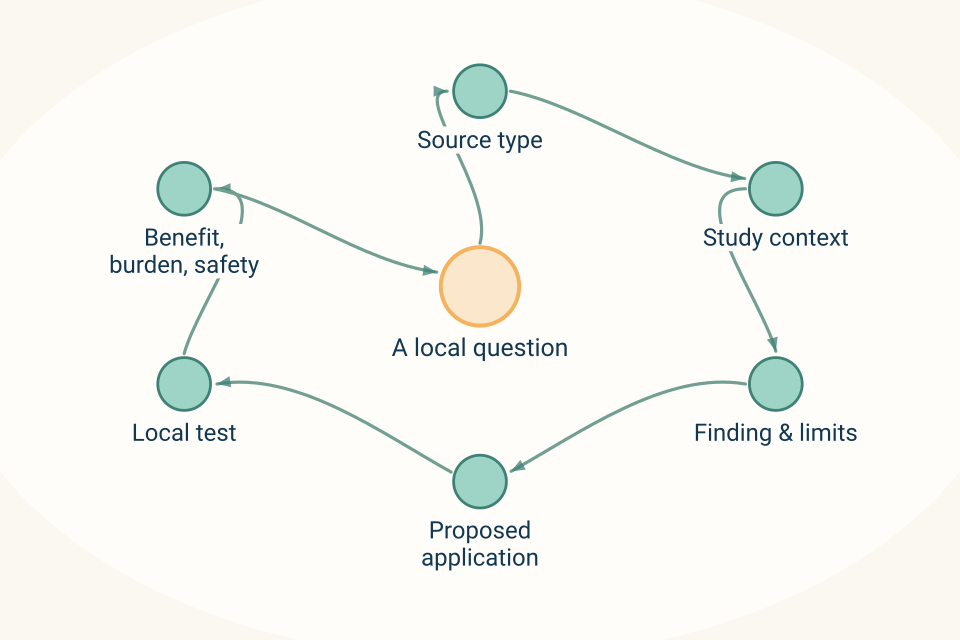
Choose sources relevant to a local question and identify the kind of answer each can provide. Read the source with its population, setting, intervention, comparison and methods. That study context qualifies the finding and its limits. Findings can inform a proposed application without proving that it works locally. A proposed application needs an appropriate local test and responsible owner. The test examines benefit, burden, safety and access. Use those observations to refine the local question and next decision. Keep source-specific evidence grades attached; theory, guidance, study findings and proposed applications are different kinds of material.
Ask of the source | Keep with the application |
Who, where, and compared with what? | Population, setting, intervention, comparator, and study design. |
What was found—and how uncertain? | Actual outcomes, estimates where useful, missing data, and limitations. |
What are we proposing? | The new care application, local dependencies, reviewer, and evaluation; no borrowed effect. |
R1.2 — The Research Map Across the Ten Principles
This map directs readers to a question and the relevant material. It is not a grade for each principle. Chapters 11–15 apply these same foundations at family, organizational, and community levels. The research discussed here remains distinct from the practical tools and applications proposed in the chapters.
Principle | Research question to explore | Where to look here; related applications |
|---|---|---|
1. Holistic Care | What do purpose, circumstances, and family capacity add to understanding the person? | R1.3: purpose and caregiver studies; Chapters 11 and 15 |
2. Awareness | Did the explanation improve understanding, and what remained unchanged? | R1.3: plain language and teach-back; Chapter 13 |
3. Behavioral Influence | Which barrier is being addressed, and does the person retain meaningful choice? | R1.3: autonomy and motivational interviewing; R2 for fuller model explanations |
4. Communications | Can practice improve the experience of being heard? | R1.3: empathy training; R1.4: conversational assistance; Chapter 11 |
5. Community | Do relationships and services become usable support? | R1.3: networks, Day Centers, and navigation; Chapters 12 and 14 |
6. Engagements | Is the activity or content worthwhile to the person? | R1.3: tailored activities and comprehension; Chapter 13 |
7. Pathways | What combination of people and follow-through was actually tested? | R1.3: care transitions; R1.5: coordinated dementia-care comparisons; Chapters 12 and 15 |
8. Technology | What does the complete access-and-support offer achieve? | R1.3: PRISM; distinguish technology from its training and support |
9. Care AI | Does assistance improve this task or outcome under these conditions? | R1.4; Chapters 13–15 |
10. Scoring | Are we observing activity, experience, outcomes, or attributable impact? | R1.1 and R1.6; Chapter 14 |
R1.3 — Key Studies, Explained
The proposed applications below are design choices to consider. They are not additional results of the studies.
Purpose: what makes the next step worthwhile?
Kim and colleagues, 2022 — prospective observational study. Researchers used data from 12,998 U.S. adults over 50 in the Health and Retirement Study, examining purpose and subsequent outcomes across four years. Higher purpose was associated with several favorable physical and psychosocial outcomes, including lower depression and loneliness, but not with every outcome examined. The study did not randomly assign a purpose-building intervention.16
Application and limit. Ask what someone wants to preserve, enjoy, or contribute. Do not turn an association into a promise that leading a group or completing a “purpose activity” improves health. A person does not have to demonstrate usefulness to deserve support.
Use in Chapters 1, 3, 5, and 6. Examine whether the offer reflects the person’s stated priorities—not whether staff assigned an inspiring goal.
Plain language: can clearer content improve understanding?
McCormack and colleagues, 2016 — randomized online study. Among 1,244 U.S. consumers, a revised drug-safety message produced better average performance on a five-item comprehension index: 63 percent correct versus 52 percent for the standard version. The groups did not differ significantly in behavioral intentions, risk perception, or trust.22
Application and limit. Test wording, headings, and organization with intended readers. The study supports a comprehension claim about the message tested—not a claim that plain language alone changes behavior or care outcomes.
Use in Chapters 2, 6, 8, and 13. Ask people to explain the main point and locate help, while separately examining whether a practical next step became possible.
Teach-back: did the explanation work?
Vick and colleagues, 2026 — systematic review and meta-analysis. The review included 18 randomized trials with 1,985 adult patients or care partners, examining teach-back in a single encounter. It found no clear pattern of benefit for knowledge acquisition, with very-low certainty. Pooled findings favored self-efficacy, also with very-low certainty, and self-reported short-term adherence, with low certainty. Results varied substantially and estimates were imprecise.23
Application and limit. Teach-back offers a way to discover misunderstandings. It is not a guaranteed memory intervention. AHRQ describes checking the explanation rather than testing the person and permits reference to written materials.24
Use in Chapters 2, 4, and 15. Check whether the relevant misunderstanding was resolved and whether the person felt respected.
Empathy training: can people notice the difference?
Riess and colleagues, 2012 — randomized trial. Ninety-nine resident and fellow physicians at two Boston institutions received standard education or additional training consisting of three one-hour sessions. The training group improved more on patient-rated empathy, with a 2.2-point difference in change on the CARE measure. Follow-up ratings were collected one to two months later.36
Application and limit. Offer practice and feedback on actual communication skills. This small study of medical trainees does not establish lasting clinical effects, validate AI emotion-reading, or justify covert empathy scores for staff.
Use in Chapters 4, 10, and 11. Ask whether people experience better listening and responses, while providing time and organizational support for the practice.
Choice and motivation: what kind of participation are we supporting?
Ntoumanis and colleagues, 2021 — meta-analysis of 73 health-intervention studies. Self-Determination Theory–informed interventions produced generally small-to-medium changes in motivational measures and health behavior, with modest, variable improvements in health outcomes. The research review informing this book grades the intervention evidence Moderate.17
Uzun and Gürhan, 2024 — motivational-interviewing meta-analysis. Across 38 chronic-illness studies involving 25,425 participants, quality of life improved by a small average amount; the pooled self-efficacy difference was not statistically significant. Variation was very high, and some studies used weaker before-and-after designs. The literature search ended in May 2021.31
Application and limit. Support the person’s own reasons and investigate mixed feelings. These findings do not turn selected phrases into a complete intervention, or AI rehearsal into trained motivational interviewing. Neither model creates an unavailable service.
Use in Chapters 3, 6, and 11. Examine informed choice, perceived pressure, and the practical barriers still present.
Social networks: does the route through people matter?
Centola, 2010 — randomized online-network experiment. More than 1,500 participants entered deliberately structured networks. Adoption of an online health resource was higher in clustered networks than in networks emphasizing longer-range connections; reinforcement from multiple contacts mattered in that setting.27,27
Application and limit. Consider whether someone needs a conversation with an appropriate trusted person, not simply another exposure to information. This was not a trial of Day Center attendance or family care. It is related network evidence, not a test of Pentland’s entire Social Physics framework.
Our commissioned review grades the broader Social Physics perspective Emerging-to-moderate and warns that social learning can spread mistakes too.
Use in Chapters 5, 12, and 14. Measure useful, permissioned connections rather than message volume.
Day Center participation: what happens to a caregiver’s day?
Zarit and colleagues, 2014 — Daily Stress and Health study. 173 caregivers of people with dementia completed daily interviews over eight consecutive days. On adult-day-service days, they reported fewer care-related stressors, more positive experiences, and lower anger, while noncare stressors increased. This was an observational comparison within caregivers’ lives, not random assignment to service use.43
Application and limit. Treat the caregiver’s experience as something to ask about directly. Attendance is not a complete account of respite: preparation, travel, uncertainty, and other work may remain. The finding does not establish a benefit from a digital summary or app.
Use in Chapters 5, 10, and 11. Examine whether the arrangement provides usable time and what it costs the caregiver in effort.
Added caregiver support: what must exist beyond the service day?
Gitlin and colleagues, 2024 — ADS Plus cluster-randomized trial. 34 sites and 203 caregivers participated. Trained staff added education, validation, referrals, problem-solving, and self-care support over 12 months. Adjusted caregiver depression scores were lower in the intervention group at 12 months. The sample was predominantly female and college educated; 22.7 percent were lost to follow-up.44
The attendance comparison was available from only 18 sites and had p = .079. Although the abstract’s conclusion describes increased utilization, that estimate should not be presented as a statistically established attendance gain.44
Application and limit. A service can offer structured support addressed to caregivers themselves. Reproducing the intervention requires the people, preparation, and sustained work—not merely an article or chatbot.
Use in Chapters 5, 11, and 15. Identify who provides caregiver support and evaluate the outcomes separately from participant attendance.
Personally tailored activities: is relevance enough?
Möhler and colleagues, 2020 — Cochrane review. Five randomized studies involved 262 people with dementia who completed the studies, generally living at home with mild-to-moderate dementia. Follow-up ranged from two weeks to four months. Low-certainty evidence suggested improvement in some behavioral difficulties and slight improvement in caregiver-rated quality of life. Clear benefits were not established for several other outcomes, including caregiver burden. None of the studies assessed adverse effects.51
Application and limit. Begin with interests and preferences, then assess fit, assistance, and enjoyment. The review did not test the shared-TV story or show that tailored activities slow dementia. A lack of assessed harms is not proof of safety.
Use in Chapters 5 and 6. Rest, listening, changing activities, and stopping remain valid choices—not unsuccessful engagement.
Care transitions: test the support package, not just the message
Coleman and colleagues, 2006 — randomized trial. 750 community-dwelling adults aged 65 or older received usual care or an intervention combining communication tools, support for expressing preferences, and transition-coach assistance. Thirty-day rehospitalization was 8.3 percent versus 11.9 percent, with a statistically significant adjusted comparison.57
Application and limit. Connect information to someone who supports the transition. Participants were English speaking, had telephone access, and had no documented dementia. The population and multicomponent design limit transfer to Pat’s later situation or to software alone.57
Use in Chapters 7, 12, and 15. Evaluate the completed human connection and subsequent support, not only whether a discharge resource was sent.
Navigation and transport: an offer can be insufficient
Gottlieb and colleagues, 2016 — navigation trial. 1,809 caregiver–child families at two safety-net hospitals were allocated by day to written information or in-person navigation with follow-up. At four months, the navigation group reported greater reductions in social needs and improvement in parent-reported child health. Follow-up was available for 1,054 participants, or 58.3 percent. This pediatric result does not directly establish effects in older-adult care.90
Chaiyachati and colleagues, 2018 — pragmatic transportation trial. Among 786 Medicaid-insured adults, a free rideshare offer did not produce a statistically significant difference in missed appointments: 36.5 versus 36.7 percent. Allocation used a fixed weekday scheme rather than individual randomization. Uptake was limited; this was not assisted transport for people living with dementia.91
Application and limit. Investigate the actual barrier and whether the offered assistance matches it. Neither a directory nor a free service automatically becomes accessible care.
Use in Chapters 5, 12, and 14. Track accepted help, received services, unresolved needs, and family coordination work separately.
Workforce support: change the conditions as well as the individual response
Panagioti and colleagues, 2017 — systematic review and meta-analysis. 19 studies involving 1,550 physicians contributed 20 comparisons. Interventions produced small average reductions in burnout measures focused on emotional exhaustion. Organization-directed interventions showed larger average effects than physician-directed approaches. The review included randomized and controlled before-and-after studies.86
Application and limit. Examine workload, coverage, role clarity, and task design alongside personal support. A subgroup finding in physician studies does not establish which staffing change works in a Day Center or for volunteers.
Use in Chapters 10 and 11. Count after-hours work, review effort, and whether people can actually obtain assistance. Do not infer well-being from training completion.
Technology access: what did the full offer include?
Czaja and colleagues, 2018 — PRISM randomized trial. 300 older adults at risk of social isolation received a specially designed computer system or a binder with similar information. The technology offer included equipment, access, training, and support. The PRISM group reported less loneliness and more perceived social support and well-being at six months; the reported between-group advantages were not maintained at 12 months. Computer confidence and proficiency improved.67
Application and limit. Evaluate the complete access arrangement. Participants did not have cognitive impairment; this is not evidence that the same results apply to Pat or that a device without support would work equally well.67
Use in Chapter 8. Examine successful useful tasks, assistance, privacy, and continuing value. WCAG provides accessibility requirements, not proof that every intended person can use the finished service.62
Public practice models: caregiver support and the Age-Friendly 4Ms
The following sources serve a different purpose from the trials above. They describe care-delivery and implementation approaches, supported by named instruments and a wider evidence base. The proposed CarePhysics applications are not additional findings of these sources.
RUSH C4C. Carbonell, Mariani, and Golden (2025) describe a customizable caregiver-support model. Their report notes lower caregiver symptoms of depression and anxiety and lower burden at one- and three-month follow-up after intervention. These uncontrolled observations are encouraging, not causal estimates. The named Planning for What Matters component is brief psychotherapy delivered by a designated clinician; it is not equivalent to an ordinary Day Center planning meeting. C4C is used here primarily as a workflow and measurement model. No caregiver effect size or denominator is inferred from the separate care-recipient utilization data.76
A separate caregiver record. Opthof’s 2022 implementation profile, informed by RUSH program leaders, documents caregivers receiving their own electronic record. This supports the design rationale for a distinct caregiver pathway. It does not establish a particular platform’s access controls or a universal legal rule that individual-session information can never be shared.83
Age-Friendly 4Ms. IHI’s 2026 hospital guide sets out What Matters, Medication, Mentation, and Mobility as an assess-and-act framework delivered together. The framework is attributed to The John A. Hartford Foundation and IHI. Our Day Center crosswalk is 4Ms-informed, with clinical responsibility and setting-specific requirements kept visible.7
What the evidence can support. Mate and colleagues’ 2021 synthesis examines evidence for the individual elements and their interactions; it is not a trial of this book’s approach. Howe and colleagues’ 2026 outpatient systematic review included 12 U.S. comparative studies found through a search ending November 22, 2024. Its public abstract reports improved process measures, while outcome and structural measures were infrequently reported and heterogeneity and reporting limits constrained interpretation. Neither source supplies a transferable effect size for a Genus implementation.105
Use these foundations to plan and examine real support. A recorded domain is not an action delivered; a documented action is not automatically a better health outcome. The person’s experience, professional review, and appropriate evaluation are still needed.
The measurement tools have different jobs
C4C’s public case study identifies the tools below. Their original research is credited separately: RUSH uses these resources; it did not create all of them. This is an orientation, not a ready-to-administer battery or a reproduction of scoring instructions.76
Measure or assessment | Purpose in the support process | Public source |
|---|---|---|
BSFC-s | The 10-item short Burden Scale for Family Caregivers: subjective caregiver burden. | Graessel et al., 2014; CG8 |
GAD-2 / GAD-7 | Brief and fuller anxiety symptom screening. Interpretation and further assessment belong to qualified professionals. | Spitzer et al., 2006; Kroenke et al., 2007; CG9–CG10 |
PHQ-2 / PHQ-9 | Brief depression screening and fuller depressive-symptom assessment. Follow the adopted clinical protocol and response pathway. | Kroenke et al., 2003 (CG12) and 2001 (CG11) |
BRIEF | Health-literacy screening to inform how information and assistance are offered—not a judgment of intelligence. | Haun et al., 2009; C4C use in CG1; CG13 |
Social-needs screening | Practical conditions affecting support. C4C describes a RUSH tool; other organizations must specify the tool they use. | Carbonell et al., 2025; CG1 |
Biopsychosocial assessment | A professional assessment of relevant personal, health, relational, and practical circumstances—not one interchangeable numeric score. | Carbonell et al., 2025; CG1 |
The locally described four-item caregiver intake is not established as equivalent to this battery. Before use, verify each instrument’s exact version, language, permissions, population, recall period, scoring, missing-response rules, and interpretation. An AI rewrite does not preserve validation automatically. New or urgent concerns need a response when raised, not only at scheduled reassessment.
The public case study’s one- and three-month follow-ups are counted after completion; the public implementation page permits a locally appropriate schedule. A six-month review may be a local decision, but should not be attributed here as a universal RUSH requirement. Our recommendation to allow a declined response is a CarePhysics design choice, not a verified statement that every item in every public C4C form has that option. Appendix F makes those choices explicit.
Operational support: where should improvement begin?
Groop, Ketokivi, Gupta, and Holmström, 2017 — design research in municipal home care. Working with practitioners in Espoo and Porvoo, Finland, the researchers combined TOC with demand-responsive resource allocation. They reported more balanced resource use and improved productivity in later implementations. An initial Espoo implementation had been terminated; the later work involved redesign and fuller implementation.106
The comparisons were uncontrolled. The authors caution against assigning all observed changes to the intervention and emphasize stakeholder goals, labor arrangements, and institutional limits. The lead author disclosed work at a for-profit health-and-social-care consultancy. These findings do not establish caregiver-health effects, a universal staffing model, or benefits from Genus.
Our application: involve people receiving and providing care when defining the objective; investigate the suspected constraint; then test a feasible change with benefit, burden, safety, and access measures. R2.5 explains the focusing method. No new overall evidence grade is assigned to TOC from this study.
R1.4 — What AI Research Does—and Does Not—Establish
AI is not one intervention. Finding a passage, drafting a reply, assisting a live conversation, and supporting a caregiver over time are different tasks. Each needs an appropriate test.
Retrieval can improve a starting point
Lewis and colleagues, 2020 — computational research. Retrieval-augmented generation combined a language model with access to an external collection. It improved performance on selected knowledge-intensive language tasks and produced more factual and specific generated language than the comparison model in the tasks studied.70
Boundary: These were language benchmarks, not clinical encounters. Retrieval does not guarantee correct source selection, faithful interpretation, privacy, or care outcomes. Providing a book is not the same as training the underlying model or testing a service.
A draft can reduce perceived effort without saving measured time
Garcia and colleagues, 2024 — single-group quality-improvement study. Over five weeks at Stanford Health Care, 162 clinicians used a system offering drafted patient-message replies; 73 completed both surveys. Mean draft use across clinicians was about 20 percent. Survey measures suggested less perceived task burden and work exhaustion, but measured reading, writing, and reply times did not improve.73
Boundary: The short, uncontrolled study cannot establish a general causal benefit. It demonstrates why usefulness, perceived burden, and actual time require separate measures.
Timely conversational suggestions can be worth testing
Sharma and colleagues, 2023 — nonclinical randomized experiment. 300 TalkLife peer supporters received a writing environment with or without HAILEY’s just-in-time suggestions. The authors reported a 19.6 percent increase on their measure of conversational empathy in assisted replies.78
Boundary: This was text-based peer support—not a trial of spoken clinical meetings, reliable emotion detection, or impartial conflict mediation. The outcome was not a 19.6 percent improvement in care or in the support seeker’s health.
CarePhysics application: With agreement, investigate whether suggestions help a person clarify a question or improve a response. Also measure distractions, errors, perceived pressure, and whether the intended human follow-up occurred.
Caregiver AI: distinguish acceptability from an outcome trial
Cheng and Ng, 2025 — PDC30 acceptability study. 21 caregivers used a purpose-built dementia-caregiving chatbot for two weeks and generally rated it as usable, understandable, and helpful. The study did not establish reduced caregiver burden or clinical benefit.72
External evidence update: Cheng and Ng, 2026 — randomized waitlist-controlled trial. Identified during verification for R1, this later study randomized 274 caregivers from 43 countries to immediate or delayed access to a broader PDC30 program: a guidebook, AI chatbot, and interactive exercises. At one month, the intervention group showed improvements in depression (d = −0.37), burden (d = −0.34), and positive aspects of caregiving (d = 0.42), but not anxiety. These are standardized effect sizes, not percentages.107
Once the waitlist group received the intervention, between-group differences mostly disappeared. The comparison therefore does not establish a longer-term advantage over a group remaining without the program. Recruitment was online, eligibility required substantial caregiving and at least mild depressive symptoms, and the study tested the whole package—not the chatbot’s isolated contribution or equivalence to professional care.107
This is encouraging outcome evidence for that defined program. It should update the discussion without becoming a claim that any caregiver assistant—or Genus—produces the same result.
Evaluate the whole assistant-supported service
The Day Center research materials separate draft quality, human-review quality, workflow efficiency, family impact, and safety and fairness. A high approval rate alone can reflect good drafts, rushed review, or overreliance.
For the proposed real-time and post-encounter learning approach, ask whether the assistant preserved the person’s words, identified an actually unanswered question, brought forward a relevant available option, and credited the contributor. Then ask whether anything useful changed.
Patients, participants, caregivers, volunteers, and frontline teams should be able to contribute or decline. Private feedback needs an appropriate route; the assistant is not inherently neutral. WHO’s guidance supports defined tasks, stakeholder participation, privacy, and accountable human judgment.1
With suitable knowledge, guidelines, rules, and review, assistance can be a gift: less repetitive preparation and more support around a human conversation. Whether it returns time or improves that conversation remains a task-specific question.
Around-the-clock access to approved routine information is not continuous professional coverage. Make human availability and urgent routes clear. No assistant can supply unavailable staffing, transport, or respite through reassuring language.
R1.5 — Where Findings Are Mixed or Questions Remain
Coordinated dementia care does not produce one uniform result
The 2019 Care Ecosystem randomized trial enrolled 780 person–caregiver pairs in three U.S. states. A navigator-led program with specialist support improved caregiver-rated participant quality of life and selected caregiver and service-use outcomes compared with usual care. 571 pairs completed the 12-month survey.59
The 2025 D-CARE trial enrolled 2,176 pairs and compared health-system care, community-based care, and usual care over 18 months. It found no significant group differences in its primary outcomes of participant behavioral symptoms and caregiver strain; caregiver self-efficacy improved in the intervention groups. These were different programs and comparisons, not direct replications of one another.60
The practical conclusion is to describe and evaluate the service actually delivered. “Coordinated care” is not a single treatment with a transferable effect size.
A saving estimated is not a saving established
Pizzi and colleagues’ 2025 ADS Plus economic analysis, drawn from the 34-site, 203-caregiver trial, estimated a delivery cost of $433 per person–caregiver pair over 12 months in that study. Estimated payer and societal savings were not statistically significant; the uncertainty included possible additional cost. The amount is not a current service price or the cost of the underlying adult day program. Two authors disclosed interests in a company receiving fees for ADS Plus training.108
Costs, affordability, and benefits belong to different parties. Report whose perspective is being used. Service evidence does not establish reimbursement eligibility, and documentation does not guarantee payment.
Delaying residential care is not a supported general promise
Udeh and Menne’s 2025 scoping review found only two studies directly addressing its question about adult day services and long-term-care placement. Both reported increased placement risk associated with use. The review judged the evidence too sparse for firm conclusions.109
That does not show that Day Centers cause earlier placement: people with greater or changing needs may be more likely to use services. It also does not justify promising that attendance delays a move. The review cannot resolve either causal claim.
Valuable design is not automatically a validated intervention
No product-specific causal evidence in the material reviewed here establishes that a CarePhysics tile, the shared-TV reading configuration, a reviewed evening note, symbolic community points, or the complete proposed pathway produces all the intended care outcomes. The behavioral review explicitly labels many of these applications plausible or emerging.
The Jack Scale remains a historical and proposed review tool; the evidence reviewed here does not establish it as a validated clinical measure.
These limits are reasons to test suitable applications, not to treat “not established” as either “certain to work” or “worthless.” A precise null result can rule out a meaningful benefit; an imprecise result may leave the question open. The evidence, not the preferred conclusion, determines the distinction.103
R1.6 — From Research to Local Learning
Make the evidence usable without making the claim larger
In context
In Context — A study becomes a design question
This hypothetical planning exchange illustrates evidence use; it does not add an event or outcome to Pat and Ellen’s chronology.
A Day Center team is preparing a family-support resource.
“The caregiver trial gives us a reason to include support for the caregiver,” one person says. “Could we describe our new article as reducing caregiver depression?”
“What did the trial actually provide?” the reviewer asks.
They look again: trained staff, repeated support, education, referrals, and problem-solving—not an article alone.
The team changes the assignment. The article will explain a support conversation the center can actually offer. A short video will demonstrate how someone can ask a question. The pathway will identify the responder and what happens after the request.
They will first test understanding and the response process. Any claim about depression will require a suitable intervention and evaluation of its own.
The study has still changed the design.
It has also kept the promise honest.
Build one evidence entry your team can reuse
Start with the question, not a pile of articles. Record the source and year, the population and setting, the intervention or exposure, the comparison, the findings, the limits, and whether the result concerns a service, a mechanism, or a product.
Add the relevant chapters, approved uses, source-access status, reviewer, and review date. Keep a proposed application visibly separate from the research finding. This follows the book’s evidence-entry specification.
An entry can inform an article, video, survey, message, conversation, or feature-planning brief. Use a recognizable structure—why it matters, main idea, demonstration, chosen next step, question route, and follow-through—without altering clinical facts or validated instruments.
The organization supplies current service facts. A clinical reviewer checks clinical material. The program owner checks capacity and commitments. Intended users help assess language, culture, format, access, and practical fit.
Choose a local question with a responsible owner
IHI recommends outcome, process, and balancing measures: what changed, whether the process happened, and whether improvement created another problem.75
For an introductory resource, an initial question might be whether people can explain the offer and reach the person who responds. Establish a baseline, a defined test period, and the versions being compared.
Report the number offered the resource, the number who used each route, and who provided feedback. Count uncompleted requests and unanswered questions. Keep missing dates visible and distinguish intake timing from referral timing; the dated example appears in Appendix J.
Include staff preparation, review, corrections, interpretation, transport, and family coordination. A service can reduce one burden while creating another. Give someone authority to change the work, staffing, or offer—not only its wording.
For stronger health or economic claims, obtain appropriate research expertise and oversight, a suitable comparison, and measures with relevant evidence. Do not label a convenient before-and-after count a causal trial.
Keep reach, understanding, first action, adoption, useful participation, outcomes, and attributable impact distinct. Willingness to recommend, actual referrals, and services received by referred people are also different questions.
No leaderboard should rank how much families care. Staff suggestions should support better work, not concealed surveillance. Credit contributions and report negative findings as readily as positive ones.
Give an assistant the evidence, the task, and the boundaries
An approved assistant could retrieve a selected entry and help prepare options:
Use this study and its limitations alongside our verified local information. Prepare an explanation and a demonstration for the stated audience. Identify what the research supports, what we are proposing, what resources must exist, and who must review the output. Suggest a way to check usefulness, burden, safety, and access. Do not invent a result, service, quotation, or personal preference.
The working sequence is retrieval → local context → draft or options → human review → testing → revision. Keep sources, owners, review dates, approved uses, and corrections. Generic design work does not require private family records. Uploading a book is not model training or proof that a configured assistant is reliable.
Genus supplies technology; partners retain care, staffing, programs, voice, and professional accountability. Research can help choose a promising direction. It cannot supply the people or capacity behind the next step.
Public sources for caregiver support and age-friendly practice
These references give readers direct access to the public material behind the additions in Chapters 1, 10, and 11, R2, R8, and the practical tools. CG labels identify sources, not evidence grades. Sources were checked October 1, 2026. Public availability does not by itself grant permission to reproduce complete instruments, training manuals, or graphics.
CG1. Carbonell E, Mariani D, Golden R (2025). Caring for Caregivers Within Age-Friendly Health Systems: An Organizational Case Study of National Scale and Spread. INQUIRY. 62:00469580251325660. DOI: 10.1177/00469580251325660. https://journals.sagepub.com/doi/full/10.1177/00469580251325660 (opens a new tab)
Public organizational case study; full text reviewed. Describes a customizable clinical model and uncontrolled observations, not a randomized outcome trial. Follow-up is described as one and three months after completion or other predetermined times. The June 2026 erratum corrects the online volume number to 62; it does not alter the reported findings.
CG2. RUSH Center for Excellence in Aging (n.d.). Caring for Caregivers Across U.S.. Public implementation resource. https://aging.rush.edu/professional-older-adult-family-care/c4c/ (opens a new tab)
Official program guidance; page reviewed. Describes identification, assessment, assistance, skill-building, Planning for What Matters, care-team planning, and locally arranged follow-up. Program description is not independent evidence of effectiveness.
CG3. Opthof E (2022). Rush Caregiver Intervention: Advancing Age-Friendly Health Systems by Prioritizing Family Caregivers. Center for Health Care Strategies. January 13, 2022. https://www.chcs.org/rush-caregiver-intervention-advancing-age-friendly-health-systems-by-prioritizing-family-caregivers/ (opens a new tab)
Public implementation profile informed by RUSH program leaders. Documents registration of caregivers as patients with their own electronic record. This does not verify any Genus privacy control or establish that all individual-session material is legally unshareable in every circumstance.
CG4. Institute for Healthcare Improvement (2026). Age-Friendly Health Systems: Guide to Using the 4Ms in the Care of Older Adults in Hospitals. Boston: IHI. Especially pp. 4–6 and 9. Public IHI 2026 hospital guide (PDF) (opens a new tab) Also available through IHI’s public resource directory (opens a new tab).
Official implementation guide; relevant text and 4Ms figure reviewed. Defines the four elements and an assess-and-act approach, delivered together. Hospital guidance is not a universal Day Center protocol. Our tables are original paraphrases, not reproductions of IHI graphics or instruments.
CG5. Institute for Healthcare Improvement (n.d.). Age-Friendly Health Systems: Recognition. Official recognition guidance. https://www.ihi.org/partner/initiatives/age-friendly-health-systems/recognition (opens a new tab)
Official recognition process; page reviewed. Recognition is a separate process for care locations. A software label or a 4Ms-informed worksheet does not establish recognition, affiliation, or endorsement.
CG6. Mate K, Fulmer T, Pelton L, Berman A, Bonner A, Huang W, Zhang J (2021). Evidence for the 4Ms: Interactions and Outcomes Across the Care Continuum. Journal of Aging and Health. 33(7–8):469–481. DOI: 10.1177/0898264321991658. https://doi.org/10.1177/0898264321991658 (opens a new tab)
Expert synthesis and literature review; public abstract and text checked. Examines component evidence and interactions; not a trial of the CarePhysics framework or Genus. Calls for more evidence on delivery of the full set.
CG7. Howe RJ, Rieke K, Mai HJ, et al. (2026). Age-Friendly Health System Implementation in Outpatient Settings: A Systematic Review. Journal of the American Geriatrics Society. 74(6):1756–1770. DOI: 10.1111/jgs.70346. https://doi.org/10.1111/jgs.70346 (opens a new tab)
Systematic review; public abstract and bibliographic record reviewed. Twelve U.S. comparative studies of all four Ms; search through November 22, 2024. Process improvements were reported, but outcome and structural measures were uncommon and reporting/heterogeneity limited interpretation. No overall certainty grade is assigned here beyond what was available in the public abstract.
CG8. Graessel E, Berth H, Lichte T, Grau H (2014). Subjective caregiver burden: validity of the 10-item short version of the Burden Scale for Family Caregivers BSFC-s. BMC Geriatrics. 14:23. DOI: 10.1186/1471-2318-14-23. https://doi.org/10.1186/1471-2318-14-23 (opens a new tab)
Instrument-validation research; public publication checked. Validation evidence belongs to the specified tool and its studied use, not a locally written four-item intake or an AI rewrite.
CG9. Spitzer RL, Kroenke K, Williams JBW, Löwe B (2006). A brief measure for assessing generalized anxiety disorder: the GAD-7. Archives of Internal Medicine. 166(10):1092–1097. DOI: 10.1001/archinte.166.10.1092. https://doi.org/10.1001/archinte.166.10.1092 (opens a new tab)
Instrument research; public abstract checked. A symptom screen supports appropriate assessment; it is not an autonomous diagnosis or a treatment decision.
CG10. Kroenke K, Spitzer RL, Williams JBW, Monahan PO, Löwe B (2007). Anxiety disorders in primary care: prevalence, impairment, comorbidity, and detection. Annals of Internal Medicine. 146(5):317–325. DOI: 10.7326/0003-4819-146-5-200703060-00004. https://pubmed.ncbi.nlm.nih.gov/17339617/ (opens a new tab)
Primary-care screening research; public abstract checked. Supports discussion of brief anxiety screening. Clinical interpretation and the actual follow-up protocol require qualified review.
CG11. Kroenke K, Spitzer RL, Williams JBW (2001). The PHQ-9: validity of a brief depression severity measure. Journal of General Internal Medicine. 16(9):606–613. DOI: 10.1046/j.1525-1497.2001.016009606.x. https://doi.org/10.1046/j.1525-1497.2001.016009606.x (opens a new tab)
Instrument-validation research; public publication checked. Does not establish that a local score is a diagnosis or that administration without a response service improves care.
CG12. Kroenke K, Spitzer RL, Williams JBW (2003). The Patient Health Questionnaire-2: validity of a two-item depression screener. Medical Care. 41(11):1284–1292. DOI: 10.1097/01.MLR.0000093487.78664.3C. https://pubmed.ncbi.nlm.nih.gov/14583691/ (opens a new tab)
Instrument-validation research; public abstract checked. A brief screen and the fuller PHQ-9 have different roles. Do not substitute one tool for the other without the approved protocol.
CG13. Haun J, Noland-Dodd V, Varnes J, Graham-Pole J, Rienzo B, Donaldson P (2009). Testing the BRIEF Health Literacy Screening Tool. Federal Practitioner. 26(12):24 [public record]. https://www.mdedge.com/content/testing-brief-health-literacy-screening-tool (opens a new tab)
Public original-publication record; author list and bibliographic entry checked. Cited to credit the instrument, not to reproduce its items or claim validation in every language or setting. Its use in C4C is documented separately in CG1.
CG14. The John A. Hartford Foundation (2024). Age-Friendly Health Systems Updated Guides: Guide to Using the 4Ms in the Care of Older Adults in Hospitals and Ambulatory Practices and Guide to the Care of Older Adults in Nursing Homes. May 28, 2024. Public Hartford Foundation guide announcement (opens a new tab)
Official foundation publication; attribution and guide context checked. Acknowledges The John A. Hartford Foundation and IHI, with the initiative’s AHA and Catholic Health Association partnership. This attribution does not imply an endorsement of this book.
Public sources for constraint-focused improvement
These references support the method, research, and reading notes on Theory of Constraints. The care examples, planning fields, and measurement definitions are our proposed applications. Public sources checked October 1, 2026.
TOC1. Goldratt Research Labs (n.d.). Introduction to Theory of Constraints (TOC). Public description of the Five Focusing Steps. Public source (opens a new tab)
Method terminology and sequence; a practitioner organization’s explanation, not independent evidence of care outcomes.
TOC2. Theory of Constraints International Certification Organization (TOCICO) (n.d.). Masterclass Series: Introduction to Theory of Constraints. Public presentation description and learning summary; Alan Barnard. Public source (opens a new tab)
The public summary places definition of the system, goal, and measures before the focusing steps. The complete course was not reviewed.
TOC3. Groop J, Ketokivi M, Gupta M, Holmström J (2017). Improving home care: Knowledge creation through engagement and design. Journal of Operations Management. 53–56:9–22. DOI: 10.1016/j.jom.2017.11.001. Public source (opens a new tab) · University record and open-access route (opens a new tab)
Public article text and Aalto University’s publication record reviewed. Context-specific design research and uncontrolled operational comparisons; no CarePhysics or Genus evaluation.
TOC4. Institute for Healthcare Improvement (n.d.). How to Improve: Model for Improvement: Establishing Measures. Public source (opens a new tab)
Improvement guidance on outcome, process, and balancing measures, participant perspectives, and repeated learning; not an effectiveness estimate.
TOC5. Goldratt EM, Cox J (2004). The Goal: A Process of Ongoing Improvement. Third edition. Routledge. ISBN 9780566086656. Public source (opens a new tab)
Authors, edition, and scope checked against the publisher’s public description. This addition is not a cover-to-cover review or permission to reproduce the book.
One thing to try
Choose one claim in a handout, proposal, training resource, or demonstration.
Find its source. Then write three sentences:
The source found…
Our application proposes…
Before claiming that it helped here, we would need to establish…
Have someone else check whether the boundary between those sentences is clear.
Research becomes useful when it changes a decision without being asked to prove more than it can.
The next reference chapter explains the ideas used to make those decisions: how COM-B, Self-Determination Theory, Social Physics, motivational interviewing, and design methods ask different questions—and how to choose among them.
Public sources for the consolidated design examples
CON1. Agency for Healthcare Research and Quality (2024). Attend to Social Needs: Tool 18. Health Literacy Universal Precautions Toolkit, 3rd edition. Public source (opens a new tab)
CON2. Agency for Healthcare Research and Quality (2024). Talk About Costs: Tool 23. Health Literacy Universal Precautions Toolkit, 3rd edition. Public source (opens a new tab)
CON3. Royal College of Physicians (2016). Experience-based co-design: designing the future of hospital services. Public interview with Catherine Dale; March 30. Public source (opens a new tab)
CON4. National Institute on Aging (n.d.). Advance Care Planning: Advance Directives for Health Care. Public planning guidance; consult qualified local professionals about legal arrangements. Public source (opens a new tab)
These sources support navigation, planning, and co-design practice. The tables, sample wording, and combined walkthrough are original CarePhysics applications, not validated questionnaires, reproduced therapy manuals, or clinical/legal advice.
Notes
World Health Organization (2024). WHO releases AI ethics and governance guidance for large multi-modal models. January 18. Source (opens a new tab)
Institute for Healthcare Improvement (2026), Age-Friendly Health Systems: Guide to Using the 4Ms in the Care of Older Adults in Hospitals. Public IHI 2026 hospital guide (PDF) [R1 source CG4]. The John A. Hartford Foundation (2024), Age-Friendly Health Systems Updated Guides: Guide to Using the 4Ms in the Care of Older Adults in Hospitals and Ambulatory Practices and Guide to the Care of Older Adults in Nursing Homes. Public Hartford Foundation guide announcement [R1 source CG14]. Source 1 (opens a new tab) · Source 2 (opens a new tab)
Kim ES, Chen Y, Nakamura JS, Ryff CD, VanderWeele TJ (2022). Sense of Purpose in Life and Subsequent Physical, Behavioral, and Psychosocial Health: An Outcome-Wide Approach. American Journal of Health Promotion 36(1):137–147. DOI: 10.1177/08901171211038545. Source (opens a new tab)
Ntoumanis N, Ng JYY, Prestwich A, et al. (2021). A meta-analysis of self-determination theory-informed intervention studies in the health domain: effects on motivation, health behavior, physical, and psychological health. Health Psychology Review. 15(2):214–244. DOI: 10.1080/17437199.2020.1718529. Source (opens a new tab)
McCormack L, Lefebvre RC, Bann C, Taylor O, Rausch P (2016). Consumer Understanding, Preferences, and Responses to Different Versions of Drug Safety Messages in the United States: A Randomized Controlled Trial. Drug Safety. 39(2):171–184. DOI: 10.1007/s40264-015-0358-9. Source (opens a new tab)
Vick JB, et al. (2026). Teach-Back in Clinical Communication: A Systematic Review and Meta-analysis. Journal of General Internal Medicine. Published online September 3. DOI: 10.1007/s11606-026-10678-y. Source (opens a new tab)
Agency for Healthcare Research and Quality (2024). Use the Teach-Back Method: Tool 5. Health Literacy Universal Precautions Toolkit, 3rd edition. Source (opens a new tab)
University of Pennsylvania, Network Dynamics Group. Spreading Behavior Online. Research summary of Damon Centola’s 2010 online-network experiment. Source (opens a new tab)
Uzun S, Gürhan N (2024). The effect of motivational interviewing on quality of life and self-efficacy behaviors of individuals with chronic illness: A meta-analysis study. Public Health Nursing. 41(5):901–922. DOI: 10.1111/phn.13339. Source (opens a new tab)
Riess H, Kelley JM, Bailey RW, Dunn EJ, Phillips M (2012). Empathy training for resident physicians: a randomized controlled trial of a neuroscience-informed curriculum. Journal of General Internal Medicine. 27(10):1280–1286. DOI: 10.1007/s11606-012-2063-z. Source (opens a new tab)
Zarit SH, Kim K, Femia EE, Almeida DM, Klein LC (2014). The effects of adult day services on family caregivers’ daily stress, affect, and health: outcomes from the Daily Stress and Health (DaSH) study. The Gerontologist. 54(4):570–579. DOI: 10.1093/geront/gnt045. Source (opens a new tab)
Gitlin LN, Roth DL, Marx KA, et al. (2024). Embedding Caregiver Support Within Adult Day Services: Outcomes of a Multisite Trial. The Gerontologist. 64(4):gnad107. DOI: 10.1093/geront/gnad107. Source (opens a new tab)
Möhler R, et al. (2020). Personally tailored activities for improving psychosocial outcomes for people with dementia in community settings. Cochrane Database of Systematic Reviews. CD010515. DOI: 10.1002/14651858.CD010515.pub2. Source (opens a new tab)
Coleman EA, Parry C, Chalmers S, Min SJ (2006). The care transitions intervention: results of a randomized controlled trial. Archives of Internal Medicine. 166(17):1822–1828. DOI: 10.1001/archinte.166.17.1822. Source (opens a new tab)
Possin KL, Merrilees JJ, Dulaney S, et al. (2019). Effect of Collaborative Dementia Care via Telephone and Internet on Quality of Life, Caregiver Well-being, and Health Care Use: The Care Ecosystem Randomized Clinical Trial. JAMA Internal Medicine. 179(12):1658–1667. DOI: 10.1001/jamainternmed.2019.4101. Source (opens a new tab)
Reuben DB, Gill TM, Stevens A, et al. (2025). Health System, Community-Based, or Usual Dementia Care for Persons With Dementia and Caregivers: The D-CARE Randomized Clinical Trial. JAMA. 333(11):950–961. DOI: 10.1001/jama.2024.25056. Source (opens a new tab)
World Wide Web Consortium (2023). Web Content Accessibility Guidelines (WCAG) 2.2. W3C Recommendation. Use the current normative text and relevant implementation guidance. Source (opens a new tab)
Czaja SJ, Boot WR, Charness N, Rogers WA, Sharit J (2018). Improving Social Support for Older Adults Through Technology: Findings From the PRISM Randomized Controlled Trial. The Gerontologist. 58(3):467–477. DOI: 10.1093/geront/gnw249. Source (opens a new tab)
Lewis P, Perez E, Piktus A, et al. (2020). Retrieval-Augmented Generation for Knowledge-Intensive NLP Tasks. Advances in Neural Information Processing Systems. 33:9459–9474. Source (opens a new tab)
Cheng ST, Ng PHF (2025). The PDC30 Chatbot—Development of a Psychoeducational Resource on Dementia Caregiving Among Family Caregivers: Mixed Methods Acceptability Study. JMIR Aging. 8:e63715. DOI: 10.2196/63715. Source (opens a new tab)
Garcia P, Ma SP, Shah S, et al. (2024). Artificial Intelligence–Generated Draft Replies to Patient Inbox Messages. JAMA Network Open. 7(3):e243201. DOI: 10.1001/jamanetworkopen.2024.3201. Source (opens a new tab)
Institute for Healthcare Improvement. Model for Improvement: Establishing Measures. Guidance on outcome, process, and balancing measures. Source (opens a new tab)
Carbonell E, Mariani D, Golden R (2025). Caring for Caregivers Within Age-Friendly Health Systems: An Organizational Case Study of National Scale and Spread. INQUIRY. 62:00469580251325660. DOI: 10.1177/00469580251325660. Source (opens a new tab)
Sharma A, Rushton K, Lin IW, et al. (2023). Human–AI collaboration enables more empathic conversations in text-based peer-to-peer mental health support. Nature Machine Intelligence. 5:46–57. DOI: 10.1038/s42256-022-00593-2. Source (opens a new tab)
Opthof E (2022). Rush Caregiver Intervention: Advancing Age-Friendly Health Systems by Prioritizing Family Caregivers. Center for Health Care Strategies. January 13. Source (opens a new tab)
Panagioti M, Panagopoulou E, Bower P, et al. (2017). Controlled Interventions to Reduce Burnout in Physicians: A Systematic Review and Meta-analysis. JAMA Internal Medicine. 177(2):195–205. DOI: 10.1001/jamainternmed.2016.7674. Source (opens a new tab)
Gottlieb LM, Hessler D, Long D, et al. (2016). Effects of Social Needs Screening and In-Person Service Navigation on Child Health: A Randomized Clinical Trial. JAMA Pediatrics. 170(11):e162521. DOI: 10.1001/jamapediatrics.2016.2521. Source (opens a new tab)
Chaiyachati KH, Hubbard RA, Yeager A, et al. (2018). Association of Rideshare-Based Transportation Services and Missed Primary Care Appointments: A Clinical Trial. JAMA Internal Medicine. 178(3):383–389. DOI: 10.1001/jamainternmed.2017.8336. Source (opens a new tab)
Altman DG, Bland JM (1995). Absence of evidence is not evidence of absence. BMJ. 311:485. DOI: 10.1136/bmj.311.7003.485. Source (opens a new tab)
Cochrane. Chapter 14: Completing “Summary of findings” tables and grading the certainty of the evidence. Cochrane Handbook for Systematic Reviews of Interventions. Current online edition. Source (opens a new tab)
Mate K, Fulmer T, Pelton L, Berman A, Bonner A, Huang W, Zhang J (2021), Evidence for the 4Ms: Interactions and Outcomes Across the Care Continuum. [R1 source CG6]. Howe RJ, Rieke K, Mai HJ, et al. (2026), Age-Friendly Health System Implementation in Outpatient Settings: A Systematic Review. [R1 source CG7]. Source 1 (opens a new tab) · Source 2 (opens a new tab)
Groop J, Ketokivi M, Gupta M, Holmström J (2017). Improving home care: Knowledge creation through engagement and design. Journal of Operations Management. 53–56:9–22. DOI: 10.1016/j.jom.2017.11.001. Source (opens a new tab)
Cheng ST, Ng PHF (2026). Intervention Without Borders—an Automated Self-Guided AI-Enhanced Psychoeducation Intervention for Dementia Caregivers: Parallel-Group Randomized Waitlist-Controlled Trial. American Journal of Geriatric Psychiatry. 34(10):1284–1296. DOI: 10.1016/j.jagp.2026.01.001. Source (opens a new tab)
Pizzi LT, Prioli KM, Molinari A, et al. (2025). Toward a payment model for augmenting Adult Day Services (ADS) with caregiver support: costs, willingness, and ability to pay for the ADS Plus program. Innovation in Aging. 9(9):igaf089. DOI: 10.1093/geroni/igaf089. Source (opens a new tab)
Udeh KC, Menne HL (2025). Impact of adult day service on long-term care placement: A scoping review. Dementia. 24(7). DOI: 10.1177/14713012251334676. Source (opens a new tab)