R8
R8 — A Shared Language for Care
Terms, Meanings, and Useful Distinctions
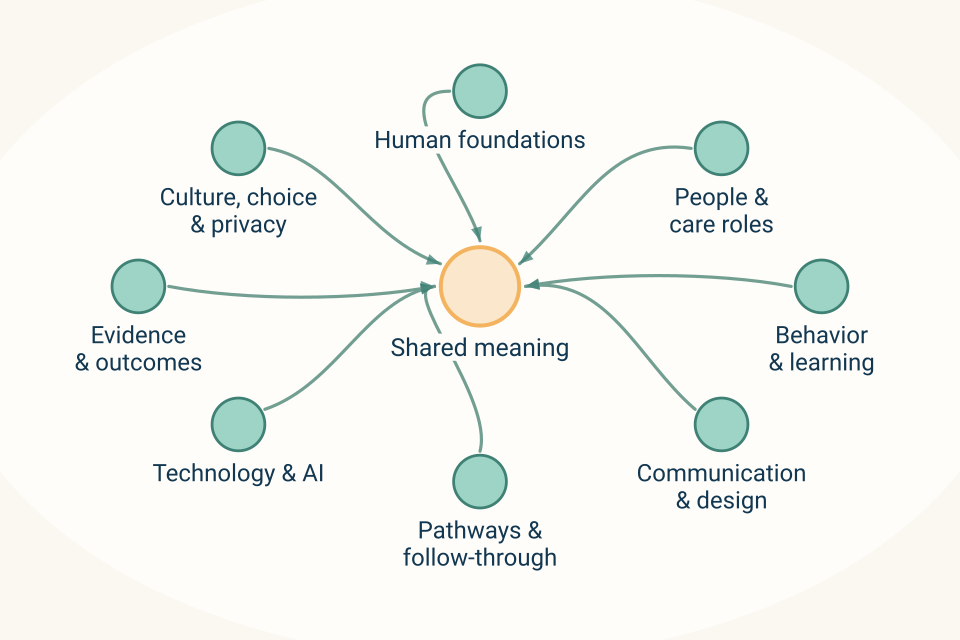
Human-foundation terms clarify the CarePhysics framework. People and care-role terms help clarify responsibilities and settings. Behavior and learning terms help distinguish the models being discussed. Communication and design terms help describe the experience being prepared. Pathway terms distinguish requests, coordination and follow-through. Technology and AI terms clarify assistance and knowledge stewardship. Evidence and outcome terms help distinguish what was observed from what can be claimed. Culture, choice and privacy terms make important boundaries and source status explicit. Definitions help people understand one another; they do not establish eligibility, availability, clinical advice or product effectiveness.
At a Glance
Use this section: Browse the eight subjects, look up a word in the A–Z finder, or follow a chapter reference for a fuller explanation.
The central idea: Shared language should make care easier to understand—not create another requirement before someone can ask for help.
An important distinction: Some entries explain CarePhysics’s own usage; others summarize established concepts or professional terminology. Definitions do not establish service availability, eligibility, clinical advice, or product effectiveness.
R8.1 — How to Use This Glossary
You should not have to guess what a word means before you can use an idea. This glossary explains the language used throughout CarePhysics, adding a short example or distinction where it helps.
The entries are grouped by subject and alphabetized within each group. The A–Z finder points to those same entries; there is only one definition to maintain, or one explicitly labeled set of meanings when a word has several uses.
In this book identifies an editorial meaning rather than a universal definition. The care-role descriptions explain functions, not professional licensing rules. Source citations support established concepts; targeted checks of public professional guidance supplement the manuscript where clinical, technical, or privacy terminology needs precision.
The short examples are hypothetical, not reports of a program’s results. The glossary adds no events to Pat and Ellen’s story.
The ten principles, in their established order
Chapter | Principle and chapter subtitle | Glossary group |
|---|---|---|
1 | Holistic Care — See the Person | A |
2 | Awareness — Make Understanding Possible | A |
3 | Behavioral Influence — Support the Next Chosen Step | A |
4 | Communications — Help People Feel Heard | A |
5 | Community — Make Belonging Practical | A |
6 | Engagements — Make Each Interaction Worthwhile | D |
7 | Pathways — Turn Good Intentions into Supported Progress | E |
8 | Technology — Make Help Easier to Reach | F |
9 | Care AI — Bring Human Wisdom Within Reach | F |
10 | Scoring — Learn What Helps | G |
Chapters 11–15 apply these principles. The reference chapters provide additional explanations and resources; they do not introduce more principles.
R8.2 — Terms by Theme
R8.2A — The CarePhysics Framework and Human Foundations
These entries describe the book’s usage. Human commitments run through the principles; they are not extra principles or scores assigned to people.
Awareness. The second principle: helping people understand what is known, what remains uncertain, what happens next, and where to ask for help. Exposure to information alone is not understanding.
Behavioral Influence. The third principle: understanding barriers and supporting a feasible next step the person chooses. It is not a license to pressure someone into the organization’s preferred decision.
CarePhysics. An evidence-informed framework of ten principles for designing care people can understand, choose, use, and share. It combines established ideas with local knowledge; it is not a set of literal laws or proof of product effectiveness.
Communications. The fourth principle: listening, explaining, asking, disagreeing respectfully, and making commitments understandable. The book uses the plural to include conversations, messages, and other forms of communication.
Community. The fifth principle: relationships and resources through which people can belong, receive support, and contribute. A directory can support community work but does not itself supply a dependable service.
Compassion. In this book, recognizing another person’s difficulty and responding with concern and appropriate help. The practical response matters alongside the words.
Connected outcomes. The reflective phrase used in R5 for what people can better understand, choose, receive, contribute, or enjoy when knowledge, relationships, and practical support work together. It is not a validated score or mathematical multiplier.
Contribution. Something a person chooses to offer: an idea, preference, skill, observation, or practical help. Contribution is an opportunity, not a condition of deserving care.
Dignity. Treating someone as a person of inherent worth, whose identity, preferences, boundaries, and voice matter regardless of illness, ability, or participation.
Grace. In R7, room to be human: to need help, acknowledge a mistake, rest, or try again without expecting a perfect encounter. It does not remove responsibility for correcting harm.
Holistic Care. The first principle: understanding the whole person and the circumstances around care, including health, relationships, practical resources, beliefs, strengths, and what matters to them.
Love. Concern made visible through attention, patience, honesty, boundaries, and practical help. In this book, love belongs to people; it does not require one person to carry everything.
Principle. A guiding commitment that helps examine a design or decision. The ten CarePhysics principles organize inquiry; the later application and reference chapters do not add new principles.
Purpose. The personally meaningful reason something is worth doing, preserving, or enjoying. A person’s purpose may differ from an organization’s target for participation.
Trust. Confidence earned through truthful information, respected boundaries, appropriate judgment, correction, and dependable follow-through. Calling a tool trusted does not establish that it is trustworthy.
R8.2B — People, Roles, and Care Settings
Role descriptions below explain their use in the book. Professional scopes, eligibility, staffing, services, and coverage must be checked with the responsible organization; a title alone does not settle them.
Activities of daily living. Basic personal tasks such as eating, dressing, bathing, using the toilet, and moving into or out of a bed or chair. Abbreviated ADL or ADLs; not the name of one particular assessment.155
Age-Friendly 4Ms. The framework of What Matters, Medication, Mentation, and Mobility in the Age-Friendly Health Systems initiative led by The John A. Hartford Foundation and IHI. It links assessment with action on all four elements. This book’s 4Ms-informed applications are not claims of recognition or endorsement. See Chapter 1 and R1, sources CG4–CG7.
Care team. The people with agreed responsibilities in the person’s support. In this book, the wider team may include professionals and chosen supporters, without making their duties or information access identical.
Caregiver strain. The demands and effects a caregiver experiences in relation to care. Ask about their own account; a busy schedule or service booking does not establish how strained or relieved they feel.
Caring for Caregivers (C4C). RUSH’s caregiver-support model: identify caregivers, understand their needs, and assist through an individualized support process with follow-up. Caregivers’ own health and privacy matter. This is a practice model, not evidence that a Genus feature improves outcomes. See Chapter 11 and R1, CG1–CG3.
Community partner. An organization or group contributing an agreed service, resource, or relationship. Partnership does not automatically transfer care responsibility or authorize information sharing.
Day Center. The book’s preferred name for an adult day-services setting. Programs may offer daytime activities, meals, personal assistance, or health-related support; the actual services and eligibility vary. It is not simply another name for every community center.156
Family caregiver. A relative, partner, friend, or other close supporter who provides care outside a professional role. The term identifies a responsibility, not the person’s whole identity or automatic decision-making authority.
Home care. Here, the broad term for support provided at home, including help with personal or household activities. Ask what the service includes; do not assume the term means skilled home health.156
Home health. Health services delivered at home, such as skilled nursing or physical, occupational, or speech-language therapy. The label does not establish which services a person qualifies for or who pays.157
Hospice. Care focused on comfort, quality of life, and support for a person approaching the end of life and those close to them. It describes an approach and service, not only a building; eligibility and arrangements require local confirmation.158
Instrumental activities of daily living. Activities supporting everyday life at home, such as preparing meals, shopping, managing money, and using communication devices. Abbreviated IADL or IADLs; distinct from basic personal-care activities.155
Mentation. Thinking and mental functioning. In the 4Ms framework, this domain addresses dementia, depression, and delirium. Observations are not diagnoses; appropriate clinicians assess and respond. See R1, CG4.
Navigator. In the book, a person helping someone understand options, address access barriers, and follow an agreed connection to support. Their training, authority, and responsibilities depend on the service.
Palliative care. Specialized care addressing symptoms, stress, and quality of life during serious illness. It may accompany treatment directed at the illness and is not limited to hospice or the end of life.159
Participant. A person taking part in a program, activity, or research study. Specify the setting: Day Center participation and research participation carry different arrangements and permissions.
Patient. A person receiving healthcare. Use the term where the clinical role matters, without reducing the person to that role or their diagnosis.
Person receiving care. A broad term for the individual whom the care or support is intended to serve. It keeps the person visible across clinical, home, and community settings.
Respite. Temporary care or support provided so the usual caregiver can take a break. In Chapters 10–11, usable respite means the support actually happened and the caregiver could use the time—not merely that it was booked.160
Social worker. A professional whose work may include psychosocial support, family conversations, resource navigation, and coordination, according to their qualifications and role. Sam’s responsibilities in the story do not define every social-work position.
Volunteer. Someone offering time or skills in a voluntary role. Here, the role has agreed boundaries, preparation, and support; willingness does not substitute for required professional qualifications.
R8.2C — Behavior, Motivation, and Social Learning
These brief explanations point back to R2 and R5. A model helps frame a question; its name does not prove the effectiveness of a particular intervention.
Agency. A person’s ability to take part in shaping their actions and circumstances, including with support. In the book, agency means more than being offered a choice nobody is prepared to honor.
Autonomy. In Self-Determination Theory, acting with a sense of choice and personal endorsement. Autonomy does not require doing everything independently.3
Behaviour Change Wheel. A framework connecting analysis of behavior through COM-B with intervention and policy options. It guides design; it is not itself a complete care intervention.
Capability. In COM-B, the physical and psychological ability needed for a specified behavior, including relevant knowledge and skills. This differs from whether resources are available or the person wants the action.
COM-B. Capability, Opportunity, and Motivation in relation to Behavior. It asks what enables or obstructs a specified action, rather than treating every difficulty as a motivation problem.
Competence. In Self-Determination Theory, experiencing effectiveness and developing mastery. In professional training, competence concerns meeting the requirements of a task or role. Feeling capable and demonstrating an assessed skill are different.3
Complex contagion. In network research, adoption that depends on reinforcing social signals rather than information passing through one contact alone. Here, contagion concerns the spread of behavior, not infectious disease.
Exploration. In Social Physics, encountering information, people, and approaches beyond the familiar circle. Discovery does not establish that a resource is appropriate or available.
Fogg Behavior Model. BJ Fogg’s model of motivation, ability, and a prompt coming together at the moment of action. In this usage, ability includes how easy or difficult the action is. See R2.3.
Idea flow. How ideas move through relationships and groups. The term concerns the movement and use of knowledge, not merely the number of messages transmitted.
Motivation. In COM-B, processes that direct behavior, including reflective intentions and more automatic responses such as habits. It is not a rating of how much someone cares.
Motivational interviewing. A collaborative conversation method that helps people explore their own reasons, concerns, and mixed feelings about change. It is not a script for securing agreement. See R2.5.
Opportunity. In COM-B, physical and social conditions outside the person that make action possible or prompt it—for example, available time, transport, or support.
Relatedness. In Self-Determination Theory, a sense of meaningful connection with others. Contact counts do not establish that someone feels understood or supported.3
Self-Determination Theory. Ryan and Deci’s theory of motivation, including the psychological needs for autonomy, competence, and relatedness. It distinguishes personally endorsed action from externally controlled participation. Abbreviated SDT.3
Self-efficacy. A person’s belief that they can perform a particular action. Confidence in performing a task is different from its observed performance or a professional competency assessment. See R2.4.111
Social Cognitive Theory. Bandura’s account of reciprocal influences among personal factors, behavior, and environment. Learning from others is one component, not the entire theory.
Social learning. Learning through observing, discussing, and working with other people’s experience. In this book, the lesson still needs review: social learning can spread errors as well as useful knowledge.
Social Physics. Alex Pentland’s perspective on idea flow, patterns of interaction, and collective learning and behavior. Its use of engagement differs from a designed CarePhysics encounter. See Engagement, R2.4, and R5.
Social support. Emotional, practical, or informational help available through relationships. In care planning, identify what someone can actually rely on rather than assuming a large network supplies the needed help.
Theoretical model. An organized explanation of relationships among concepts that helps frame questions or predictions. It differs from an AI model and from a service model describing how care is organized.
R8.2D — Communication, Content, and Experience Design
These entries connect the design practices in Chapters 2, 4, 6, and 8. The glossary preserves one meaning across formats without requiring identical wording.
Accessibility. Whether people with differing abilities and access needs can use the information, environment, or service, with appropriate support. A simpler sentence alone does not establish accessibility.
Adaptation. A deliberate change for a different person, audience, setting, or situation. Record what changes and preserve the facts, essential safeguards, and purpose that must remain. See R3 and Chapter 13.
Co-design. Developing an experience with the people who will receive or provide it, so their contributions can influence decisions—not merely asking for approval after the design is finished.
Content. The information or material used in an experience: words, images, video, audio, questions, or demonstrations. Content is one part of care, not the service or relationship itself.
Content pattern. The book’s flexible sequence: why it matters, main idea, demonstration, chosen next step, questions or connection, and what follows. Urgency takes priority; recreation may end with enjoyment rather than a task.
Demonstration. Showing how an action, conversation, or tool works. It supports explanation but does not, by itself, establish competence, clinical benefit, or that a staged example is a real case.
Encounter. A particular interaction, such as a call, visit, meeting, or shared activity. A CarePhysics engagement is an encounter deliberately shaped around a worthwhile purpose; not every encounter is planned.
Engagement. CarePhysics design: an intentionally shaped encounter that offers value to the person; Engagements is the sixth principle. Evaluation: useful involvement or participation, defined for the particular task. Social Physics: interaction through which people interpret, reinforce, coordinate, and act on ideas. Do not combine these meanings into an unlabeled activity score.
Health literacy. The ability to find, understand, and use health information and services, together with how well organizations make that possible. It is not simply reading ability or a label for someone’s intelligence.161
Interpretation. Language access: conveying spoken or signed communication in another language. Analysis: explaining what information may mean. A person’s interpretation of an event should remain distinguishable from the observation itself.14
Personalization. Adapting a response to relevant, verified information and expressed preferences about an individual. It does not justify inventing beliefs, changing clinical facts, or using private information beyond its permitted purpose.
Plain language. Language organized and expressed so the intended audience can find, understand, and use the message. It preserves necessary information rather than replacing professional accuracy with informality.161
Prompt. Conversation: an optional question or cue. Behavior model: something that signals an action at a particular moment. AI: instructions and other input supplied to guide a model’s response. A prompt is not proof of agreement or a substitute for enforced permissions. 162
Teach-back. Asking someone to explain relevant information or an action in their own words so the speaker can check the explanation. It is not a memory examination; appropriate written materials may remain available.24
Tile. In the book’s content examples, a unit bringing related material together—such as a video, article, document, survey, interactive element, link, or question route. A tile is not a whole pathway or evidence that its contents were understood.
Translation. Rendering written material in another language. Care content needs appropriate review for meaning and use; a generated translation does not automatically preserve clinical instructions or an instrument’s validity.14
Wayfinding. The cues that help someone know where they are, what they can do, and where to find help—in a building, document, interface, or service. Familiar labels matter as well as visual appearance.
R8.2E — Coordination, Pathways, and Follow-Through
These are working service terms. A status must identify the action, responsible party, and relevant date. “Completed” without that context can conceal an unmet need.
Accepted responsibility. A defined task or role that a named person or organization has agreed to carry, including its limits and timing. An assignment on a screen is not acceptance.
Backup plan. An agreed arrangement for when the usual person or service is unavailable. A name is not a functioning backup unless willingness, availability, preparation, and scope have been checked.
Bottleneck. A stage whose usable capacity is insufficient for the demand placed on it within a defined process. It may limit the overall result, but a visible queue alone does not establish the cause. See Constraint and R2.5.
Care plan. A person-specific account of assessed needs, goals, agreed care, responsibilities, and review arrangements. Clinical elements require the appropriate professionals; an educational pathway does not replace them.
Closed-loop communication. An exchange in which the recipient acknowledges the message and the sender checks that it was understood correctly. Closing that communication loop does not establish that the requested service occurred.37
Confirmation. Verification of a specific fact or commitment. State what is confirmed: receipt of a request, a booking, an arrival, or completion of an action.
Constraint. In TOC, the condition currently limiting a defined system goal. In this book’s application, examine the support arrangement rather than labeling a person. Safety, privacy, and rights remain requirements, not constraints to discard. See R2.5.
Escalation. Passing a concern to the person or service with the authority and expertise needed to respond. Urgent clinical concerns follow the appropriate urgent route, not the next routine review.
Fallback. An alternative route when the intended route cannot work—for example, a telephone option when digital access fails. It must be available and appropriate, not merely named.
Handoff. A transfer of relevant information and a defined responsibility to a receiving person or team, with acknowledgment and opportunity to clarify. Community handoffs transfer only the agreed role—not unlimited clinical responsibility.88
Human-experience map. In this book, a source-labeled account of what people say they understand, want, encounter, and find difficult across a defined care journey. Keep participant, caregiver, and staff perspectives distinct; mark untested interpretations rather than recording inferred emotions. See Chapter 7 and Appendix D4.
Journey mapping. Examining the stages of a care experience with the people receiving and providing it, then using that understanding to design or revise support. The map is a learning and design aid, not evidence that a service worked. See Chapter 7, R2.5, and Appendix D4.
Lead time. Elapsed time between specified start and end events. Name both: time from request to confirmation differs from time to actual service. State calendar or working time and report still-open requests separately. Lead time is not a delivery rate.
Local optimization. Improving one task or department without establishing that the whole intended result improves. Faster drafting may create a longer review queue; better source quality may instead reduce review work. Examine the complete experience, including effects on other people.
Pathway. A planned, adaptable sequence of information, encounters, and support around a meaningful need, with responsibility and next steps made explicit. Pathways is the seventh principle. A hypothetical sequence might include a tile, saved contact, call, virtual meeting, visit, and review—not just a fixed playlist.
Process map. A representation of events, decisions, responsibilities, and transitions in a defined process. It can be read alongside a human-experience map; neither alone proves the cause of a delay or the value of a proposed change.
Referral. A request or recommendation to another professional or service. Distinguish making the referral from its acceptance, scheduling, and the person actually receiving support.
Response route. The stated way to obtain a reply or help, including who receives the request, their availability, and what happens if no response arrives. A reply box alone is not a response service.
Service capacity. The people, time, places, equipment, and resources actually available to deliver a defined service. Demand, eligibility, and capacity are separate questions.
Service model. The arrangement through which a service is organized and delivered: its purpose, people, responsibilities, activities, and resources. It is not an AI model or a theory of behavior.
Service received. The agreed support actually took place. A booked day is not an attended day; even verified delivery does not by itself establish usefulness or health benefit.
Status language. Requested: an action was asked for. Received: it reached the intended recipient. Accepted: a defined action was agreed. Scheduled: a time was arranged. Delivered/completed: the named action occurred. Waitlisted: awaiting an available opportunity. Declined: identify who declined what. Unresolved: a need or action remains open. No response is not the same as declining.
Theory of Constraints. Goldratt’s management approach to focusing improvement on the limit to an agreed system goal. The Five Focusing Steps are explained in R2.5. CarePhysics uses a labeled, human-centered adaptation; the method is not an eleventh principle or proof of effectiveness.
Workflow. The practical sequence of work, information, decisions, and responsibilities within or between organizations. A pathway describes the supported care experience; workflow describes how people deliver and maintain it.
R8.2F — Technology, AI, and Knowledge Stewardship
The book uses these terms to describe bounded assistance and reviewed knowledge. A definition is not a claim that a Genus feature is available in every configuration.
AI assistant. An application using artificial intelligence to help with defined tasks, such as preparing questions, retrieving information, or drafting material. In the book’s proposed care uses, permissions, sources, review, and human response routes are specified.
AI model. A computational model used to produce outputs from inputs. For the learned models discussed here, training adjusts internal parameters. It is a component of an assistant, not the complete service, its permission system, or the responsible professional.162
Care AI. The ninth principle: using AI to bring relevant knowledge into reach and assist the work around care, while people retain professional judgment, decisions, relationships, and accountability.
Configuration. The settings and arrangements for a particular use: sources, enabled functions, roles, permissions, review rules, and response routes. One configuration does not establish the capabilities of every deployment.
Deployment. Putting a system or workflow into actual use in a specified setting. Deployed does not mean universally available, clinically validated, or demonstrated to improve outcomes.
Generative AI. AI that produces content such as text, images, or audio in response to input. Producing plausible content does not establish that its statements are accurate.162
Human review. A responsible person checks an output for its intended use and can correct, reject, or escalate it. The reviewer needs relevant competence, time, and authority; approval alone is not clinical validation.
Implemented. Built or established in the described system or process. The term does not, on its own, show live use, testing quality, broad availability, or benefit.
Knowledge bank. A maintained collection of reviewed sources, guidance, local facts, and approved examples, with ownership, dates, and reuse conditions. It is not the same as training an AI model.
Knowledge stewardship. Responsibility for selecting, reviewing, maintaining, correcting, and appropriately sharing knowledge. It includes preserving contributors’ credit and withdrawing outdated material.
Model training. For the machine-learning systems discussed here, using data to adjust the model’s internal parameters. Giving an assistant a document for a response is not the same operation.162
Proposed. An idea or workflow offered for consideration or testing. It is not a statement that the function has been built, deployed, or shown to work.
Provenance. The account of where information came from and how it was selected, changed, or reviewed. Provenance supports checking a claim; the presence of a citation does not make the claim correct.
Retrieval. Finding relevant material in an available collection for a task. Retrieval can supply context to an assistant without changing the underlying model; relevance, freshness, and permissions still need attention.163
Retrieval-augmented generation. A system design combining retrieval of relevant material with a generative model’s response. Abbreviated RAG. It does not guarantee faithful use of the retrieved source.163
Review owner. The named person or organizational role responsible for keeping an item suitable for its approved use, including review dates, corrections, and escalation. Ownership of this task is not necessarily copyright ownership.
Technology. The eighth principle: choosing and designing tools around the care task and people’s access needs. It includes appropriate help and alternatives, rather than assuming everyone must use the same device or account.
Tested. Examined under stated conditions. Always ask what version, task, users, criteria, and comparison were involved; tested is not an automatic synonym for effective or safe in every setting.
R8.2G — Research, Measurement, and Outcomes
These definitions support Chapter 10 and R1. Counts of activity, reported experiences, changes over time, and causal conclusions answer different questions.
Activation. In this book, the first meaningful action the person chooses, such as requesting a call. It is distinct from account registration and from validated measures of patient activation used elsewhere.
Adoption. Beginning to use the relevant service or approach. A request without subsequent use is not adoption; adoption alone does not establish continuing value.
Association. A relationship observed between variables. By itself, it does not establish that changing one causes the other to change.
Attributable impact. The part of a change that can credibly be attributed to an intervention. It requires an evaluation capable of addressing other explanations—not merely a favorable before-and-after result.
Baseline. The stated starting measurement or period used for later comparison. It is not automatically a control group and does not by itself establish causation.
Bias. A systematic influence that can distort data, measurement, or conclusions—for example, when responses come mainly from people with a favorable experience. More observations do not automatically remove bias.104
BRIEF health-literacy screen. A named health-literacy screening tool used in C4C to help understand communication and assistance needs. It is not a cognitive examination. Use the appropriate instrument instructions and distinguish it from an informal comprehension question. See R1, CG1 and CG13.
Burden. The effort, time, cost, distress, or other demands created by care or participation. Here, the burden is in the work and circumstances—not a label for the person receiving care.
Burden Scale for Family Caregivers, short form (BSFC-s). A 10-item measure of subjective caregiver burden. Its validation does not transfer to an unrelated four-item intake or altered wording. See R1, CG8.
Causation. A relationship in which a change in one factor produces a change in another. Establishing it requires a suitable design and justified assumptions, not correlation alone.
Clinical significance. Whether a finding is important enough to matter for health or care in the relevant situation. This is different from crossing a statistical threshold.164
Comparator. The alternative against which an intervention is evaluated, such as usual care, another approach, or no added intervention. What the comparator actually receives affects the meaning of the finding.
Confidence interval. A range expressing uncertainty around an estimate under stated statistical assumptions. A conventional 95% interval uses a method that would cover the fixed true value in 95% of repeated comparable studies; it is not a 95% probability that this particular interval contains it.164
Denominator. The total group or opportunities forming the base of a proportion. Hypothetical example: if 15 of 20 requests due for a reply received one, the denominator is 20—not only the 15 answered requests.
Effect size. The magnitude of a difference or relationship, expressed in a stated unit or standardized measure. A standardized value such as 0.3 is not automatically a 30% improvement.165
Equity. In the book’s evaluations, attention to fair opportunity to reach and benefit from care, including who is missing and which avoidable barriers remain. Equal invitations do not establish equal access.
Evidence grade. A judgment about support for a specified conclusion under a named system. The behavioral review uses Strong: substantial convergent support; Moderate: support with important limitations; Emerging: limited, new, or contextual evidence; Plausible but untested: a reasonable basis without direct testing of the application; and Unsupported/contradicted: an inadequately supported claim or evidence that weakens it. State which problem applies. These are source-specific judgments, not GRADE levels.
Evidence-based. Describes a practice or decision supported by relevant evidence. Ask which evidence supports which use. It is not a blanket certification; CarePhysics uses evidence-informed to retain the distinction between its foundations and proposed applications.
Evidence-informed. Using relevant research, professional judgment, and local knowledge to guide a decision while retaining their limitations. Describing CarePhysics this way does not mean every proposed application is proven.
Experience. How the person reports or describes an encounter, such as feeling heard or finding it useful. Distinguish their account from a caregiver’s report or a staff observation.
GAD-2 / GAD-7. Two-item and seven-item anxiety symptom measures. A screening result supports an appropriate assessment and response; it does not independently establish a diagnosis. See R1, CG9–CG10.
GRADE. Grading of Recommendations Assessment, Development and Evaluation: a framework for judging certainty in a body of evidence for an outcome. Its levels are high, moderate, low, and very low. A certainty grade is not a score for a whole organization.104
Hypothesis. A stated, testable expectation or explanation. It remains a proposal to examine, not a result already found.
Jack Scale. CarePhysics’s historical and proposed review scale from −5 to +5, with zero as neutral. The reviewed sources do not establish clinical validation. Missing information is not zero; the scale must not rank families or determine entitlement to support.
Meta-analysis. A statistical combination of results from sufficiently comparable studies. It may form part of a systematic review; pooling does not remove limitations in the underlying studies.
Null finding. A finding that does not establish the specified difference or effect. A nonsignificant result may be imprecise; examine the estimate and uncertainty rather than automatically concluding there is no effect.164
Observational study. A study that examines exposures and outcomes without researchers assigning the exposure under study. Associations may reflect other differences between the people or settings compared.166
Outcome. A result or change being examined, such as health, function, caregiver strain, understanding, or quality of life. Name the outcome; the word does not imply improvement or prove what caused it.
Participation. Taking part in an activity, service, or study. Specify what occurred. Presence or a response does not alone establish enjoyment, understanding, or benefit.
PHQ-2 / PHQ-9. The two-item depression screener and nine-item depressive-symptom measure in the Patient Health Questionnaire family. The adopted clinical protocol governs follow-up and interpretation. See R1, CG11–CG12.
Qualitative study. Research that systematically examines experiences, meanings, or processes, often through interviews or observation. An informal comment is not automatically a qualitative study.
Quality of life. The person’s perception of their life in relation to their culture, values, goals, and concerns. Specify whose account and which measure are used; attendance alone does not establish quality of life.167
Randomized controlled trial. A study using chance to assign participants to intervention and comparison conditions. In a cluster-randomized trial, groups such as sites are assigned, and analysis must account for that grouping. Abbreviated RCT.168
Reach. Whether the intended population had a reasonable opportunity to encounter the offer. Successful delivery is not evidence that the information was understood.
Reliability. Measurement: consistency under relevant conditions. Service delivery: dependability in carrying out agreed work. Consistency does not by itself establish that a measure captures the right thing or that a service improves health.
Safety. Attention to potential and actual harm associated with the service or change. Review errors, missed responses, inappropriate sharing, and other unintended consequences—not only reported successes.
Scoring. The tenth principle: evaluating the support and learning what helps. Scores and counts serve decisions; they are not verdicts on the person, family love, or staff commitment.
Screening. A defined initial check for a possible need or concern that may warrant fuller assessment. It is not automatically a diagnosis, and recording a score is not the same as providing support. See R1’s measurement orientation and Appendix F.
Service delivery rate. The number of defined services actually delivered per stated period. Specify the unit—people, visits, or service hours—and keep these separate. A higher rate does not establish appropriate care or improved well-being. See Appendix F6.
Statistical significance. Meeting a specified statistical threshold for evidence against a tested hypothesis, under the analysis assumptions. It does not establish practical importance, eliminate bias, or give the probability that a claim is true.164
Systematic review. A review using explicit methods to identify, select, assess, and synthesize research addressing a defined question. It may or may not include meta-analysis.169
Throughput. Specify the usage. In operations, a throughput rate describes completed units per unit of time. This book uses service delivery rate for care processes, not TOC’s financial throughput-accounting measure. Waiting time and completion proportions are different quantities.
Time window. The defined period over which a count, experience, or change is examined. Reports using different periods are not automatically comparable.
Understanding. Grasping the relevant meaning, choice, or next step sufficiently to use it with appropriate support. Opening a document or finishing a video does not establish understanding.
Useful participation. Participation that serves something worthwhile to the person in the relevant setting. It can include asking, choosing, contributing, listening, or enjoying an activity—not simply maintaining a digital streak.
Validated instrument. A measurement tool with evidence supporting a specified interpretation and use in relevant populations and conditions. Validity is not universal: check the version, language, administration, and scoring before transferring it. An AI rewrite does not automatically preserve it.170
R8.2H — Culture, Choice, Privacy, and Source Status
These terms preserve both the person’s voice and what a source can support. Brief explanations do not establish legal compliance or determine anyone’s authority.
Author recollection. An account of what the author remembers. In R7, Joe’s family passages have this status; they are not independently recorded testimony or outcome evidence.
Confidentiality. Protecting information against access or disclosure outside its authorized boundaries. Explain who may receive it and any relevant limits; confidential does not mean nobody else can ever see it.171
Consent. Agreement to a specified action. Informed consent involves understandable relevant information, an opportunity for questions, and a voluntary decision. Treatment, research, recording, and information sharing have distinct requirements; one agreement does not authorize everything.172
Cultural humility. Continuing to examine one’s assumptions and learn from the person about their life, values, and preferences, while attending to power and partnership. It is not mastery of a cultural profile.13
De-identification. Removing or transforming identifying information to reduce the risk that a person can be identified. Applicable standards require more than deleting a name; even properly de-identified information can retain some identification risk.173
Decision-making capacity. The ability relevant to making a particular decision, including understanding information and considering its implications. The required assessment and authority depend on the situation and jurisdiction; a glossary or AI response does not determine capacity.172
Fictional illustration. An invented scene, character, or example used to explain an idea. It must not become a testimonial, focus-group quotation, or measured result when reused.
Local facts. Verified information about the actual organization or setting, such as service hours, contacts, costs, capacity, and responsibilities. These facts need owners and review dates; research cannot supply them.
Observation. What someone noticed and recorded, identified by source and context. It is distinct from the explanation they infer and from an assessment or diagnosis.
Permissioned sharing. The book’s term for sharing defined information with appropriate recipients for an authorized purpose. Applicable consent, law, policy, and technical access controls still govern; an invitation to one conversation is not blanket access.
Personal context. Information about an individual’s circumstances, preferences, relationships, and care. Use only what is appropriate and authorized for the task; private context does not automatically belong in a shared knowledge bank.
Preference. What a person says they want or favor in the situation. Preferences may change and should not be inferred from group identity. A preference is distinct from clinical instructions and from what a service can provide.13
Privacy. Boundaries around a person’s life, information, and access to them. Confidentiality is one part of protecting information; privacy also asks whether collecting or using it is appropriate in the first place.174
Private caregiver record. In this book’s proposed design, a separately authorized place for the caregiver’s sensitive information, available to the caregiver and appropriate professionals—not automatically to the participant or other relatives. Verify controls at collection, retrieval, sharing, and export. See Chapter 11 and Appendices B/C/J.
Professional assessment. An evaluation conducted by the appropriately qualified person within their role. It may consider the person’s report and others’ observations without treating every account as the same kind of evidence.
Proposed application. A suggested use of an idea or finding in care. A plausible design may be worth testing, but it is not a documented implementation or established benefit.
Research finding. A result from a particular investigation, interpreted in relation to its methods, population, comparison, and limitations. A memorable quotation or fictional scene is not a research finding.
Social determinants of health (SDOH). The social and material conditions surrounding health. An individual social-needs screen asks about relevant practical circumstances; it does not explain all structural causes or prove that a reported need has been resolved. Specify the local screening and response process. See R1, CG1.
R8.3 — Similar Words, Important Differences
The entries above provide the definitions. These comparisons show why keeping them separate matters in a care conversation or report.
Do not collapse these terms | A useful check |
|---|---|
Engagement, encounter, useful participation | Are we describing the planned experience, the interaction that occurred, or whether involvement was worthwhile? See D and G. |
Content, tile, encounter, pathway, care plan | An article may sit in a tile; a conversation is an encounter; a pathway connects steps; a care plan identifies the person’s agreed care. None automatically replaces the others. See D and E. |
Referral sent, handoff accepted, service received | What reached another organization, what responsibility did it accept, and what did the person actually receive? See E. |
Communication closed, need resolved | Both parties may understand that no appointment is available. Communication can be complete while the need remains open. See E. |
Human-reviewed, clinically validated, shown to improve an outcome | Who checked this item? What use was validated? What evaluation demonstrated a benefit? These require different evidence. See F and G. |
Knowledge bank, retrieval, model training | Maintaining sources, selecting relevant material, and changing a model’s parameters are different operations. See F. |
Capability, competence, self-efficacy | Can the person perform the action? Do they experience effectiveness? Do they believe they can do this task? In professional practice, competence also has an assessed role-specific meaning. See C. |
Model | Specify theoretical model, service model, or AI model. A framework about behavior is not a trained software component. See C, E, and F. |
Prompt | Specify a conversation invitation, a cue for action, or input to an AI model. See D. |
Capacity | Service capacity concerns available resources; decision-making capacity concerns a particular decision. Neither should be inferred from the other. See E and H. |
Participation, experience, outcome, attributable impact | Taking part, reporting an experience, observing a result, and establishing what caused it are different questions. See G. |
Recommendation, referral, received support | Saying one would recommend a service, actually referring someone, and that person receiving help are separate events. See E and G. |
Recollection, illustration, finding | Remembered words, invented teaching dialogue, and research results retain different source status in every reuse. See H. |
An experience measure can itself be a study’s prespecified outcome. The distinction is about the question being answered—not a rule that one kind of measure can never serve another role.
These distinctions apply across videos, articles, surveys, messages, and meetings. An assistant should preserve them rather than make a status sound more complete or an observation more certain.
R8.4 — Abbreviations and Names Readers May Encounter
Unfamiliar abbreviations should still be explained when they first appear in a chapter. This lookup is a return point, not a requirement to memorize them.
Short form | Expanded form or name | Where to look |
|---|---|---|
ADL / ADLs | Activities of daily living | B |
AI | Artificial intelligence | AI assistant and AI model, F |
BCW | Behaviour Change Wheel | C; R2.2 |
BRIEF | BRIEF health-literacy screen | G; R1 public sources |
BSFC-s | Burden Scale for Family Caregivers, short form | G; R1 public sources |
C4C | Caring for Caregivers (RUSH) | B; Chapter 11; R2.5 |
CI | Confidence interval | G |
COM-B | Capability, Opportunity, Motivation–Behavior | C; R2.2 |
GAD-2 / GAD-7 | Generalized Anxiety Disorder symptom measures | G; R1 public sources |
GRADE | Grading of Recommendations Assessment, Development and Evaluation | G; R1.1 |
IADL / IADLs | Instrumental activities of daily living | B |
IHI | Institute for Healthcare Improvement | B: Age-Friendly 4Ms |
JAHF | The John A. Hartford Foundation | B: Age-Friendly 4Ms |
MI | Motivational interviewing | C; R2.5 |
PHQ-2 / PHQ-9 | Patient Health Questionnaire depression measures | G; R1 public sources |
RAG | Retrieval-augmented generation | F |
RCT | Randomized controlled trial | G; R1.1 |
SDOH | Social determinants of health | H; R1 public sources |
SDT | Self-Determination Theory | C; R2.2 |
TOC | Theory of Constraints | E; Chapter 7; R2.5 |
Named learning and improvement methods
ADDIE. Analyze, Design, Develop, Implement, and Evaluate: a framework for developing and reviewing learning experiences. It organizes work; it does not guarantee an outcome. See R2.5.48
ARCS. Attention, Relevance, Confidence, and Satisfaction: John Keller’s model for motivational design in learning. See R2.5.50
Backward design. Begin with the intended learning result, identify suitable evidence of learning, then plan the experience. Associated with Grant Wiggins and Jay McTighe; see R2.5.47
PDSA. Plan–Do–Study–Act: an improvement cycle for planning an appropriate test, trying it, examining what happened, and deciding what to do next. Necessary care, privacy, and research approvals remain separate. See Chapters 14–15.55
Organization and instrument names
AHRQ is the Agency for Healthcare Research and Quality; NIA is the National Institute on Aging; NIH is the National Institutes of Health; NIST is the National Institute of Standards and Technology; and WHO is the World Health Organization. They are source organizations, not CarePhysics tools.161
Katz ADL, Lawton IADL, and Hendrich II name particular assessment instruments, not interchangeable labels for daily activity or safety. Use the applicable instrument instructions and appropriate professional review; this glossary does not reproduce their items, cutoffs, or scoring. The dated Day Center record names these instruments but does not establish their suitability for every population or use.
Product names in the manuscript likewise identify particular offerings. Their presence is not a promise of current availability, integration, or effectiveness. Verify the relevant configuration and records rather than treating a glossary entry as a capability statement.
R8.5 — A–Z Finder
Browse a theme in R8.2 or select a linked term below. Each entry has one maintained definition. An arrow indicates an alternative lookup route, not that related concepts are interchangeable. Abbreviations and named learning methods are also explained in R8.4.
A: Human foundations • B: People and settings • C: Behavior and learning • D: Communication and design • E: Coordination and pathways • F: Technology and knowledge • G: Evidence and outcomes • H: Culture, privacy, and source status
0–9 — 4Ms (B).
A — Accepted (E); Accepted responsibility (E); Accessibility (D); Activation (G); Activities of daily living (B); Adaptation (D); ADDIE (R8.4); ADL / ADLs (B); Adoption (G); Age-Friendly 4Ms (B); Agency (C); AHRQ (R8.4); AI (F); AI assistant (F); AI model (F); AI prompt (D); ARCS (R8.4); Association (G); Attributable impact (G); Author recollection (H); Autonomy (C); Awareness (A).
B — Backup plan (E); Backward design (R8.4); Baseline (G); BCW (C); Behavior prompt (D); Behavioral Influence (A); Behaviour Change Wheel (C); Bias (G); Bottleneck (E); BRIEF (G); BRIEF health-literacy screen (G); BSFC-s (G); Burden (G); Burden Scale for Family Caregivers, short form (BSFC-s) (G).
C — C4C (B); Capability (C); Capacity, decision-making (H); Capacity, service (E); Care AI (F); Care plan (E); Care team (B); Caregiver strain (B); Caregiver, family (B); CarePhysics (A); Caring for Caregivers (C4C) (B); Causation (G); CI (G); Clinical competence (C); Clinical significance (G); Closed-loop communication (E); Cluster-randomized trial (G); Co-design (D); COM-B (C); Communications (A); Community (A); Community partner (B); Comparator (G); Compassion (A); Competence (C); Completed (E); Complex contagion (C); Confidence interval (G); Confidentiality (H); Configuration (F); Confirmation (E); Connected outcomes (A); Consent (H); Constraint (E); Content (D); Content pattern (D); Contribution (A); Conversation prompt (D); Cultural humility (H).
D — Day Center (B); De-identification (H); Decision-making capacity (H); Declined (E); Delivered (E); Demonstration (D); Denominator (G); Deployed (F); Deployment (F); Dignity (A).
E — Effect size (G); Emerging (G); Encounter (D); Engagement (D); Engagement in Social Physics (D); Engagements (D); Equity (G); Escalation (E); Evidence grade (G); Evidence-based (G); Evidence-informed (G); Experience (G); Exploration (C).
F — Fallback (E); Family caregiver (B); Fictional illustration (H); First meaningful action (G); Fogg Behavior Model (C).
G — GAD-2 / GAD-7 (G); Generative AI (F); Grace (A); GRADE (G).
H — Handoff (E); Health literacy (D); Hendrich II (R8.4); Holistic Care (A); Home care (B); Home health (B); Hospice (B); Human review (F); Human-experience map (E); Human-reviewed (F); Hypothesis (G).
I — IADL / IADLs (B); Idea flow (C); IHI (B); Impact (G); Implemented (F); Informed consent (H); Instrumental activities of daily living (B); Interpretation (D).
J — Jack Scale (G); JAHF (B); Journey mapping (E).
K — Katz ADL (R8.4); Knowledge bank (F); Knowledge stewardship (F).
L — Lawton IADL (R8.4); Lead time (E); Local facts (H); Local optimization (E); Love (A).
M — Mentation (B); Meta-analysis (G); MI (C); Model training (F); Model, AI (F); Model, service (E); Model, theoretical (C); Moderate (G); Motivation (C); Motivational interviewing (C).
N — Navigator (B); NIA (R8.4); NIH (R8.4); NIST (R8.4); Null finding (G).
O — Observation (H); Observational study (G); Opportunity (C); Outcome (G).
P — Palliative care (B); Participant (B); Participation (G); Pathway (E); Pathways (E); Patient (B); PDSA (R8.4); Permissioned sharing (H); Person receiving care (B); Personal context (H); Personalization (D); PHQ-2 / PHQ-9 (G); Plain language (D); Plausible but untested (G); Preference (H); Principle (A); Privacy (H); Private caregiver record (H); Process map (E); Professional assessment (H); Prompt (D); Proposed (F); Proposed application (H); Provenance (F); Purpose (A).
Q — Qualitative study (G); Quality of life (G).
R — RAG (F); Randomized controlled trial (G); RCT (G); Reach (G); Received (E); Referral (E); Relatedness (C); Reliability (G); Requested (E); Research finding (H); Respite (B); Response route (E); Retrieval (F); Retrieval-augmented generation (F); Review owner (F).
S — Safety (G); Scheduled (E); Scoring (G); Screening (G); SDOH (H); SDT (C); Self-Determination Theory (C); Self-efficacy (C); Service capacity (E); Service delivery rate (G); Service model (E); Service received (E); Social Cognitive Theory (C); Social determinants of health (SDOH) (H); Social learning (C); Social Physics (C); Social support (C); Social worker (B); Statistical significance (G); Status language (E); Strong (G); Systematic review (G).
T — Teach-back (D); Technology (F); Tested (F); Theoretical model (C); Theory of Constraints (E); Throughput (G); Tile (D); Time window (G); TOC (E); Translation (D); Trust (A).
U — Understanding (G); Unresolved (E); Unsupported/contradicted (G); Useful participation (G).
V — Validated instrument (G); Volunteer (B).
W — Waitlisted (E); Wayfinding (D); WHO (R8.4); Workflow (E).
Keep the Language Useful
When a team adapts this glossary, retain the intended meaning, source, reviewer, and version. Add verified local terms where needed, and mark unresolved differences instead of quietly replacing one concept with another.
An approved assistant can help writers use the same definitions across an article, video, survey, message, or conversation. People remain responsible for meaning, accuracy, local fit, and permissions. The glossary itself neither authorizes access to private information nor trains the assistant.
Try a small usability check: ask an intended reader to find a word and explain the entry in their own words. Record which entries remain confusing, including the help and access route used, and revise them. Finding a definition is useful; it is not evidence that a care outcome improved.
The purpose of shared language is not to make everyone speak like an organization. It is to help people understand one another—and know what happens next.
Notes
Center for Self-Determination Theory. The Theory. Official account of the work of Edward L. Deci and Richard M. Ryan on autonomy, competence, and relatedness. Source (opens a new tab)
Agency for Healthcare Research and Quality (2024). Consider Culture, Customs, and Beliefs: Tool 10. Health Literacy Universal Precautions Toolkit, 3rd edition. Source (opens a new tab)
Agency for Healthcare Research and Quality (2024). Address Language Differences: Tool 9. Health Literacy Universal Precautions Toolkit, 3rd edition. Source (opens a new tab)
Agency for Healthcare Research and Quality (2024). Use the Teach-Back Method: Tool 5. Health Literacy Universal Precautions Toolkit, 3rd edition. Source (opens a new tab)
Agency for Healthcare Research and Quality. Closed-Loop Communication. TeamSTEPPS communication tools. Source (opens a new tab)
McTighe J (2019). The Fundamentals of Backward Planning. Educational Leadership. 77(1). ASCD. September 1. Source (opens a new tab)
Branch RM (2009). Instructional Design: The ADDIE Approach. Springer. DOI: 10.1007/978-0-387-09506-6. Source (opens a new tab)
Keller JM (1987). Development and use of the ARCS model of instructional design. Journal of Instructional Development. 10:2–10. DOI: 10.1007/BF02905780. Source (opens a new tab)
Institute for Healthcare Improvement. Model for Improvement. Improvement guidance developed by Associates in Process Improvement. Source (opens a new tab)
Agency for Healthcare Research and Quality. Handoff. TeamSTEPPS communication tools. Source (opens a new tab)
Cochrane. Chapter 14: Completing “Summary of findings” tables and grading the certainty of the evidence. Cochrane Handbook for Systematic Reviews of Interventions. Current online edition. Source (opens a new tab)
Bandura A (2004). Health promotion by social cognitive means. Health Education & Behavior. 31(2):143–164. DOI: 10.1177/1090198104263660. Source (opens a new tab)
National Cancer Institute. Activities of daily living. NCI Dictionary of Cancer Terms. Source (opens a new tab)
National Institute on Aging. Services for Older Adults Living at Home. Caregiving guidance. Source (opens a new tab)
Centers for Medicare & Medicaid Services. Home Health Services. Medicare coverage information. Current eligibility and coverage must be checked for the individual situation. Source (opens a new tab)
National Institute on Aging. Hospice and Palliative Care. Public information resources. Source (opens a new tab)
National Institutes of Health (2023). What Is Palliative Care? NIH News in Health. October. Source (opens a new tab)
National Institute on Aging. What Is Respite Care? Caregiving guidance. Source (opens a new tab)
Agency for Healthcare Research and Quality. Health Literacy. Public resource collection. Source (opens a new tab)
Google for Developers. Machine Learning Glossary. Definitions of model training, models, and related terms. Source (opens a new tab)
National Institute of Standards and Technology. Retrieval-augmented generation. Computer Security Resource Center glossary. Source (opens a new tab)
Cochrane. Chapter 15: Interpreting results and drawing conclusions. Cochrane Handbook for Systematic Reviews of Interventions. Current online edition. Source (opens a new tab)
Cochrane. Chapter 6: Choosing effect measures and computing estimates of effect. Cochrane Handbook for Systematic Reviews of Interventions. Current online edition. Source (opens a new tab)
National Cancer Institute. Observational study. NCI Dictionary of Cancer Terms. Source (opens a new tab)
World Health Organization. WHOQOL: Measuring Quality of Life. Instrument and programme resources. Source (opens a new tab)
National Cancer Institute. Randomized clinical trial. NCI Dictionary of Cancer Terms. Source (opens a new tab)
Cochrane. Cochrane Evidence. Systematic-review summaries and explanation of evidence. Source (opens a new tab)
COSMIN. Guideline for Conducting a Systematic Review of Patient-Reported Outcome Measures. Methodological tools and guidance. Source (opens a new tab)
National Institute of Standards and Technology. Confidentiality. Computer Security Resource Center glossary. Source (opens a new tab)
American Medical Association. Informed Consent. Code of Medical Ethics. Source (opens a new tab)
U.S. Department of Health and Human Services. Guidance Regarding Methods for De-identification of Protected Health Information in Accordance With the HIPAA Privacy Rule. Official guidance. Source (opens a new tab)
National Institute of Standards and Technology. Privacy. Computer Security Resource Center glossary. Source (opens a new tab)