Chapter 4
Communications — Help People Feel Heard
At a Glance
The central idea: Understanding begins with listening, not explaining.
What you’ll explore: How to make room for concerns, disagree respectfully, repair misunderstandings, and turn general offers into dependable commitments. Follow Pat’s family as they discover that sharing care means sharing the work of arranging it—not simply waiting to be asked.
Design and AI: Give conversations, messages, videos, and family updates a recognizable structure without making them sound scripted. Explore how an approved AI assistant could help people prepare, rehearse, summarize, and respond while preserving their own voices, private concerns, and disagreements.
Put it to work: Create a Family Conversation Guide, a short Shared-Responsibility Agreement, and a family-update example with a clear route for questions and corrections.
Evidence and evaluation: Examine patient-centered communication, empathy training, autonomy-supportive approaches, and closed-loop communication, alongside early research on digital communication in Day Centers. Evaluate whether people feel heard, understand responsibilities, receive responses, and experience useful support—not merely whether more messages were exchanged.
“And the only instruction is: listen generously.”
— Rachel Naomi Remen, MD, describing an exercise in listening to experiences of loss, in an On Being interview originally broadcast in 2005.33
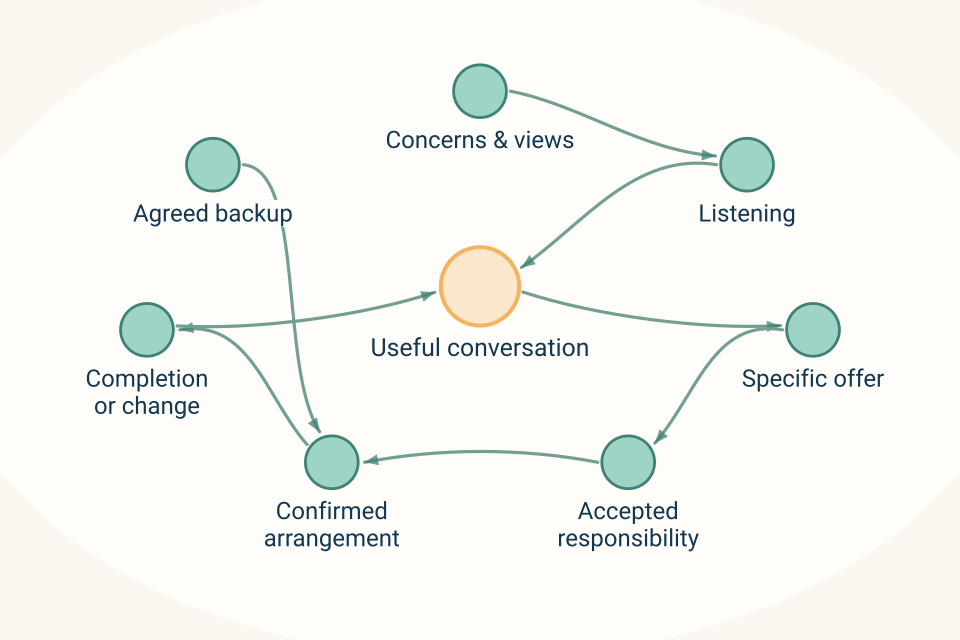
Listening makes room for people’s concerns and different views. What people say shapes the useful conversation. The conversation can turn goodwill into a specific offer. An offer becomes a responsibility only when someone accepts it. Confirm the arrangements behind the accepted responsibility. Check whether the confirmed arrangement was completed or needs to change. Report completion or a change back through the conversation. A backup supports the arrangement only when someone has accepted it; otherwise the gap remains unresolved. A request, an offer, an accepted responsibility and completed support remain distinct.
Make the commitment specific Offer: Name the action and its limits. Acceptance: The person agrees to take it on. Confirmation: Check who will do what, and when. Backup: Keep an unresolved gap visible until someone accepts it. An accepted commitment is not yet a completed task. |
In context
In Context — “Just tell us what you need”
Before their scheduled conversation with Lena, Pat and Ellen met again with Sam to discuss the arrangements around them. Daniel came in person. Maya joined by phone, with her parents’ agreement.
“I keep telling Mom,” Daniel said, “just call me when you need something.”
“I know,” Ellen replied.
“I mean it.”
“I know you do.”
Sam waited.
Ellen looked down at the appointment information.
“First I have to work out what needs doing. Then I have to think about who might be free. Then I call. And if the time changes, I start again.”
“You can always ask me,” Maya said.
“I can. But sometimes, by the time I’ve explained it, I’ve already done it.”
Daniel leaned back.
“I didn’t realize asking was part of the problem.”
“It isn’t asking exactly,” Ellen said. “It’s keeping all of it in my head.”
Pat had been listening.
“And I would like people to ask me before making arrangements. Yesterday I heard about a possible appointment time from three people. Nobody had asked whether it worked for me.”
Maya began to apologize.
“I was trying to make it easier.”
“I know,” Pat said. “But I’m still available for consultation.”
Ellen smiled, then looked toward Sam.
“I don’t want this to sound as though nobody helps.”
“It doesn’t,” Sam said. “You’re describing what help currently requires from you.”
He turned to the others.
“Before we decide who does what, could we make sure we understand what each person is asking for?”
Daniel answered first.
“Mom needs us to take responsibility for something, not wait for instructions every time.”
“And Dad?” Sam asked.
“To be part of the arrangement before we make it.”
Pat nodded.
“That would be a promising development.”
Nobody had stopped caring. They had been expressing care in ways that left important work unassigned—and important preferences unheard.
Listening changes what we are trying to solve
In Chapter 1, we learned more about the person and family. In Chapter 2, we made information easier to understand. In Chapter 3, we examined what would make a next step worthwhile and possible.
Communications brings those gains into the relationship between people.
Understanding begins with listening, not explaining.
Active listening, empathy, respectful language, and attention to individual differences become useful when they change how people ask, respond, agree, and follow through.
Our aim is not to teach everyone to speak perfectly. It is to create conditions in which people can say something important, discover how it was understood, and influence what happens next.
A warm sentence can open that possibility. What follows must support it.
In the family’s conversation, the problem initially sounded like a shortage of requests. Listening revealed a different problem: Ellen was still responsible for noticing, allocating, explaining, reminding, and checking.
A more encouraging invitation to ask would have left that arrangement largely unchanged.
Listen before deciding what the words mean
Listening is more than leaving enough silence to prepare a reply.
For practice, begin with an open question. Let the answer develop. Reflect what you think you heard, then leave room for correction. AHRQ’s clear-communication guidance recommends attentive listening, questions that invite explanation, and checks of understanding rather than relying on a yes-or-no answer.6
A useful reflection might be:
“You want help with the arrangements, but you don’t want to become the person who assigns and checks every task. Have I understood?”
It should not become:
“You’re overwhelmed because your family isn’t supportive.”
The first invites clarification. The second adds an interpretation and assigns blame.
The same discipline applies when someone sounds angry, hesitates, or goes quiet. Ask what the experience means to them. Do not treat a facial expression, a pause, or a computer-generated sentiment label as a reliable account of their inner life.
Acknowledging an experience also does not require accepting every conclusion attached to it.
“I can hear that you felt left out” is different from “Everyone deliberately excluded you.” We can take the feeling seriously while remaining careful about what is known.
Sometimes the person needs a practical response. Sometimes they need to finish speaking before considering one.
“Would it help to think through options, or would you like me to listen a little longer?” gives them a say in that decision.
Turn goodwill into something someone can rely on
A general offer leaves several questions unanswered.
What is being offered? When is the person available? Does the offer include arranging the task? What happens if plans change? Who tells the other people involved?
The supporting CarePhysics behavioral review proposes chosen, bounded roles for this reason. It distinguishes the plausible value of reducing ambiguity from evidence that a particular family-task feature improves care.
In context
In Context — An offer becomes a commitment
Daniel looked at the next follow-up appointment.
“I can take you next Thursday, Dad.”
“Both ways?” Pat asked.
“Both ways.”
“Then yes.”
Daniel checked the appointment details with him.
“I’ll call you Wednesday evening to confirm when I’m coming. And I’ll bring the car around rather than have you waiting outside.”
Ellen started to add something, then stopped.
“What were you going to say?” Sam asked.
“I was going to remind him to check the time.”
Daniel looked at the page again.
“That part should be mine too.”
Maya offered to make one scheduling call about a different follow-up question, once Pat approved the request and the office had the necessary permission to speak with her.
“I can do that Tuesday,” she said. “I can’t take over all the calls, but I can take this one.”
“That helps,” Ellen replied.
Sam asked what would happen if Daniel’s work prevented the Thursday trip.
They did not yet have a confirmed alternative. Rather than write “family backup” as though someone had accepted the job, they recorded the gap. Daniel would tell Pat and Ellen promptly if his availability changed and take responsibility for exploring an acceptable alternative with them. Sam would help investigate available support within his role.
“Let’s check that before we depend on it,” Sam said.
The agreement was modest. That was part of its value.
It identified something people could actually undertake—and something they still needed to resolve.
Confirm understanding, then confirm completion
AHRQ’s TeamSTEPPS guidance describes closed-loop communication: a message is given, the recipient confirms what they understood, and the sender verifies or corrects that understanding. A check-back is one way to do this.34
In a family conversation, it need not sound like a clinical procedure.
“So you’re handling the ride and checking the time with Dad?”
“Yes. I’ll confirm it with him Wednesday.”
“That is what we’re agreeing.”
That closes the understanding loop. It does not complete the ride.
CarePhysics adds the practical follow-through question: how will the people relying on the arrangement know it happened—or know promptly that it cannot?
The same distinction applies to a professional message. “Received” may mean someone has seen the request. “Accepted” means someone has taken responsibility. Neither necessarily means the requested support has been provided.
Use those words carefully. Do not let an automated acknowledgment sound like a human has already acted.
Make disagreement possible without making it the whole relationship
A family conversation does not need to resolve every difference before it becomes useful.
One person may want more information. Another may feel there have already been too many conversations. The person receiving care may want a different balance of assistance and independence than relatives initially propose.
Start with the specific issue rather than a judgment about character.
“I did not know the appointment time had changed” gives people something to clarify.
“You never tell me anything” may express real frustration, but it makes the immediate repair harder to identify.
That does not mean asking a distressed person to rephrase everything politely before receiving help. The facilitator can acknowledge the frustration and help find the concern underneath it.
Repair can be direct:
“I moved too quickly. I should have checked with you.”
“The note does not accurately reflect what you agreed to. I will correct it.”
“I said I would call, and I did not. Here is what I can do now.”
An apology should not become a substitute for correcting the arrangement. Nor should a carefully written summary erase a disagreement to make the meeting appear successful.
Some matters need a private conversation. Others require a qualified professional rather than another family discussion. Where someone cannot speak freely or there is a safety concern, the appropriate response may be private support—not gathering everyone into the same room.
Adapt the conversation without assigning people a cultural script
A familiar structure should make communication easier to navigate. It should not prescribe one acceptable way to express concern.
Ask about language, privacy, who should be involved, and how people prefer difficult information to be discussed. AHRQ’s cultural guidance emphasizes learning from individuals and avoiding assumptions based on how they look, sound, or identify. It also notes that expectations about eye contact and touch can differ.13
Do not equate directness with honesty, quietness with agreement, or strong emotion with lack of understanding.
Someone may find it easier to begin in writing. Another may prefer a private call before a group meeting. A person may wish to include a trusted friend or faith leader. Another may want fewer people involved.
Language support is a separate responsibility. Ask what language people prefer for speaking and reading, and arrange qualified assistance for consequential care conversations rather than relying on children or untrained relatives to interpret.14
Accessibility belongs in preparation too: readable materials, captions when needed, appropriate communication aids, enough time, and a setting where people can hear and respond comfortably.
Preserve the same facts while adapting the route into them. A softer tone must not hide an important concern. A shorter version must not remove a condition on which the plan depends.
Design the conversation before designing the form
The practical output for this chapter begins with a Family Conversation Guide.
It is not an assessment or a compulsory script. It helps the facilitator and participants identify what the meeting is for, what needs discussion, and what should remain outside it.
Before the meeting, ask each participant what they want addressed and what information they are comfortable sharing. Explain who will attend, whether notes will be taken, and who will receive the summary. Recording or AI assistance requires its own appropriate explanation and permission.
During the meeting, begin with the person receiving care and make room for the caregiver’s separate needs. Discuss one manageable issue at a time. Confirm offers before recording them as commitments.
Afterward, share only the agreed information through the chosen routes. Include a way to correct it.
A brief working guide can hold the following:
Conversation element | What needs to be clear |
|---|---|
Purpose | What are we trying to make easier, protect, or decide? |
Voices | What does each person want understood? Who has not yet had an opportunity to speak? |
Boundaries | What is private, outside this meeting’s scope, or awaiting professional assessment? |
Commitments | What has someone actually accepted, by when, and with what limits? |
Follow-through | How will completion, a change, or an unresolved gap be communicated? |
Review | Who checks the summary, receives corrections, and revisits the arrangement? |
Do not make the family explain its entire history every time it meets. Start from the reviewed information already available and ask what has changed.
The organizing idea is straightforward: share the work, not merely the information about the work.
Show people what a useful conversation looks like
The content surrounding the meeting should help people participate, not add another lesson to complete.
A short preparation article might explain that an offer can include arranging and confirming a task, not only performing it. A video could demonstrate the difference between “Call me when you need something” and a bounded offer the other person can accept, change, or decline.
Show an imperfect moment too. A person realizes they cannot commit to every Thursday and offers one specific date instead. The family adjusts without treating the limit as evidence of insufficient love.
End the demonstration with confirmation and a fallback question—not just a warm exchange.
A companion prompt might ask:
“What is one part of the week you could realistically take responsibility for, including the arrangements?”
Someone can answer “none at present.” That answer identifies a limit the plan must respect.
The video, article, invitation, and follow-up can use the same recognizable headings: What matters / What we agreed / What is still open / Who responds. Each medium performs a different job while preserving the same meaning. Our communication approach explicitly distinguishes consistent meaning from identical wording across channels.
Chapter 6 develops the creative choices within that consistency: a demonstration, metaphor, story, photograph, welcomed humor, or quiet moment can be appropriate when it fits the person and the purpose.
For a feedback question, explain what the answer will influence and who will review it. A reply box without a response process is not a conversation.
Send an account people can use—and correct
In context
In Context — The summary they agree to share
Before ending the meeting, Sam reads back the proposed family summary.
What matters
Pat wants arrangements discussed with him before they are finalized. Ellen wants help that includes organizing and following through, not only responding when she asks.
What we agreed
Daniel will provide the agreed Thursday ride and confirm details directly with Pat on Wednesday. Maya will make one scheduling call on Tuesday after Pat approves the request and the office confirms the necessary permission.
What remains open
A backup ride has not been confirmed. Regular Day Center attendance has not been agreed. Clinical questions remain with the healthcare team.
Questions or corrections
Contact Sam through the route provided with this summary. A change affecting an immediate arrangement should also go directly to the people relying on it.
Maya asks Sam to keep “one scheduling call” in the final version.
“I don’t want Mom to think I’ve taken all of that over.”
“That stays,” Sam says.
Pat asks for his own copy.
“It would be helpful to know what I’m agreeing to.”
The family chooses who receives the summary. Private conversations are not included.
The document does not claim the tasks are complete. It records an agreement they can check against what happens.
Communication should carry life, not only tasks
Not every family update should become an action list.
A person’s day may include enjoyment, disappointment, humor, quiet, and a conversation worth remembering. The organization can make room for those experiences without turning every moment into a clinical interpretation.
A useful family update can distinguish something to talk about, an optional idea for home, support for the caregiver, and a question for the next visit. In our proposed design, each section has a clear purpose and review route. The dated Genus example and its limits appear in Appendix J.
Consider a separate, invented example—not a later event in Pat’s story. A participant enjoys discussing gardens, then chooses a quieter seat when the room becomes noisy.
A note could offer an optional conversation about gardens, describe the quieter setting that was offered, and say that there is no additional task for the family that evening. It should not declare that the person was happy all day or infer why they wanted quiet.
Important concerns need their own clear place and appropriate human follow-up; they should not be hidden among cheerful suggestions.
Give families an appropriate way to correct the account and request a reply. A saved comment or notification is only one step; name who reads it, accepts the response, and follows through.
The purpose is to bring the day into the relationship—not require relatives to quiz someone about it.
A photograph, story, or poem may also offer a point of connection when the person welcomes it. It need not produce a measurable action to deserve a place in family life.
Where AI can help people find their words
A person may know what they need to say and still struggle to begin.
In a proposed, organization-approved workflow, an AI assistant could help rehearse a conversation, organize questions, or revise a message for clarity. The person remains the author and decides whether the wording sounds like them.
For example:
“Help me explain that I need assistance with the arrangements, without implying that my family does not care.”
The assistant could offer several openings and ask which fits. It should not decide that a relative is selfish, infer motives, or turn frustration into a diagnosis of the family.
Meeting preparation offers another useful role. With appropriate permission, an assistant could organize selected notes by source and distinguish concerns, proposals, accepted commitments, and unresolved questions.
Its first draft still needs checking.
“Family will share transportation” sounds reassuring but may be inaccurate. “Daniel accepted one Thursday ride; no recurring arrangement or backup has been confirmed” preserves the actual agreement.
Likewise, “Everyone agreed” must not replace a record that one person remained uncertain.
The proposed CarePhysics workflow keeps approved research and guidance separate from current organizational facts and permissioned personal information. It identifies sources, review owners, permitted uses, and corrections. Supplying the book to an assistant is not model training or proof that it will follow the material reliably.
Properly applied, AI could reduce repeated preparation, help staff draft useful updates, and let families revisit routine information at any hour. The human service must still explain when people are available and provide a clear route for urgent or consequential concerns.
Private notes should not automatically enter shared summaries or become training examples. The named reviewer checks accuracy, omissions, permissions, tone, and responsibility before a personalized care summary is released. Where the Day Center workflow uses AI drafting, its documented rule is that a person approves family-facing content.
The opportunity is more support around the conversation—not a machine taking over the relationship.
Help the team practice—and listen to the team
Communication requires organizational support.
A team needs protected time to learn, clear responsibilities for incoming questions, access to current guidance, and enough staffing to carry out the commitments made in its messages.
Short paired practice and branching fictional scenarios can give staff a supported place to rehearse. Keep voluntary reflection private rather than turning personal commitments into rankings. Appendix J identifies the dated training examples; required competency assessment remains a separate professional process.
A team might practice responding to a family correction, clarifying a vague request, or explaining a service limit without becoming dismissive. Then ask staff what would make the real encounter easier.
Perhaps the form obscures the responsible person. Perhaps different shifts receive different information. Perhaps a promised callback window is unrealistic. Those problems require operational changes, not another reminder to be compassionate.
Budget for interpretation, accessible materials, preparation, human review, and responses. Keep telephone and paper options. Agree how staff cover absences and how an unresolved concern reaches someone with authority to act.
A health system, home-care organization, and Day Center may use similar communication structures while retaining different professional responsibilities. Community and state groups can help partners agree on status terms and response expectations without erasing local voice.
Capture useful staff suggestions, credit their contributors, and report back on what changed. AI could help organize permissioned feedback for that discussion. It should not secretly score staff emotion, attention, or kindness.
Listening should reach the people providing care as well as those receiving it.
How would we know it helped?
Begin with one communication process: a family meeting, routine update, or request for help.
Establish a baseline, then try a defined change over a stated period. A short local improvement project can identify practical problems; it should not be presented as proof of long-term clinical benefit.
Ask the people involved whether their concern was accurately represented, whether they could disagree, and whether they know who is doing what. A locally written feedback question is useful for improvement, but it is not automatically a validated measure.
Track follow-through separately. For example, the team could count routine questions due for a response during a month and report the proportion that received a substantive answer—or a clear, owned next step—within the stated service window. Urgent concerns require their own process.
Also examine commitments completed, unresolved gaps, corrections, privacy problems, and time spent preparing, reviewing, and responding. Include people using different languages and non-digital routes. Report missing feedback rather than treating silence as satisfaction.
Do not make a low correction rate the goal. Corrections may reveal that people feel able to speak and that the process is working. What matters is whether the error is understood, repaired, and prevented where possible.
Separate communication activity, understanding, useful participation, experience, and outcomes. The CarePhysics measurement framework includes access, burden, and safety alongside these stages.
Give a named leader authority to revise or stop a process that creates more work, hides concerns, or leaves questions unanswered.
We are evaluating the support—not how well a family performs harmony.
Models and Evidence Behind This Chapter
This chapter emphasizes listening, compassion, practical commitments, and reviewed communication. The external studies and guidance below help examine those choices.
They do not all provide the same kind of evidence. A conceptual model explains possible mechanisms; a training trial tests a particular intervention; a feasibility study asks whether an approach appears workable.
Patient-centered communication
Connect the conversation to what happens afterward
Foundation and use. Richard Street, Gregory Makoul, Neeraj Arora, and Ronald Epstein’s 2009 paper, How Does Communication Heal?, describes pathways connecting clinician–patient communication with understanding, trust, decisions, support, agency, and health. It is a conceptual synthesis, not a randomized trial demonstrating one communication package.35
In this chapter, its contribution is to look beyond whether the exchange sounded warm. Did listening change the problem being addressed? Did the resulting plan reflect the person’s priorities? Did someone gain practical support?
Evidence boundary. The paper helps identify intermediate outcomes worth examining. It does not establish that the proposed family summary, AI workflow, or CarePhysics chapter improves health.
Local question: What changed because the concern was heard—not merely recorded?
Empathic communication skills
Practice can matter, but a course is not the whole solution
Supporting study. Helen Riess and colleagues’ 2012 randomized trial involved 99 resident and fellow physicians from six specialties at two Boston institutions. The intervention added three one-hour empathy-training sessions to standard education.
Patient-rated empathy improved more in the training group than in the control group, with a 2.2-point difference in change on the CARE measure. Patient ratings were collected one to two months after training. The study had a small, volunteer sample, one instructor, and no long-term follow-up. It did not establish improved clinical outcomes or reduced burnout.36
Where we used it. The chapter proposes practice, feedback, and organizational support rather than asking staff simply to “be more empathetic.”
Evidence boundary. This is experimental support for one training approach in medical trainees. It does not validate automated emotion-reading or staff empathy scores.
Local question: After practice, do the people receiving care experience better listening and clearer responses?
Self-Determination Theory
A commitment needs an authentic yes
Foundation and use. Self-Determination Theory’s attention to autonomy, competence, and relatedness carries forward from Chapter 3. Here, it informs chosen roles, realistic limits, and the ability to disagree.
The research review informing this book specifically proposes bounded family responsibilities and grades the wider intervention evidence as Moderate, while distinguishing it from stronger claims about individual product features.
Maya’s offer of one call and Daniel’s agreement to a particular ride illustrate this application. Neither is assigned unlimited responsibility because of distance, proximity, or family role.
Evidence boundary. The family agreement is a proposed application, not a validated intervention. More accepted tasks do not necessarily mean less strain; the arrangements may redistribute or increase work.
Local question: Did people accept roles they could realistically carry, without pressure or hidden obligations?
Closed-loop and family-centered communication
Confirm the meaning and support the process
Practice foundation. AHRQ’s TeamSTEPPS guidance recommends feedback that confirms a message was correctly understood. The chapter applies that principle to checking responsibilities, while distinguishing understanding from actual task completion.37
Related study. Alisa Khan and colleagues’ 2018 multicenter study examined a family-centered communication program across 3,106 pediatric admissions in seven North American hospitals. The program combined structured bedside conversations, written summaries, staff training, and implementation support.
Harmful errors fell from 20.7 to 12.9 per 1,000 patient-days after implementation. The overall medical-error rate did not change significantly. This was a before-and-after study, not a randomized comparison; other changes could have contributed, and the intervention’s components cannot be separated into individual effects.38
Evidence boundary. Pediatric hospital rounds differ from family care planning and Day Center communication. The result supports investigating structured, supported communication—not promising the same reduction elsewhere.
Local question: Do people have an opportunity to raise concerns, check the plan, and identify who follows through?
Digital communication in Day Centers
Test usefulness inside the working day
Supporting study. Amy Zheng and colleagues’ 2024 mixed-methods study examined a CareMOBI prototype with 22 Day Center staff members from three U.S. states. Staff generally viewed the proposed communication tool favorably, while identifying training, technical support, language access, and fit with existing work as important issues.
Participants explored a prototype and completed interviews and questionnaires. The sample was small and entirely women; the study did not establish long-term adoption, reduced workload, or improved family or health outcomes.39
Where we used it. The chapter treats a digital update as part of a human response process, not as proof that communication has improved.
Evidence boundary. This is early acceptability and feasibility evidence for a different product, not validation of Genus. The added value of a reviewed family summary remains a local evaluation question.
Local question: Does the communication channel help families and staff exchange useful information without introducing unacceptable work or excluding people?
Where Social Physics fits
The Social Physics perspective remains useful in the background: information becomes more valuable when people can discuss, interpret, and work with it. The research review informing this book emphasizes both discovering resources and having relationships through which to consider them, while warning that social learning can also spread mistakes.
In this chapter, that suggests a design question rather than another claim: does the message reach someone able to respond, clarify, or help?
More messages are not the objective. A useful exchange is.
One thing to try
Choose one recurring offer in your organization, such as “Contact us with questions” or “Let us know how we can help.”
Follow it through as though you were the person receiving it.
Who responds? What can they do? When should an answer arrive? What happens when the usual person is unavailable? How does someone correct a misunderstanding?
Improve the weakest part, then test it with the people using the service.
Your team’s question is:
After we invite someone to speak, have we made it possible for their words to change what happens?
The conversation makes room for something else
In context
In Context — A call that is not only about care
On Wednesday evening, Daniel called Pat.
“I checked the appointment details. I’ll be there at the time we agreed, and I’m taking you home afterward too.”
“Good,” Pat said. “Have you finished that book?”
“What book?”
“The one you borrowed.”
“I’ve been busy.”
“So have I. Apparently I have a full calendar.”
Daniel laughed.
“I’ll bring it.”
Ellen was nearby, but she did not need to take over the call. Daniel and Pat had made the arrangement together.
One small piece of the week had a responsible person behind it.
There were still questions about care, and the family had not solved them all. Better conversation had helped them share some responsibilities. It could not create every service they might need.
They could offer a ride. They could make a call. They could remain family.
The next step was to discover what could become possible with people beyond the household: a welcoming place, appropriate support, useful relationships, and opportunities for Pat to participate in a community of his own choosing.
That is the fifth principle:
Community — Make Belonging Practical.
Notes
Agency for Healthcare Research and Quality (2024). Communicate Clearly: Tool 4. Health Literacy Universal Precautions Toolkit, 3rd edition. Source (opens a new tab)
Agency for Healthcare Research and Quality (2024). Consider Culture, Customs, and Beliefs: Tool 10. Health Literacy Universal Precautions Toolkit, 3rd edition. Source (opens a new tab)
Agency for Healthcare Research and Quality (2024). Address Language Differences: Tool 9. Health Literacy Universal Precautions Toolkit, 3rd edition. Source (opens a new tab)
Remen RN. Listening Generously. Interview with Krista Tippett. The On Being Project. Transcript and recording. Source (opens a new tab)
Agency for Healthcare Research and Quality. Check-Back. TeamSTEPPS communication tools. Source (opens a new tab)
Street RL Jr, Makoul G, Arora NK, Epstein RM (2009). How does communication heal? Pathways linking clinician-patient communication to health outcomes. Patient Education and Counseling. 74(3):295–301. DOI: 10.1016/j.pec.2008.11.015. Source (opens a new tab)
Riess H, Kelley JM, Bailey RW, Dunn EJ, Phillips M (2012). Empathy training for resident physicians: a randomized controlled trial of a neuroscience-informed curriculum. Journal of General Internal Medicine. 27(10):1280–1286. DOI: 10.1007/s11606-012-2063-z. Source (opens a new tab)
Agency for Healthcare Research and Quality. Closed-Loop Communication. TeamSTEPPS communication tools. Source (opens a new tab)
Khan A, Spector ND, Baird JD, et al. (2018). Patient safety after implementation of a coproduced family centered communication programme: multicenter before and after intervention study. BMJ. 363:k4764. DOI: 10.1136/bmj.k4764. Source (opens a new tab)
Zheng A, Bergh M, Patel Murali K, Sadarangani T (2024). Using mHealth to Improve Communication in Adult Day Services Around the Needs of People With Dementia: Mixed Methods Assessment of Acceptability and Feasibility. JMIR Formative Research. 8:e49492. DOI: 10.2196/49492. Source (opens a new tab)