Chapter 5
Community — Make Belonging Practical
At a Glance
The central idea: Care becomes stronger when people know how they can help—and how they can belong.
What you’ll explore: How a community becomes more than a collection of services. Follow Pat and Ellen from an introduction to a Day Center toward chosen participation, familiar relationships, and usable respite. Examine why transportation, affordability, culture, language, staffing, and program fit belong in the same conversation as compassion and connection.
Design and AI: Create invitations that show what people can expect, introduce the person who will respond, and make room for questions. Explore how an approved AI assistant could help maintain resource information, prepare introductions, adapt materials, and capture useful ideas without replacing human relationships or assuming a referral succeeded.
Put it to work: Build a Community Introduction and Follow-Through Plan that connects a person’s priorities with an appropriate service, a responsible contact, practical arrangements, and a review.
Evidence and evaluation: Examine social support, Social Physics, community-access research, and adult day services studies. Measure actual connections, participant experience, caregiver relief, access, and burden—not simply referrals or attendance.
“Being connected to others socially is widely considered a fundamental human need — crucial to both well-being and survival.”
— Julianne Holt-Lunstad, PhD, psychologist and social-connection researcher, quoted by the American Psychological Association in 2017.40
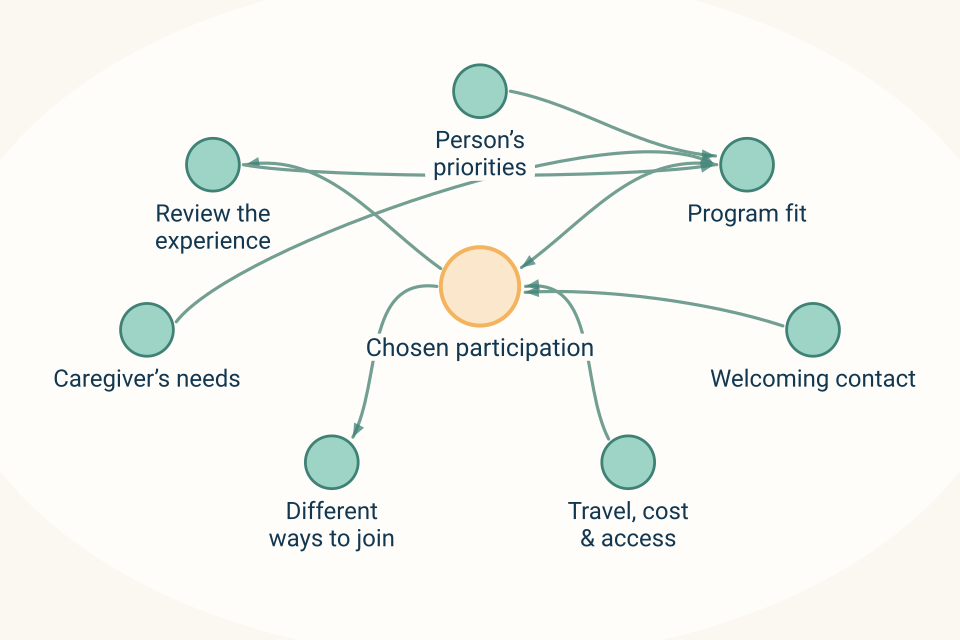
The person’s priorities guide the assessment of program fit. Program fit informs the person’s choice about participation. A welcoming contact makes an introduction and a route for questions available. Travel, cost and access arrangements affect whether chosen participation is usable. Participation leaves room for different ways to join, including quieter company. Consider the caregiver’s needs separately when examining fit. Review the experience of participation rather than counting attendance alone. Use that experience to reconsider program fit. An introduction is not proof that support or usable respite was received.
In context
In Context — Someone at the door
Pat stopped just inside the Day Center.
“Do I have to stay for the whole morning?”
“No,” Lena said. “Today you and Ellen are here to look around and ask questions. That is what we agreed.”
The telephone conversation had answered some things. Seeing the place raised others.
Pat looked past the reception area. There were people talking around a table, someone reading near a window, and another group preparing an activity.
Lena spoke to him directly.
“Sam mentioned that you enjoy books and local history. What do you like reading now?”
“History. And mysteries, provided nobody explains the ending.”
“Would you like to see what we have?”
“Is it all reading aloud?”
“Not all. Some people prefer listening. Some read on their own. We can show you.”
Ellen asked where she could sit during the visit.
“Come with us,” Lena said. “Then we can find somewhere to talk.”
On a table lay photographs of neighborhood streets. Two participants were discussing what a building had once been used for.
Pat slowed down.
“I thought that was a bakery.”
“One of us thinks so,” a participant replied.
Lena waited.
“Would you like to join them for a few minutes?”
“I’ll listen first,” Pat said. “Nobody’s appointed me historian.”
“No appointment necessary.”
“That makes a change.”
Ellen sat nearby. She had not decided whether the center would work for them. Neither had Pat.
But the question was becoming more concrete. They were no longer trying to imagine an unfamiliar service from a description.
They were meeting people.
Community has to become usable
A family can communicate more clearly and still need support it cannot provide alone.
Daniel can offer a ride. Maya can take responsibility for a call. Ellen and Pat can explain what matters to them. None of those commitments creates a staffed program, an accessible vehicle, or someone available when family members are not.
The Community principle extends care beyond the household.
Care becomes stronger when people know how they can help—and how they can belong.
Community connects the person receiving care with chosen supporters, professionals, volunteers, and appropriate services. It also makes room for people to give as well as receive support.
That is broader than a directory and more personal than a referral network.
A directory can tell someone that a service exists. An introduction can bring them into contact with a person. A workable arrangement can make participation possible. Over time, the experience may become somewhere they feel recognized and welcome.
Those are different achievements.
A person can arrive at a building without feeling included. A caregiver can have an appointment on the calendar without receiving any relief. An organization can have many partners without knowing whether people reach them.
Community becomes practical when we examine what happens between those points.
Being connected is not the same as being supported
Social-support research distinguishes the existence of relationships from the help those relationships provide. Sheldon Cohen and Thomas Wills’ foundational review examined both the general benefits of social connection and the possibility that support protects people during stressful events. Their analysis emphasized the relevance of interpersonal resources to the needs a stressful situation creates.41
For our purposes, that distinction changes the questions we ask.
Instead of stopping at “Does this person have family?” ask who is willing and able to help, with what, and under which circumstances.
Instead of asking only whether someone attends a group, ask whether the experience offers the connection they want.
Instead of describing a program as respite, ask what time and responsibility it actually releases for the caregiver.
Pat may find companionship around a history discussion. Ellen may need dependable time when someone else has accepted responsibility for the agreed support. A friend who listens to Ellen may be important in another way.
These forms of support can complement one another. They are not substitutes.
And someone without a large family, a trusted circle, or nearby relatives should not have to build those relationships before receiving appropriate services.
Help knowledge travel through people
Alex Pentland’s Social Physics draws attention to idea flow: how people discover information and work with it through their social connections. Its themes of exploration and engagement give us a useful way to examine whether knowledge reaches beyond a familiar circle—and whether someone helps turn that knowledge into something usable.5
In the care application proposed here, Casey’s introduction to Sam opened a route beyond the hospital. Sam’s relationship with Lena helped the family ask questions about a community option. Lena could answer for the program rather than leave Pat and Ellen interpreting a brochure.
The information mattered. So did the people who could discuss it and act on it.
This does not mean every person needs a navigator. Someone may prefer to use a directory independently. Another may want a telephone introduction, a conversation with a peer, or help arranging a visit.
Choose the amount of assistance with the person, not for them.
A peer’s experience can be useful when offered honestly and with permission. It should not become a testimonial presented as a typical result. Nor should a familiar messenger make unverified advice appear authoritative.
The research review informing this book is explicit about this limit: social learning can spread mistakes as well as useful ideas. It recommends connecting the discovery of a resource with a trusted person who can help examine whether it fits—not simply increasing message volume.
A welcoming place still has to be the right place
An encouraging first visit does not establish that a service can meet someone’s needs.
Before attendance begins, the organization must confirm eligibility, required assessments, available staffing, the support it can provide, costs, access arrangements, and the limits of its role. Pat’s interest in a discussion cannot answer those questions.
The same care applies when a service is not suitable. Explain the reason clearly and, with permission, help identify another route. Do not leave the family believing that a poor fit means the person is too difficult or that they asked for too much.
Research on community-service access reinforces why this matters. Molly Waymouth and colleagues’ 2023 study analyzed 35 in-depth interviews with service providers, administrators, and advocates. It identified barriers at several levels, including infrastructure, cultural differences, awareness, and caregiver circumstances. This was qualitative research about access—not an estimate of how common each barrier is or proof that one navigation method solves them.42
In context
In Context — From a visit to an agreed day
Clinical follow-up continued alongside the family’s conversations about support.
Over the following weeks, further assessment led Pat’s clinicians to explain a diagnosis of early-stage dementia to him and Ellen. They needed time and further conversations to understand it. The diagnosis did not settle what Pat wanted his days to be like.
Lena’s team reviewed the relevant clinical information and completed its own intake and assessment of service fit. They established what support the center could provide and discussed the arrangements with Pat and Ellen.
The family reviewed the costs and a limited initial schedule. Transportation for the first attended day was confirmed; Daniel’s earlier offer of one medical-appointment ride was not silently converted into an ongoing responsibility.
They also agreed when to review the experience.
Pat had one condition.
“If I don’t like that history table, I’m allowed to do something else.”
“Yes,” Lena said.
“And I don’t have to explain myself to a committee?”
“You can tell us what would work better.”
“I can usually manage that.”
This was not simply a successful invitation. It was an invitation followed by assessment, practical arrangements, and a choice Pat could revisit.
Design a welcome people can recognize
The experience begins before the front door.
A first-visit message should answer the questions a person actually needs resolved: why they are coming, whom they will meet, what will happen, what they need to bring, and what they have—or have not—agreed to.
An illustrative message might read:
Your introductory visit
This visit is a chance to meet the team, see the setting, and decide what else you would like to know.
Lena will meet you at the entrance identified in your confirmation. She will explain what is happening that day and show you the places available for activities and quieter time.
You may ask questions, look around, or spend a little time observing an activity where appropriate. An introductory visit is not an agreement to enroll.
Please tell Lena before the visit about any language, access, or other assistance you would like us to arrange.
Afterward, you can discuss whether to explore participation, consider another option, or take more time.
A real message needs confirmed local details: the entrance, date, time, contact route, available assistance, and the person covering if Lena is absent. Do not promise choices the program cannot provide.
A short video can show the route from arrival to welcome. With appropriate consent—or clearly identified demonstration footage—it can show someone asking to observe before joining. The article can carry fuller details about services and costs. A telephone conversation can address an individual concern.
The formats differ, but the meaning should remain consistent.
The CarePhysics design pattern applies: why this matters, the main idea, a visible example, a chosen next step, a route to questions, and what follows. It is a flexible design proposal, not a requirement to turn every welcome into a six-part lesson.
Belonging includes the freedom to participate differently
Knowing a person’s interests creates a starting point. It does not give the organization a permanent activity assignment.
Ask what someone enjoys now. A past occupation, cultural background, or faith tradition may suggest a question, but it should not determine the answer.
A retired teacher may enjoy leading a discussion—or be relieved never to lead one again. Someone may want familiar music, new music, or no music during lunch. A participant may appreciate a community celebration without wanting their identity represented in every activity.
Ask about language, food, routines, beliefs, accessibility, and privacy in terms the person can choose to discuss. Then examine whether the service can respond.
A quiet option is not useful if no one can help someone reach it. An invitation to contribute is not meaningful if staff take over as soon as the person begins.
The Day Center export offers concrete design examples: ask about present as well as past interests, offer different ways to take part, and preserve the ability to observe, decline, or change one’s mind. Those are documented approaches, not evidence that every implementation achieves them.
In context
In Context — An invitation, not an assignment
During a later attended day, Lena asked Pat whether he would like to read a short passage that introduced the afternoon discussion.
“How short?”
“One paragraph.”
“I’ve heard that before.”
She showed it to him.
Pat read it silently.
“That is unusually honest.”
He agreed to read it to the group. When he finished, another participant asked a question, and the conversation moved beyond the passage.
Later, the room became busier. Pat asked to sit somewhere quieter.
The team helped him move. They did not describe the change as a loss of interest in the program.
At pickup, Lena told him what she intended to mention in the family update and invited his correction.
“The reading was fine,” Pat said. “The room got a bit much afterward.”
Both parts belonged in the account.
Pat had contributed. He had also needed support. Neither canceled the other.
People do not have to earn belonging by being useful. Purpose can be offered through genuine opportunities to contribute, while rest, enjoyment, and receiving care remain enough.
Ellen needs a life beyond the arrangements
Pat’s experience matters in its own right. So does Ellen’s.
On an attended day, do not calculate respite solely from the program’s opening and closing times. Ask what the arrangements require from the caregiver: preparation, travel, waiting, collecting information, remaining available, and managing changes.
The Daily Stress and Health study found that caregivers reported fewer care-related stressors on adult-day-service days, alongside more positive experiences—but also more stressors unrelated to care. That is a useful reminder that time away from caregiving is not automatically restful time.43
In context
In Context — Time that is hers to use
On Pat’s first attended day, Ellen stayed nearby.
She had the contact information and knew what the team had agreed to communicate. Even so, she found herself looking at her phone.
At the review, Lena asked what had been useful and what remained difficult.
“I knew where he was,” Ellen said. “I didn’t quite know what to do with myself.”
Sam did not prescribe a list of self-care activities.
“What would you like that time to make possible?”
“Lunch with a friend. An appointment without asking someone to sit with Pat. Sometimes nothing.”
“Nothing is an option,” Pat said.
On a later day, Ellen met her friend. The transport and pickup arrangements were already settled. The Day Center had accepted responsibility for the agreed support, and Ellen knew how to contact the team.
She did not become unworried. She had a meal, a conversation, and time that did not require her to organize the next task.
That was something she could describe at the next check-in.
Relief should not have to look productive to count. Nor should every period of respite be filled with caregiver education. Offer learning and support, but leave room for the person’s own choices.
Put the introduction and follow-through in one place
The practical tool for this chapter is a Community Introduction and Follow-Through Plan.
It can be brief. Its purpose is to make the next responsibility visible, not create a second care record.
Element | What the plan should establish |
|---|---|
Purpose and permission | What does the person hope to receive or explore? What may be shared, with whom, and for what reason? |
Named connection | Who is making the introduction? Who at the receiving service has accepted the next action? |
Fit and access | What is confirmed about eligibility, support needs, cost, language, transport, and capacity? What remains unresolved? |
Current stage | Was information requested, contact made, a visit arranged, assessment completed, or a service actually received? |
Responsibility and fallback | Who acts next, by when, and who helps when the usual route fails? |
Review | How will the person, caregiver, and relevant team members describe usefulness, difficulties, and any change they want? |
The stages matter. An introduction can be complete while service access remains unresolved. A first visit can happen without leading to enrollment. A booked day can be canceled.
In the proposed family pathway, Lena confirms the completed visit with Sam, within the information Pat and Ellen have agreed to share. Later, the team records actual attendance separately from the original referral.
Agree how relevant information will return to the referring service and who accepts that work. Verify the actual event dates before calculating time to care. Neither task should be assumed automatic; see the dated examples in Appendix J.
The plan should therefore say who keeps any additional record needed. Technology cannot supply an event nobody recorded.
Where AI can help the connections hold
Sam may know several relevant services, but preparing accurate information for each family still takes work. Lena’s team may repeat the same introductory explanations while needing to adapt them to different questions.
An approved AI assistant could help with those tasks.
In the workflow proposed here, it retrieves current organizational information and relevant CarePhysics guidance, then prepares options based on the needs the person has actually expressed. It identifies what remains unconfirmed rather than inventing availability, eligibility, funding, or a transport arrangement.
A useful instruction might be:
Help prepare this community introduction using our approved sources and the information we have permission to share. Explain the options, identify unresolved access questions, and name the person who must confirm each one. Do not record a request as an accepted referral or an accepted referral as a delivered service.
Sam reviews the navigation material. Lena confirms program facts. Clinical questions return to the clinical team. Each organization retains responsibility for its own service and decisions; Genus supplies technology, not the people or capacity behind the promise.
The knowledge collection should preserve sources, owners, review dates, approved uses, and corrections. Research, design examples, local facts, and private personal information should remain distinguishable. Providing the book is not training a model or proving that it will follow the guidance correctly.
Families could use a properly configured assistant to revisit routine information or prepare questions outside office hours. When a question needs a person, the route should be visible, with honest response expectations and separate urgent guidance.
AI could also help staff turn a useful explanation into a draft welcome resource, with the contributor credited and private details removed. It could organize voluntary feedback for a review meeting and help compare versions of an invitation.
That is a positive use of assistance: less repetitive preparation, more useful knowledge available, and more attention for the people arriving. Whether time is actually returned must be measured after checking and corrections.
The assistant should help people reach community, not make the assistant the community they are expected to settle for.
Let the community help shape the service
A program should not have to guess everything its participants need. It should create practical ways for them—and the people supporting them—to influence what happens.
Ask which part of a first visit was confusing. Invite suggestions about activities, timing, food, or communication. Provide a private route for concerns. Offer conversation or paper alongside digital feedback.
Explain who reviews the response and what can realistically change.
When the team acts, return the result: “You asked for a quieter place to talk at pickup. Here is the arrangement we are trying.” When it cannot act, explain the limit rather than letting the suggestion disappear.
Our approach treats this exchange of ideas as part of Community: participants, families, and staff contribute to improvement, and the organization shows what happened to their input.
Staff need the same opportunity. They may see a confusing entrance, an unreliable handoff, or an activity that works better in a smaller group. Ask what support they need to respond, not merely what else they can take on.
Budget for welcoming, navigation, training, interpretation, coordination, and review. Establish cover for absences and limits for volunteers. Companionship should not quietly become responsibility for clinical or personal-care tasks outside someone’s role.
This principle travels beyond Day Centers. A person receiving rehabilitation at home may want to remain connected with an existing club. A homebound adult may prefer a regular telephone conversation to a group meeting. A working caregiver may need a service whose hours match the working day.
Community and state groups can help organizations examine repeated gaps—such as inaccessible transport or unavailable service hours—without turning different populations into a league table.
A good relationship can reveal an unmet need. It cannot replace the service or resources required to meet it.
How would we know it helped?
Evaluate the connection, the experience, and the effort separately.
Before changing an introduction process, establish what currently happens. For a defined group of referrals over a stated period, record the date and stage of each request, the responsible person, unresolved barriers, and whether appropriate help was actually received.
Then ask about life on the receiving side.
For the participant: Was there something they wanted to do? Could they choose differently? Did they have someone to talk with? What would they change?
For the caregiver: Did the arrangement provide usable time? What did getting to and from the service require? What responsibility or uncertainty remained?
These are proposed improvement questions, not a validated questionnaire. Where an organization uses a validated instrument, preserve its required wording and scoring and confirm its suitability for the setting.
Belonging should not be inferred from attendance or a staff member’s impression alone. Participation, meaning, belonging, and autonomy need separate attention; one activity count cannot describe them all.
Report denominators, time windows, and missing information. Include people who wanted a service but could not reach it, not only those who enrolled. Examine access by language, geography, care needs, and other relevant circumstances where appropriate data can be collected safely.
Count travel, fees, paperwork, staff time, family coordination, and AI review. Examine safety concerns and missed follow-through separately from routine satisfaction.
An informed decision not to attend can be a sound decision. An unmet need caused by cost or unavailable support should not be relabeled as personal preference.
Willingness to recommend, an actual referral, and a referred person receiving services also remain distinct. None alone establishes improved health or attributable impact.
Give a named leader responsibility for reviewing the findings with the team and authority to change, narrow, or stop an approach. Share difficult findings as well as encouraging ones.
Models and Evidence Behind This Chapter
The following foundations help explain the chapter’s choices. The family scenes and practical tools are proposed applications, not tests of the models or results of the studies.
Social support and the buffering hypothesis
Ask what the relationship makes available
Foundation. Cohen and Wills’ 1985 review distinguished integration into a social network from interpersonal resources responsive to particular needs. It found evidence consistent with both a general benefit of support and a stress-buffering process, depending on what was measured.41
Where we used it. The chapter separates companionship, practical help, professional support, and caregiver relief. A person can have relationships while still lacking the assistance needed for a particular situation.
Evidence boundary. This is a foundational review and model, not evidence that adding contacts or a care-circle feature necessarily improves health.
Local question: What help can the person actually rely on—and is it the help they need?
Social Physics and social learning
Connect discovery with someone who can help
Foundation. Pentland’s Social Physics perspective emphasizes idea flow, exploration, and engagement. We apply it to the route from discovering a service to discussing and using relevant knowledge. MIT’s book description establishes these themes, not the effectiveness of the care pathway proposed here.5
Where we used it. Casey, Sam, and Lena connect distinct areas of knowledge while retaining their own responsibilities.
Evidence boundary. The research review informing this book grades the broader perspective Emerging-to-moderate. Its value is a network lens, not a rule that more interaction produces better outcomes.
Local question: Did the introduction help someone obtain a reliable answer or usable support?
Adult day services and daily caregiver stress
Examine the time that service days make possible
Supporting study. Steven Zarit and colleagues’ Daily Stress and Health study, published in the 2014 volume of The Gerontologist, followed 173 family caregivers of people with dementia over eight consecutive days. Caregivers reported fewer care-related stressors, more positive experiences, and lower anger on adult-day-service days, while reporting more noncare stressors.43
Where we used it. Ellen’s own experience is an outcome to ask about, not something inferred from Pat’s attendance.
Evidence boundary. This was a within-person observational study, not random assignment to service use. It supports examining day-level relief, not promising that attendance eliminates strain, delays residential care, or that a digital summary produces the same effect.
Local question: What usable time did the caregiver receive, and what did the arrangement cost them in effort?
ADS Plus
Add support for the caregiver, not only a place for the participant
Supporting trial. Laura Gitlin and colleagues’ multisite trial involved 203 caregivers across 34 adult day service sites. Sites were randomized to usual services or services plus staff-delivered education, support, referrals, problem-solving, and caregiver self-care strategies.
At 12 months, adjusted caregiver depression scores were lower in the added-support group. The sample was predominantly female and college educated, and 22.7 percent were lost to follow-up. The reported attendance difference did not meet the conventional statistical-significance threshold.44
Where we used it. Sam and Lena make room for Ellen’s questions and support needs separately from Pat’s program.
Evidence boundary. The trial tested a structured, multicomponent human-support program. It does not establish that a brochure, occasional check-in, or AI assistant delivers the same benefit.
Local question: What caregiver support is actually offered, who is trained to provide it, and what changes for the caregivers receiving it?
Community-service access
Keep structural barriers visible
Supporting study. Waymouth and colleagues’ 2023 qualitative study analyzed 35 interviews with stakeholders in home- and community-based services. It identified interacting barriers involving infrastructure, information, culture, service systems, and individual or caregiver circumstances.42
Where we used it. The introduction plan includes affordability, transport, language, staffing, and eligibility—not only willingness to attend.
Evidence boundary. These were stakeholder interviews, not a representative prevalence survey or an intervention trial.
Local question: Which obstacle requires a clearer explanation, and which requires a change in resources or service design?
Person-centered outcomes in Day Centers
Measure more than being present
Supporting study. Clara Scher and colleagues’ 2025 e-Delphi study engaged 22 practitioners and researchers in reviewing measures of meaning and purpose, engagement, social networks, and belonging. The panel reached consensus on selected measures in three domains but did not agree on a single engagement measure. Real-world testing remained necessary.45
Where we used it. Pat’s choices and experience are considered separately from attendance, while staff observations remain distinct from his own account.
Evidence boundary. Expert consensus helps select candidates for measurement; it does not validate every instrument for every person or show that a center improves those outcomes. The commissioned review classifies this measurement work as Emerging.
Local question: Can the organization learn what matters without making measurement another burden?
One thing to try
Select five recent community referrals.
Find out what happened after each was sent. Was the person contacted? Was the service appropriate and reachable? Did help begin? Who knows whether it was useful?
Do not ask families to reconstruct missing organizational records unnecessarily. Begin with the responsible teams, then seek the person’s perspective through an appropriate, permissioned conversation.
Choose one recurring gap and name who will address it.
Your team’s question is:
Where are we counting a connection that the person has not yet experienced as support?
A place in the day—and something to bring home
In context
In Context — “We could read that together”
After one of Pat’s attended days, Ellen asked whether he wanted to go back.
“For the reading,” he said. “Not that loud activity afterward.”
“We can tell Lena.”
“I already did.”
At their next conversation, Lena confirmed that they would revisit the afternoon options. She also mentioned the short illustrated story Pat had enjoyed and asked whether he would like information about finding an appropriate copy for home.
“The grandchildren might like it,” Pat said.
Ellen looked at him.
“You could read it together.”
“They can do some of the reading,” he replied. “I’m not doing all the work.”
They did not need another care assignment. They had found something they might enjoy sharing.
The community had offered more than a place for Pat to spend time. It had introduced people he could get to know, a contribution he could choose, support Ellen could use, and an idea that could return home with them.
Now the design question became smaller and more specific.
How could the family make that reading experience comfortable, accessible, and worthwhile—without turning it into a lesson, a test, or another task to finish?
That is where the next part of CarePhysics begins.
Notes
Massachusetts Institute of Technology, Industrial Liaison Program. Social Physics: How Ideas Turn into Action. Book description of Alex Pentland’s work on idea flow, exploration, and engagement. Source (opens a new tab)
American Psychological Association (2017). So Lonely I Could Die. Public research report quoting Julianne Holt-Lunstad on social connection and health. Source (opens a new tab)
Cohen S, Wills TA (1985). Stress, social support, and the buffering hypothesis. Psychological Bulletin. 98(2):310–357. DOI: 10.1037/0033-2909.98.2.310. Source (opens a new tab)
Waymouth M, Siconolfi D, Friedman EM, Saliba D, Ahluwalia SC, Shih RA (2023). Barriers and Facilitators to Home- and Community-Based Services Access for Persons With Dementia and Their Caregivers. The Journals of Gerontology: Series B. 78(6):1085–1097. DOI: 10.1093/geronb/gbad039. Source (opens a new tab)
Zarit SH, Kim K, Femia EE, Almeida DM, Klein LC (2014). The effects of adult day services on family caregivers’ daily stress, affect, and health: outcomes from the Daily Stress and Health (DaSH) study. The Gerontologist. 54(4):570–579. DOI: 10.1093/geront/gnt045. Source (opens a new tab)
Gitlin LN, Roth DL, Marx KA, et al. (2024). Embedding Caregiver Support Within Adult Day Services: Outcomes of a Multisite Trial. The Gerontologist. 64(4):gnad107. DOI: 10.1093/geront/gnad107. Source (opens a new tab)
Scher CJ, Anderson K, Zagorski W, Siamdoust S, Finik J, Sadarangani T (2025). Identifying Person-Centered Outcome Measures for Use in Adult Day Services: An E-Delphi Consensus Study. Sage Open Aging. DOI: 10.1177/30495334251408570. Source (opens a new tab)