Chapter 15
Begin with One Meaningful Pathway
At a Glance
The central idea: Begin where the need is real, the responsibility can be named, and the result can be observed.
What you’ll explore: How to bring the ten principles into one manageable project rather than launch an entire collection of features. Join a health-system team and community partners as they plan a better first connection for people returning home with cognitive concerns under evaluation. Define the population, practical support, responsibilities, and boundaries before inviting anyone to participate.
Design and AI: Prepare a small set of useful materials and encounters: an explanation, a contact, a conversation, and a reviewed next step. Use AI to help organize approved knowledge, draft alternatives, rehearse the experience, and capture learning while people retain care decisions and accountability.
Put it to work: Complete a First Pathway Project Charter, walk through the proposed experience, and establish reasons to continue, change, pause, or expand.
Evidence and evaluation: Apply care-transition guidance, behavioral models, and small-cycle improvement methods. Examine understanding, completed human connections, received support, access, and total effort—not the appearance of a successful launch.
“We can do more together than separately. Thematic focus and rapid action matter.”
— Donald M. Berwick, MD, physician and healthcare-improvement leader, in an Institute for Healthcare Improvement interview, October 14, 2021.101
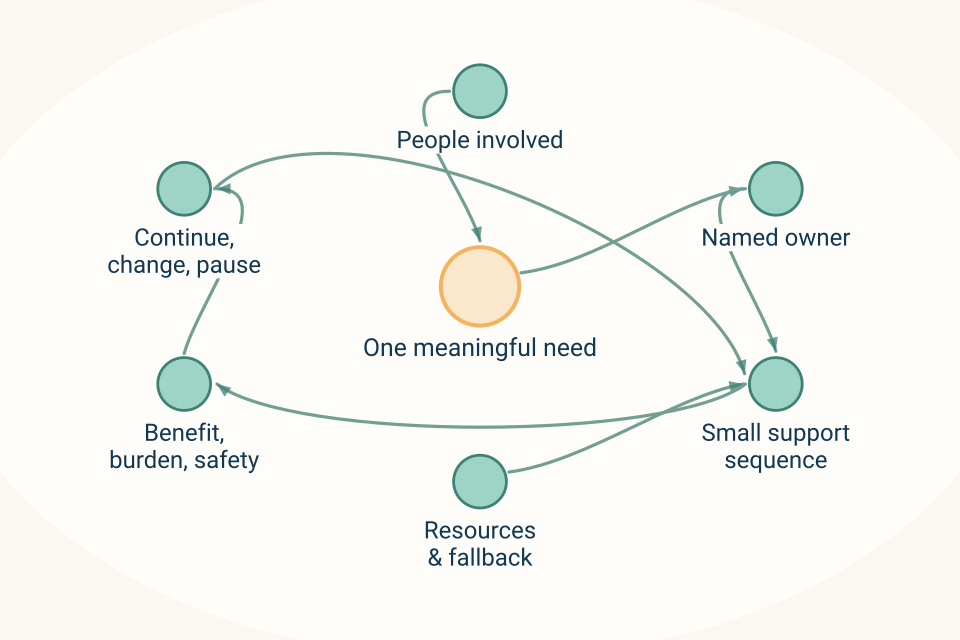
People who will live and deliver the support help define one meaningful need. The chosen need has a named owner and explicit responsibility. The owner prepares a small, complete support sequence. Resources and a fallback make the sequence deliverable when circumstances change. Try the sequence and examine benefit, burden and safety. The measures inform a decision to continue, change or pause. That decision changes the sequence or whether it proceeds. This is a testable project proposal, not a promise of benefit or an instruction to expand automatically.
Choose | Make it real |
One meaningful need | Understand the person’s purpose and the support they actually want. |
One workable arrangement | Provide the people, information, resources, response route, and backup. |
One responsible test | Define evidence, benefit, burden, safety, access, and who can revise the work. |
In context
In Context — “Start where we were”
Sam brought a one-page description to a conversation with Pat and Ellen.
Casey’s hospital team and a community partner were considering a small project. They wanted to make the first steps after returning home easier to understand and less dependent on a family finding every answer alone.
“Would you be willing to look at the idea?” Sam asked.
Pat put down his book.
“How many pages?”
“One.”
“That is an encouraging start.”
Ellen read the proposed purpose.
“This says support for families dealing with memory concerns.”
“Yes.”
“Do they already have to know what is happening?”
“No. The clinical questions would remain with the healthcare team. The community conversation would help people discuss everyday support.”
Ellen looked at Pat.
“That would have mattered to me. I wasn’t sure which questions had to wait.”
“And I wasn’t sure everyone understood they were still questions,” Pat said.
Sam asked what they would put first.
“Tell people who they can speak with,” Ellen replied. “And whether that person is actually expecting the call.”
Pat had another request.
“Start where we were. Not where we are now.”
The team would not ask a new family to begin with a diagnosis, a Day Center application, or a detailed plan for the coming year.
It would begin with uncertainty, a person’s own priorities, and a human connection worth making.
Begin with something complete enough to help
By this point, CarePhysics offers many possibilities.
A team could prepare educational tiles, organize a resource collection, arrange shared conversations, support family responsibilities, improve handoffs, introduce AI assistance, and build a learning process.
Trying all of them at once is not the only way to take the framework seriously.
Begin where the need is real, the responsibility can be named, and the result can be observed.
This final chapter focuses on one population, one meaningful need, a small set of content and communication patterns, available partners, practical response capacity, and a few measures. Expansion depends on usefulness and capacity—not enthusiasm alone.
A small project should still provide a complete piece of support.
Publishing a welcome tile is a content task. Helping someone understand an option, reach an appropriate person, and leave with an agreed next step is a pathway.
The distinction does not require sophisticated technology. It requires connecting the explanation to the help behind it.
Choose a beginning that can matter on an ordinary day.
Define the need before choosing the tool
For the worked example, the partners choose a specific situation:
Older adults returning home from one hospital service after cognitive concerns have been identified for further clinical assessment, with family or other chosen support people involved as appropriate.
The first project addresses the connection between the discharge conversation and an initial community-support conversation.
It does not diagnose dementia. It does not require a diagnosis before someone can ask about everyday support. It does not assume that a Day Center is the right destination.
Clinical follow-up continues through the responsible healthcare team. The community pathway helps people understand available support, discuss practical difficulties, and pursue an appropriate next step they choose.
Those two lines of work need to connect without becoming confused.
AHRQ’s IDEAL discharge-planning guidance supports including people and families as partners, discussing life at home and follow-up, using clear explanations, checking understanding, and listening to goals and concerns. It provides a foundation for the hospital portion—not a substitute for individualized clinical planning.15
Define the project’s starting and review points.
The beginning might be the hospital conversation in which community support is offered. The initial review might follow the completed support conversation and the next action agreed there.
An unresolved need does not disappear at the project’s reporting deadline. It retains a responsible person and an appropriate route onward.
Do not make having a nearby relative, smartphone, or comfortable use of English an unexamined condition of receiving support. Identify the assistance and alternatives required for the population the project intends to serve.
A focused scope is useful. Quietly selecting only the easiest people to help is something else.
Design with the people who will live and deliver it
Bring together the people who understand different parts of the proposed experience.
The person receiving care and their chosen supporters can explain what would make the offer useful. Clinical staff know which information and follow-up must remain under clinical authority. Community staff know their services, capacity, and access requirements. Frontline staff and volunteers can identify practical problems a planning document may miss.
Include people receiving care and chosen supporters alongside the relevant professionals and community teams. Connect the purpose with actual resources, communication, accessibility, training, and evaluation.
Not everyone needs to attend every meeting. Everyone whose responsibility changes needs an opportunity to examine the change.
Ask a few concrete questions.
What is difficult now? What already works? What does the family repeatedly explain? Where does a request wait without an owner? What can the receiving service actually provide?
Pat and Ellen’s contribution helps the fictional team ask better questions. It does not establish what every household will want.
Seek other perspectives, including people using different languages, people without family support, and those who have not found the existing route useful. Make participation accessible and account for the time and assistance it requires.
Then return the decisions to the contributors. Show which suggestion changed the design, which could not be adopted, and why.
Co-design should leave a trace in the project.
Choose the limiting condition before choosing the intervention
The people shaping the project have described the need. Now distinguish the result they want from the solution someone first suggested. If families want a useful response, producing another guide is only one possible action. It becomes the right choice when the problem actually concerns what the guide can address.
Use the Theory of Constraints questions from R2.5 to identify a suspected limiting condition, the evidence behind it, and at least one alternative explanation. A queue may reflect unavailable capacity, unclear ownership, incomplete inputs, unsuitable timing, or a decision still being considered. Do not turn a convenient dashboard signal into a verdict on a family or colleague.
Name who has authority to change the arrangement and which resources are required. Select a proportionate test, protect existing care and private information, and decide what observation would make the team reconsider its explanation. COM-B informs the barrier analysis; TOC helps focus the process-wide choice; PDSA supports learning from the test. Their combination remains our proposed design approach. See the constraint fields in Appendix D1. See Appendix F6.
Write the charter before promising the experience
The First Pathway Project Charter is a short agreement about the work the organizations intend to undertake.
It is not a promotional brief. It should be understandable to the people expected to deliver it and specific enough to expose an unfilled responsibility.
The example below is a proposed design, not a ready-to-launch clinical protocol.
Charter element | Worked example |
|---|---|
Human purpose | Help people returning home understand their next clinical and community contacts and reach a useful support conversation without carrying every coordination step themselves. |
Population and scope | One defined hospital service; cognitive concerns remain under clinical assessment. Family involvement follows the person’s preferences and appropriate authorization. The project does not replace discharge planning or treatment. |
Initial offer | A clear explanation, a verified contact, an accepted community introduction, an agreed conversation, and a reviewed account of the chosen next step. Digital, telephone, and paper routes are available as appropriate. |
Responsibilities | A named hospital lead owns the outgoing process; a named community lead owns accepted support requests. Clinical decisions remain with clinicians. Each role has coverage, and one project lead coordinates the test without inheriting every care task. |
Resources | Protected staff time, response capacity, interpretation and accessibility support, approved information-sharing arrangements, technical assistance where needed, and a funded route for reviewing unresolved needs. |
Timing and records | Defined enrollment and follow-up periods, response expectations agreed with services and participants, actual event dates, pathway versions, and a process for requests that remain unanswered. |
Learning | Baseline and measures of understanding, completed conversations, subsequent service receipt, family effort, staff workload, access, and safety. A named owner reviews findings with contributors. |
Decision rules | Continue, revise, narrow, pause, or expand according to usefulness, safety, workload, access, and available capacity. People already receiving support retain a clear plan if the test changes or ends. |
Before launch, replace role descriptions with names and confirm the arrangements behind each row.
For example, a proposed target of responding to a nonurgent community request within two working days must be checked against staffing and coverage before it appears in family information. That is an illustrative operational commitment—not a clinical standard or a reason to delay urgent care.
Agree who acts when the target cannot be met.
A promise is part of the workload.
Map the smallest useful sequence
A pathway can combine digital resources and human encounters. It does not have to begin in an application.
For this project, a compact sequence could look like this:
Point in the experience | What the person encounters | Responsibility and confirmation |
|---|---|---|
The need is discussed | A direct conversation about what matters, what is becoming difficult, and whether community support would be useful. | The hospital professional separates clinical questions from support questions and confirms whom the person wants involved. |
The offer becomes understandable | A brief explanation, available as a tile or printed page, with optional video, an article, and a way to ask a question. | The content owner verifies facts. The person can request a conversation without completing optional material. |
The introduction is accepted | A telephone introduction or another agreed contact route. A verified contact can be saved in a phone book or provided on a card. | The receiving service accepts a defined next action. Sending the request alone does not complete the handoff. |
A conversation happens | An agreed call, virtual meeting, or in-person encounter, with appropriate access assistance. | The receiving professional discusses the person’s priorities and practical options. Required clinical questions return to the clinical team. |
A chosen next step is supported | A reviewed summary stating what was agreed, what remains open, who acts, and when the person will hear again. | Each responsibility has an accepted owner. Any later service assessment, booking, or attendance is confirmed separately. |
The experience is reviewed | A brief, optional opportunity to say what helped, what was difficult, and what should change. | The project lead organizes review; the responsible professionals address individual needs. Useful changes return to the people who contributed. |
AHRQ’s referral guidance supports making the process easier to navigate and following up on what happens after a referral. It does not turn a transmitted request into a completed service.89
A Day Center introduction may follow the support conversation when it is wanted and appropriate. Its eligibility, capacity, costs, and required assessment remain separate questions.
Check each proposed destination’s eligibility and assessment requirements. A requirement of one Day Center must not become a condition for asking about broader community support. Appendix J identifies the dated program-specific example.
The initial pathway should remain useful even when the eventual answer is a different service—or no service at present.
Make the content answer today’s question
The first resource does not need to explain the entire care journey.
It needs to make the immediate offer understandable.
An illustrative introduction might read:
A conversation about support at home
Returning home can bring practical questions alongside the questions you are discussing with your healthcare team.
A community professional can help you explore available support and decide what would be useful to discuss next.
You do not need to know every question in advance. You might begin with: “I would like help with the arrangements, but I still want to make my own decisions.”
Your clinical questions remain with your healthcare team. This introduction is not a diagnosis or an agreement to enroll in another service.
You can ask us to help arrange contact, take the information to use yourself, or decline for now. We will explain who will respond, what information would be shared, and what happens next.
The organization adds its verified contacts, response arrangements, privacy explanation, and appropriate urgent-care route.
A short video can show the conversation: someone asks a question, the professional answers, and the person chooses how to proceed. Show one exception, such as the preferred appointment time being unavailable.
The article can provide more detail. A survey or interactive question can help prepare the conversation, provided someone is responsible for reading and responding. A message can confirm the actual arrangement.
Use the familiar pattern: why it matters, the main idea, a demonstration, a chosen next step, questions or connection, and what follows. It remains flexible; urgent information leads, and validated instruments retain their wording and scoring.
Ask about language, culture, beliefs, preferred involvement, format, and assistance. Do not assume that a shared address or demographic category means people want the same explanation.
Keep controls, action labels, and help routes familiar. Adapt the content and support without making every new item feel like an unfamiliar remote.
Bring the methods together around a life
In context
A retrospective teaching walkthrough of the established fictional family. This organizes questions and possible responsibilities; it adds no diagnosis, treatment, accepted family duty, or measured outcome to their story.
Pat’s wish to read, spend time with people, and remain part of decisions gives the project a human purpose. Ellen’s request for help with arrangements gives it another. We should be able to point to what changes for each person without requiring one person’s needs to be justified by the other’s.
CarePhysics keeps that wider life in view: relationships, language, beliefs, practical resources, enjoyment, and choice. The 4Ms provide a more specific older-adult care lens within it. They do not replace the financial, legal, social, or caregiver concerns around the plan.
Relevant 4Ms question | What it changes in this proposed plan |
|---|---|
What Matters | Begin with Pat’s stated wish to read, see people, and remain involved. Confirm the particular activity he wants now, the company he chooses, and whether he would rather rest. |
Medication | Bring relevant medication information and questions to the qualified clinician or pharmacist. Do not infer that a medicine caused a difficulty, add a treatment, or record a review as completed before it occurs. |
Mentation | Use the appropriate clinician’s assessment and distinguish it from Pat’s account, family observations, and Day Center observations. Choose an activity that does not test recall or turn enjoyment into a diagnostic signal. |
Mobility | Connect the chosen activity with current professional guidance on movement and the practical help required for access, travel, and arrival. A risk score is not the assistance itself. |
Ellen has a separate support pathway. A C4C-informed approach recognizes her needs, offers an appropriately private conversation, agrees assistance with an accepted owner, and returns to ask what changed. Any clinical assessment or psychotherapy requires the relevant professional. Only the information suitable and agreed for the shared plan travels into the family discussion.
Now map the experience. The existing transport episode distinguishes an unavailable vehicle from a missing update. One prevents the visit; the other prolongs uncertain waiting. Pat’s and Ellen’s accounts explain what each failure meant. TOC helps the partners decide which operational change they can test, while an honest update can remain worthwhile even before replacement capacity exists.
COM-B asks about the conditions for the chosen next action. Self-Determination Theory and respectful conversation keep the choice self-endorsed. Communication and learning design shape the invitation, demonstration, questions, and help route. A pathway makes timing, responsibility, confirmation, and alternatives explicit.
Technology can help carry agreed information. An approved assistant can prepare a source-labeled draft from authorized material; it must not receive Ellen’s confidential assessment just because it is preparing a family meeting. Sam, the clinical team, and Lena retain their distinct responsibilities. The grandchildren remain family members, not monitors.
Finally, examine the result at the level the evidence supports. Was the question answered? Was the journey made? Did the participant find the visit worthwhile? Did the caregiver receive usable support, and what work did the arrangement create? The extra-Tuesday request remains unresolved unless the responsible provider accepts a suitable arrangement. A local test informs the next decision; it does not validate the complete combination.
The methods do different jobs. The person’s life gives those jobs a common purpose.
For a first project, use only the elements the situation requires. The overview above is not a new combined intervention, and it does not create another form for every model. R1 explains the evidence; R2 explains the methods; the existing appendices help turn a chosen design into accountable work.
A single reviewed summary might therefore carry several principles without displaying their names.
Love is visible when someone listens without rushing the answer. Purpose appears in what the person wants the support to protect. Trust grows when a promised call happens. Contribution appears when a participant’s suggestion changes the design.
None requires another mandatory field.
Use AI to prepare a better first version
The team already has useful knowledge: relevant CarePhysics chapters, approved clinical and program guidance, verified local services, and experience contributed by the people doing and receiving care.
An approved assistant could help turn that material into a draft pathway and content set.
A practical assignment is:
Using these approved sources, prepare a first version of this pathway for the stated population and need. Identify the purpose of each encounter, the information required, the responsible person, and the confirmation needed. Draft the introductory article and demonstration outline. Preserve source limits, identify unavailable resources, and mark every assumption requiring review.
Generic design work does not require private patient records.
Keep research, design guidance, local facts, fictional demonstrations, and permissioned personal context separate. Record sources, owners, review dates, approved uses, and corrections. The proposed knowledge-bank workflow moves from relevant material through local context, drafting, human review, testing, and revision.
In context
In Context — The first draft asks too much
The assistant’s proposed pathway included a detailed questionnaire before the introductory call.
Sam reviewed it.
“We would be asking people to tell us most of the story before meeting the person who could help them.”
Casey pointed to information already available through the permitted discharge handoff.
“And some of these questions have already been answered.”
Lena found another problem.
“This draft treats a Day Center visit as the expected next step. It should be an option we discuss when it fits.”
The team shortened the preparation, removed duplicate questions, and restored the decision point.
The revised invitation asked what the person most wanted to discuss and whether assistance was needed for the conversation.
The first draft had helped reveal the work.
The reviewers made the offer appropriate.
With reliable knowledge, guidelines, rules, and accountable review, AI can be a gift: less repetitive assembly and more attention available for people. That value must include the effort of checking and correction.
WHO’s guidance supports defined tasks and stakeholder involvement while warning about inaccurate outputs, bias, privacy risks, and inappropriate delegation. A confident draft is not authority to make a care decision.1
For the first project, AI may remain entirely behind the scenes. A tested family-facing assistant could later explain approved routine information or help prepare questions at any hour. Actual human availability and urgent routes must remain explicit.
Optional live conversation assistance is another separate decision. Establish consent, accuracy, distraction, privacy, and reviewer requirements before introducing it. Do not bundle it into the project simply because drafting proved useful.
Uploading the book is not training a model, and successful drafting is not proof that every additional AI role is ready.
Rehearse the ordinary route—and the interruption
Before inviting people into the new process, walk through it.
Use a clearly fictional case and the actual staff roles, contact methods, materials, and permissions proposed for the service.
Can the receiving person find the request? Do they know what they are accepting? Can the family obtain the same essential support without using an app? Does someone know how to correct an inaccurate summary?
Then introduce an interruption.
The usual coordinator is absent. The person wants another language. A contact cannot be reached. A service has no capacity. A private concern has been placed in the wrong draft.
Do not create these errors in live care records as a staff test.
In context
In Context — “Who has it now?”
During the rehearsal, Casey sent the fictional request through the proposed route.
Sam was assigned to be unavailable.
The group waited.
“Who has it now?” Jordan asked.
The draft procedure named Sam’s role but did not identify the person covering it.
“That would send the work back to the family,” Casey said.
The community lead corrected the coverage arrangement and tested the route again.
The problem had been found before a person was left waiting for help.
Rehearsals and fictional branching scenarios can help staff prepare, but available materials are not evidence of readiness. Provide time, support, and appropriate competency checks for the actual role.
Provide protected practice time, appropriate supervision, and clear volunteer boundaries. The purpose is to improve the process and prepare people, not rank how much they care.
Start small enough to learn responsibly
A first test can be modest without being casual about care.
The Institute for Healthcare Improvement’s Plan–Do–Study–Act approach supports trying a change on a small scale, examining what happened, and refining it through repeated tests under different conditions. It is a learning method, not permission to bypass necessary approvals.56
After preparation and appropriate review, the team might begin with one willing person or household, then a small number the services can support. Include realistic variation as the test develops rather than restricting it indefinitely to the easiest circumstances.
Usual care continues. Optional project participation should not determine access to necessary services.
Before real-world testing, the responsible organizational review process should establish what approvals, consent, privacy protections, and evaluation oversight apply. Calling something a pilot does not settle those questions.
An illustrative enrollment period might last four weeks, with each participant followed through a defined first-month review. A decision about expansion would wait until the relevant follow-up was available. These are planning examples, not clinical deadlines or evidence-based guarantees about how quickly support should be resolved.
Clinical needs follow their own appropriate timing.
Unresolved support needs keep their owners after the evaluation window closes.
Decide what would count as useful
Establish the baseline before claiming improvement.
Where existing records can answer the question reliably, use them. Where they cannot, observe the current process with appropriate permissions rather than inventing a starting value.
Choose a few measures that can change a decision.
Understanding: Can the person identify the relevant clinical contact, community contact, and next step, with the materials and assistance they normally use?
Follow-through: Of requests due for an agreed community conversation during the review period, how many resulted in that conversation? Report all requests lacking an agreed date separately, so they do not disappear from the denominator.
Received support: What subsequent assistance was actually provided? Keep an introduction, assessment, booking, and service received separate.
Burden and safety: What did preparation, calls, travel, documentation, AI review, and corrections require? Were important concerns delayed, information shared inappropriately, or people excluded by the chosen route?
IHI distinguishes process, outcome, and balancing measures; balancing measures examine whether improvement in one part of the service creates difficulty elsewhere.75
Report how many people were eligible for the offer, received it, requested assistance, participated, and provided feedback. Identify withdrawals, later choices, unavailable services, and unknown outcomes without converting them all into “nonparticipation.”
A small test can reveal an unowned request or a confusing invitation. It cannot establish reduced hospital use, sustained caregiver relief, or cost savings merely because the first encounters went well.
The behavioral review distinguishes reach, understanding, first action, adoption, useful participation, outcomes, burden, equity, and safety. Willingness to recommend, an actual referral, and a referred person receiving support are also separate questions.
The records must support the measure. Verify return communication, evidence of learning, and the dates defining the pathway. Plan the human follow-through and appropriate records rather than assuming those facts will appear automatically.
Let people improve the project while it is small
After an encounter, offer a brief opportunity to say what helped, what remained unclear, and what should change.
Patients, participants, caregivers, clinicians, frontline staff, and volunteers may identify different improvements. Preserve those differences.
A person may prefer the call before the article. A staff member may discover that the response process duplicates existing work. A caregiver may notice that the summary leaves them responsible for contacting everyone else.
An approved assistant can help organize authorized feedback and prepare options. It should not infer agreement, decide which person is right, or turn feedback into a hidden performance score.
Record the suggestion, contributor’s preferred credit, decision, actual change, and later review. Share null, difficult, and burdensome findings alongside the encouraging ones.
Give findings authority to stop, narrow, or redesign the process. Record the decision and remeasurement in an accountable place, whether or not the product supplies that register.
Then return to the contributor.
“You raised this. Here is what we changed.”
That is where feedback becomes part of the care culture rather than another collection of answers.
Expand the support—not just the invitation
Before increasing enrollment, ask whether the process works beyond its most favorable conditions.
Can someone other than the original champion deliver it? Are sources maintained? Is coverage dependable? Have people using different routes been included? Can receiving services accept the additional work?
Continue when the offer is useful and the remaining questions can be examined safely.
Adapt when the need is real but the format, timing, ownership, or service arrangement is wrong.
Pause or narrow when errors, privacy problems, missed responses, or workload make the proposed process unacceptable. Preserve continuity for people already receiving care.
Expand only when the evidence is sufficient for the decision being made and the resources are available.
Those choices should be recorded, not treated as a judgment about the team’s enthusiasm.
A resource gap may require funding rather than more content. A missed response may require coverage rather than a more persuasive reminder. A lack of clinical follow-up cannot be repaired by labeling a community conversation complete.
Budget for the full work: preparation, interpretation, accessibility, staffing, supervision, review, technical support, measurement, and the handling of exceptions. Include what happens when initial funding ends.
Genus supplies technology. Partners retain responsibility for their care, staffing, programs, relationships, professional decisions, and voice.
Community and state groups can help fund capacity and share reviewed learning. They should not require every organization to adopt the same sequence or judge unlike populations by one completion rate.
Begin elsewhere when the need is elsewhere
The hospital-to-community example is one starting point, not the required CarePhysics project.
A rehabilitation team might begin with helping people use one professionally taught skill at home and obtain help when it is difficult.
A home-care organization might improve the first visit: who arrives, what assistance is agreed, what remains private, and how a change is communicated.
An independent-living community might begin with a request for support that currently passes between several people without clear acceptance.
A Day Center might improve its first-visit introduction or the reviewed account families receive afterward.
In each case, use the same discipline: a meaningful need, a workable offer, an accepted responsibility, accessible participation, and a way to learn.
The framework is shared. The starting point belongs to the people and organization using it.
Models and Evidence Behind This Chapter
This chapter combines the earlier principles into a proposed project. The charter, sequence, scripts, and test periods are design examples—not validated interventions.
IDEAL discharge planning
Begin with the person’s life after the encounter
AHRQ’s IDEAL approach includes people and families as partners, addresses practical life at home and follow-up, supports clear explanations and checks of understanding, and listens to goals and concerns. It informs the clinical-transition side of the proposed pathway.15
Evidence boundary: This is practice guidance. Copying its headings into a tile does not establish that the resulting service improves outcomes.
Local question: Does the person understand what follows, with appropriate support behind the explanation?
The Care Transitions Intervention
Study the whole support package
Eric Coleman and colleagues’ 2006 randomized trial included 750 community-dwelling adults aged 65 or older in a Colorado delivery system. The intervention combined communication tools, support for expressing preferences, and continuity from a transition coach.
Thirty-day rehospitalization was 8.3 percent with the intervention versus 11.9 percent with usual care; the adjusted comparison was statistically significant. Eligibility included English language, telephone access, and no documented dementia.57
Evidence boundary: The study tested a multicomponent intervention in a defined population, not this proposed pathway or an AI assistant. Its exclusions limit direct application to people with diagnosed dementia.
Local question: Which human services and practical arrangements make the pathway more than information delivery?
Structured caregiver support
An introduction is not the complete intervention
Gitlin and colleagues’ ADS Plus trial included 203 caregivers across 34 adult day-service sites, randomized by site to usual services or services with structured caregiver support. Trained staff provided education, validation, referrals, problem-solving, and self-care support over time.
Adjusted depression scores were lower in the added-support group at 12 months. The sample was predominantly female and college educated; 22.7 percent were lost to follow-up. The reported attendance difference did not meet the conventional statistical-significance threshold.44
Evidence boundary: A completed introduction does not deliver the sustained program studied here. The result should not be assigned to a brochure, occasional call, or technology feature.
Local question: What support is actually available after the first conversation?
Behavioral models
Match the response to the obstacle
The research review informing this book uses COM-B to examine capability, opportunity, and motivation; Self-Determination Theory to preserve chosen participation; and Social Physics to consider how people discover and work with knowledge through relationships.
Its judgments differ: strong conceptual support for COM-B, moderate intervention evidence for Self-Determination Theory, and emerging-to-moderate support for the broader Social Physics perspective. They are not a combined effectiveness grade for the proposed project.
The review’s first-use experiment—one immediately useful action rather than a feature tour—is explicitly a hypothesis to test.
Local question: Are we removing the barrier people described, or asking them to become more motivated?
Small-cycle improvement and responsible AI
Learn before making the arrangement standard
IHI’s Model for Improvement combines clear aims and measures with repeated Plan–Do–Study–Act tests. The approach supports learning under different conditions before making a change routine.55
WHO’s guidance adds defined AI tasks, stakeholder involvement, human responsibility, and assessment of errors and unintended consequences.1
Evidence boundary: These are methods and governance guidance, not guarantees of success. A satisfactory demonstration does not establish sustained effectiveness, and a small pilot cannot answer every outcome question.
Local question: What must we learn before more people are asked to rely on this arrangement?
One thing to try
Bring together one person who understands the need from experience, one person who provides the relevant care, and one person authorized to change the process.
Complete this statement:
For these people, at this particular moment, we believe this defined support will improve this meaningful result without creating unacceptable burden or risk. We will examine it using these measures, during this period, with this person responsible for the decision.
Then walk through the proposed experience, including one interruption.
Do not begin by asking which feature to add.
Ask:
What is the smallest complete piece of support we can make dependable?
The project should leave something with the family
In context
In Context — A place to begin
When Sam next spoke with Pat and Ellen, he brought back the revised description.
“The first project begins with a clearer offer and an accepted community conversation,” he said. “The teams are checking the response arrangements before they invite people.”
“And the medical questions?” Ellen asked.
“Stay with the healthcare team. The summary will make the different contacts clear.”
Pat read the page.
“This sounds less like joining something.”
“That was one of the changes your questions helped us make.”
“Good.”
Ellen looked at the final line about reviewing whether the support had been useful.
“Make sure somebody asks that.”
“They will need to,” Sam said. “And be able to change the plan because of the answer.”
The proposed project had not produced a result yet. It had a purpose, a first experience to test, and people responsible for what would happen next.
That is enough to begin—but not enough to declare success.
CarePhysics started with questions about understanding, relationships, practical help, and the knowledge people could share. It ends by asking us to put those questions to work in one place where they matter.
A clearer explanation. A completed introduction. A responsibility someone has accepted. A useful idea carried forward with credit. A service a person can actually receive.
From there, we can learn what deserves to grow.
The measure of the work remains outside the project plan: in the choices people regain, the support they can reach, and the ordinary time they can spend with one another.
Notes
World Health Organization (2024). WHO releases AI ethics and governance guidance for large multi-modal models. January 18. Source (opens a new tab)
Agency for Healthcare Research and Quality. Strategy 4: Care Transitions From Hospital to Home—IDEAL Discharge Planning. Guide to Patient and Family Engagement in Hospital Quality and Safety. Source (opens a new tab)
Gitlin LN, Roth DL, Marx KA, et al. (2024). Embedding Caregiver Support Within Adult Day Services: Outcomes of a Multisite Trial. The Gerontologist. 64(4):gnad107. DOI: 10.1093/geront/gnad107. Source (opens a new tab)
Institute for Healthcare Improvement. Model for Improvement. Improvement guidance developed by Associates in Process Improvement. Source (opens a new tab)
Institute for Healthcare Improvement. Model for Improvement: Testing Changes. Plan–Do–Study–Act guidance. Source (opens a new tab)
Coleman EA, Parry C, Chalmers S, Min SJ (2006). The care transitions intervention: results of a randomized controlled trial. Archives of Internal Medicine. 166(17):1822–1828. DOI: 10.1001/archinte.166.17.1822. Source (opens a new tab)
Institute for Healthcare Improvement. Model for Improvement: Establishing Measures. Guidance on outcome, process, and balancing measures. Source (opens a new tab)
Agency for Healthcare Research and Quality (2024). Make Referrals Easy: Tool 21. Health Literacy Universal Precautions Toolkit, 3rd edition. Source (opens a new tab)
Institute for Healthcare Improvement (2021). Berwick Looks Back: IHI Ideas and Innovations. Interview with Donald M. Berwick. October 14. Source (opens a new tab)