Epilogue — More Room to Be a Family
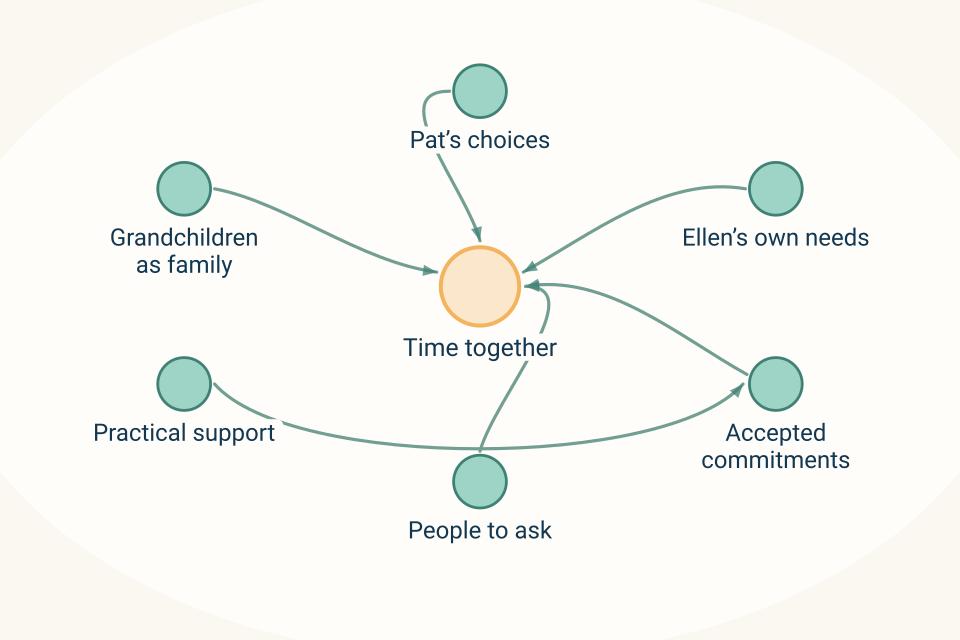
In the fictional family story, Pat’s choices shape their time together. Ellen’s own needs belong alongside the shared family time. Accepted commitments are part of the arrangements that make room for ordinary time. Knowing people to ask means every question need not start by reconstructing whom to contact. Practical staffing, preparation and services make accepted commitments workable. The grandchildren share enjoyment as family rather than taking responsibility for a care plan. The fictional ending retains uncertainty and service limits; it is not evidence of an intervention’s outcomes.
In context
In Context — Shall we start?
Emma had two stories ready on the television.
“The harbor or the railway?” she asked.
“The harbor,” Pat said.
Noah settled beside him.
“Does anything happen in it?”
“We could read it and find out.”
Daniel had helped open the story and check that the words were comfortable to see. Now he was bringing tea from the kitchen. There was no care record on the screen, no set of questions the children needed to complete.
Ellen came into the room carrying the reading guide.
“Do we need this?” she asked.
“Only if we get stuck,” Emma said.
“Then put it somewhere we can find it,” Pat replied. “Not on top of the biscuits.”
Ellen placed it on the side table.
Pat read the first paragraph. Then he asked Emma to continue.
The illustration showed a small boat, a crowded quay, and a dog looking toward something beyond the edge of the picture.
“That dog knows something,” Pat said.
“What?” Noah asked.
“We haven’t reached that part.”
They stayed with the picture for a moment.
Ellen sat down beside her husband.
What has changed—and what has not
Pat was still living with dementia. The family still had questions. There were appointments to attend, choices to discuss, and days that did not go as planned.
Ellen still sometimes wondered whether she had missed something important. Maya and Daniel could not take on everything. The services around the family had limits, and not every request had become an arrangement they could rely on.
This was not an ending in which uncertainty disappeared.
But Ellen no longer had to begin every question by working out whom she might ask. There were people whose roles she understood, conversations in which she could raise her own concerns, and parts of the week supported by commitments others had accepted.
She had used some of that time for a friend. She had begun explaining what help needed to include, rather than apologizing for needing it.
Pat had found people at the Day Center he wanted to talk with. He could enjoy the reading group and ask for a different afternoon. His preferences could change an arrangement, not merely be recorded beside it.
Maya had learned that helping from a distance could mean accepting a particular responsibility, with its limits made clear. Daniel had begun making offers that included arranging and finishing the work, not waiting for Ellen to direct every step.
Emma and Noah had stories to share with their grandfather. They did not have a care plan to manage.
These changes did not restore an earlier version of the family’s life. They made more of the present life available to them.
The work behind an ordinary evening
The people whose work helped make this evening possible were not all in the room.
Casey had listened when the hospital conversation widened beyond the fall. Clinicians had assessed questions that belonged with them. Sam had helped the family hear different perspectives and turn some concerns into agreed next steps.
Lena and the Day Center team had asked what Pat enjoyed, offered appropriate choices, and listened when part of the day did not suit him. Partner organizations had been asked to account for a failed arrangement rather than leave Ellen to reconstruct it alone.
None of those contributions was sufficient by itself.
Nor could a thoughtful conversation replace a service that was unavailable. The work included staffing, practical arrangements, preparation, and people accepting responsibility for what came next.
That is part of what this book asks organizations to protect. A good explanation deserves a working service behind it. A staff member asked to listen needs time to hear the answer. An invitation to ask for help needs someone able to respond.
For a leader, the useful question is not only whether the new process has launched. It is what people can now do, understand, or set down because of it.
Could a family make one fewer unnecessary call? Could a professional arrive better prepared? Could a participant change an activity without being described as difficult? Could a caregiver use the time the service was intended to provide?
Those are things to examine with the people involved. An encouraging story gives us a reason to ask; it does not supply the result.
What our knowledge is for
Losing both of my parents to dementia is part of why I began this work. I cannot know how different information or support would have changed our experience. I do know that the questions it left with me became part of the purpose of Genus and CarePhysics.
As I met other families and the people working beside them, the question became larger than my own experience. How could more of what people knew become available while someone could still use it—to understand a choice, ask for help, share a responsibility, or protect a relationship under strain?
I have been humbled by the people willing to bring their experience into that conversation. Their insight belongs beside the research, with its source and limits respected. A professional’s practical judgment, a participant’s preference, and a study finding contribute different things. We lose something important when we treat one as a substitute for all the others.
CarePhysics brings those kinds of knowledge into a common discussion. Its ten principles are an evidence-informed way to examine care, not literal laws or proof that a particular product works. The framework asks what matters, what gets in the way, what support is available, and how we will learn whether our response helped.
That is also why this book was written as something to work with, not simply something to finish.
A team can return to a chapter when preparing a conversation, revising an article, developing training, or reconsidering a handoff. Its own reviewed guidance, services, culture, and experience belong in that work. The purpose is to give the next person a better starting point, not prescribe an identical answer everywhere.
Use assistance to make room for people
AI gives us another way to work with that knowledge.
Properly applied, it can be a gift to an organization: assistance with finding relevant guidance, organizing questions, preparing a draft, or carrying a useful explanation into another format. We should give it defined tasks, appropriate sources, clear rules, and responsible reviewers—and test whether the work becomes better or easier rather than assuming it does.
A useful idea can come from anyone involved in care. The assistant may help capture it, but the contribution still belongs to the person who made it. The organization remains responsible for deciding what to try and returning to find out what happened.
A family could also use an approved assistant to revisit routine information or prepare a question when the thought occurs, rather than only during office hours. Human availability must remain clear, and getting to a person must remain a real option.
The opportunity is not to keep families talking to technology for longer. It is to help them understand what they need, reach appropriate support, and spend less of their lives assembling the same information again.
We should be willing to discover that the best use of the assistant was brief. It prepared a question. A person answered. The family went on with its day.
The next family will be different
Pat and Ellen’s household is one way to make the principles visible. It is not a template for everyone else.
Another person may live alone. Their trusted support may be a friend or neighbor rather than an adult child. Someone may be caring for a younger relative, returning from rehabilitation, or arranging assistance in an independent-living community.
The language, beliefs, routines, resources, and care needs will differ. So may the meaning of privacy, the people someone wants included, and the kinds of contribution they enjoy.
The question is not how closely those lives resemble this story.
It is whether the organization is prepared to ask, listen, and adapt.
A health system can begin with an explanation people need after an encounter. A care organization can begin with a first visit. A Day Center can begin with a welcome or a useful account of the day. A community or state group can begin where families repeatedly encounter a gap that no one organization can close alone.
Keep the important questions recognizable: What matters here? What is known? What remains uncertain? Who has accepted the next action? What help is actually available? How will we find out whether it was useful?
The answers must come from the setting and the people, not from the expectation that every pathway should look the same.
Carry the learning forward
The next person should not have to rediscover every useful lesson.
Share the explanation that helped, with its context. Credit the participant who suggested a better choice. Preserve the staff member’s practical insight. Report the change that created more work as honestly as the one worth keeping.
Protect the private story while making the lesson available.
And return to those who contributed. Let them know what was considered, what changed, and what still needs attention. That is a more meaningful response than thanking people for feedback that never influences anything.
We welcome what you discover—including where this book needs a clearer explanation, a different example, or stronger evidence. The work should remain open to correction by the people who use it.
There is no need to begin everywhere. Begin with one responsibility you can make clearer, one encounter worth improving, or one piece of support you can make dependable. Let the people involved help judge the result.
Then carry forward what is useful.
The page can wait
In context
In Context — One more page
On the television, the little boat had reached the other side of the harbor.
Noah wanted to know where it would go next.
“Out to sea,” Emma said.
“Or back for something they forgot,” Pat replied.
“What did they forget?”
“I expect we’ll find out.”
Emma reached for the next page, but Pat pointed to the dog again.
“Wait a moment.”
She waited.
He made a comment about the picture. Noah offered a different explanation. They talked about which of them was more likely to be right, and Daniel joined in from his chair.
Ellen laughed.
There was still a calendar in the other room. Some questions would need another conversation. The people supporting the family would need to keep listening and adapting; an evening like this did not mean their work was finished.
But none of those questions needed to be answered in this moment.
Ellen was not preparing an update or finding someone to call. She was listening to her husband and their grandchildren argue about a dog in a picture.
Emma looked at Pat.
“Shall I go on?”
“Yes,” he said. “I want to see where they end up.”
She turned the page.
They had not removed every uncertainty. They had people to turn to, responsibilities they could discuss, and support that made room for something beyond the next arrangement.
Tonight, they were using that room to be together.
More Room to Be a Family.