R3
R3 — Culture, Beliefs, and Care — Understand the Person, Not Just the Background
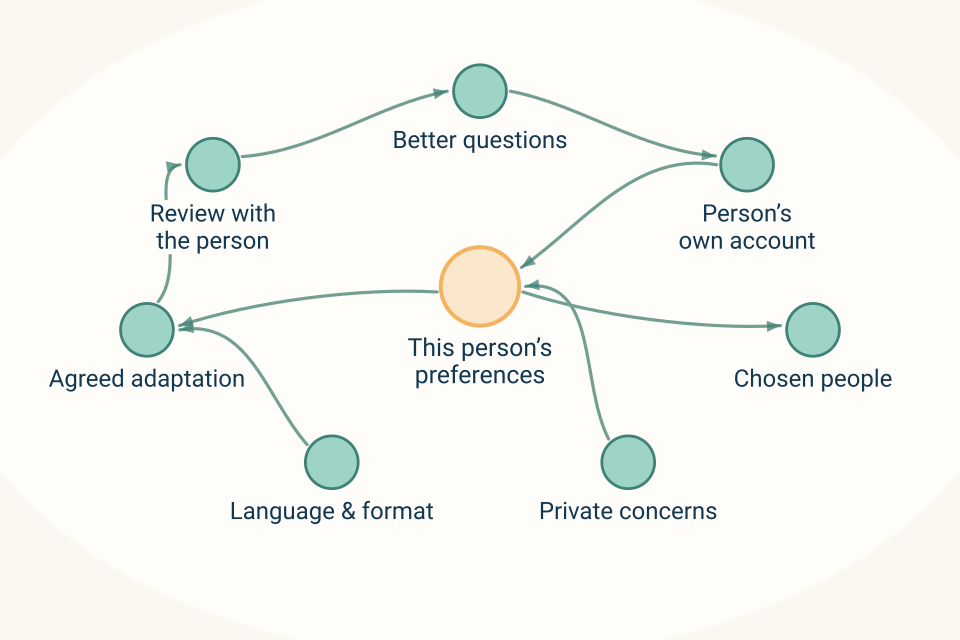
Better questions invite the person’s own account rather than substitute a cultural assumption. The person’s account establishes which preferences matter here. Ask whom the person wants involved in the conversation. Respect private concerns and the boundaries around sharing them. Language and format preferences inform a usable adaptation. The person’s expressed preferences change the agreed offer. Review the fit of the adaptation with the person. What is learned helps the next question become more useful. Cultural knowledge helps form a question; it does not establish someone’s beliefs or replace their answer.
At a Glance
The central idea: Cultural knowledge can help us ask a better question. The person supplies the answer—and the answer should change the support.
What you’ll explore: How beliefs, relationships, life experience, language, and practical circumstances shape what care means to someone. Examine family involvement, privacy, faith and secular values, everyday routines, trust, and meaningful participation without treating a cultural background as a set of instructions.
Design and AI: Adapt explanations, videos, questions, messages, and pathways to preferences people actually express. Use approved AI assistance to prepare options and preserve useful knowledge—not infer beliefs, interpret silence as agreement, or replace professional judgment.
Put it to work: Create a Conversation and Adaptation Guide that connects what someone wants understood with an agreed action, a responsible person, appropriate sharing, and review.
Evidence and evaluation: Distinguish cultural-humility principles, professional guidance, and intervention research. Evaluate whether people receive respectful, workable support—not how many cultural details an organization collects.
“Cultural humility incorporates a lifelong commitment to self-evaluation and self-critique…”
— Melanie Tervalon and Jann Murray-García, “Cultural Humility Versus Cultural Competence,” 1998.117
In context
In Context — “Which part would you change?”
The reference scenes in this chapter are fictional teaching examples. They do not continue Pat and Ellen’s chronology or assign new beliefs to the established family.
Lena and Sam are reviewing an invitation with people helping them examine a proposed community-support pathway.
The draft says: “Bring your family so we can plan together.”
“That would suit me,” Ruth says. “I would like my daughter there. Perhaps someone from my faith community too.”
Ben reads the sentence again.
“I’d like to speak with you first. Then decide what I want to tell everyone.”
“Would you prefer a different explanation?” Sam asks.
“Not necessarily. A different arrangement.”
Elena has another question.
“Can the conversation happen after work? The invitation makes sense. The time doesn’t.”
Lena draws a line beneath the proposed instruction.
They do not need three assumptions about three backgrounds.
They need an invitation that allows three people to explain what would work—and a service able to respond.
R3.1 — Culture Is Part of the Person’s Story, Not the Whole Story
Learn enough to ask, not enough to assume
Communication, language, health beliefs, food, religious practices, and preferred involvement can all matter. Begin with the individual’s account rather than a country-based or cultural profile.
Cultural knowledge can help us ask a better question. It cannot answer on someone else’s behalf.
Culture includes customs, meanings, values, and ways of relating. It is not confined to ethnicity or religion. AHRQ’s guidance recognizes multiple influences, including age, occupation, language, family composition, and identity, and recommends learning from the individual rather than assuming preferences from group membership.13
For care design, ask what matters here, now, and for this decision. A family tradition may be central to one person and unimportant to another. Someone may welcome help with a practical task while wanting a different degree of privacy around health information.
A group’s history or a well-reviewed cultural resource can prepare a respectful inquiry. It should not produce a standing instruction that everyone from that group wants indirect explanations, family-led decisions, a particular activity, or a particular kind of clinician.
The revised writing guidance is explicit: do not infer religion, family structure, literacy, technology comfort, or decision preferences from race, age, language, disability, or neighborhood. Ask how this person wants care organized.
The organization brings a culture too
A clinic may prize a concise explanation. A family may need space to tell the story before the explanation feels relevant. A program may treat its timetable as fixed while asking participants to describe what matters to them.
Examine those institutional habits alongside individual preferences. Kleinman and Benson’s clinical essay argues that culture belongs to professionals and institutions as well as patients, and that a focus on presumed cultural traits can obscure practical difficulties.118
This is not a reason to abandon professional standards. It is a reason to ask which routines protect care and which merely reflect how the organization has always worked.
A useful staff question is: “Whose assumptions made this the default?”
Cultural humility adds a continuing willingness to examine one’s own assumptions, address unequal power, and develop partnerships rather than claim mastery of another person’s culture. Tervalon and Murray-García proposed it as an educational orientation, not a checklist that confers permanent competence.117
R3.2 — Beliefs About Illness, Help, and Hope
Begin with the meaning of the concern
Before offering an explanation, find out what the person is trying to understand.
You might ask: “How have you been making sense of these changes?” or “What concerns you most about the help being suggested?”
These are proposed conversation starters, not a diagnostic interview. They can reveal a question about the condition, the service, the future, or what accepting assistance would mean.
Kleinman and Benson’s explanatory-model approach similarly seeks the person’s account of illness and what is at stake. Their purpose is to open communication, not turn the answer into another fixed classification.118
Keep belief and clinical assessment distinguishable. Someone’s understanding deserves a hearing; it does not establish the medical cause of symptoms. When a clinical explanation is needed, the appropriate professional supplies it and checks understanding.
A respectful account can say, “The person is concerned that…” without converting the concern into a diagnosis or dismissing it as irrational.
Make room for faith, spirituality, and secular purpose
Invite the topic without prescribing its importance: “Are there beliefs, practices, or sources of strength you would like us to take into account?”
The answer may concern prayer, a trusted community, being present for family, independence, art, nature, friendship, or something not on the form. A person can also choose not to discuss it.
When spiritual support is requested, clarify what kind and from whom. Ask before arranging contact or sharing information. Do not assume a generic religious message represents the person’s own tradition or that a faith community is the appropriate place for a private concern.
A secular option should be equally usable. Someone should not have to participate in religious content to obtain ordinary service information.
The practical goal is to learn what support should protect. It may be time for a valued practice, a familiar meal, an important relationship, or a conversation about fear. Record the relevant adjustment rather than collecting an unnecessary biography. The book’s person-and-family profile already includes meaningful roles, routines, concerns, and communication preferences.
Do not confuse love with unlimited capacity
A caregiver may describe receiving help as a difficult personal decision. Explore that meaning without telling them that their culture explains it.
They may also be facing cost, unavailable transport, exhaustion, or an earlier poor experience. The research review informing this book treats these as different possible barriers requiring different responses.
An invitation such as “What would support need to include for it to be useful?” leaves more room than “Your family needs to become comfortable asking for help.”
Love can be expressed through providing care, accepting assistance, setting a limit, or protecting time together. The proposed design should make those possibilities discussable—not make sacrifice the test of devotion.
R3.3 — Family, Independence, Privacy, and Decisions
Ask who belongs in this conversation
Start with the person receiving care. Who would they like involved, in what role, and with access to which information?
A daughter, partner, friend, neighbor, or another chosen supporter may help prepare questions or consider options. An emergency contact is not automatically the person authorized for every decision or disclosure.
AHRQ recommends confirming the person’s wishes about companion involvement, speaking directly to the patient, preventing a companion from taking over the discussion, and preserving private time. These are practice recommendations, not a requirement that everyone attend with someone.119
Interdependence can be chosen. So can an individual conversation. Do not describe one as “over-involvement” and the other as a lack of support.
Make the scope explicit: joining one meeting does not authorize access to every future note. Being invited to help does not establish availability. As Chapter 11 showed, family responsibilities need acceptance and realistic limits.
When someone says, “Please don’t tell them”
A relative may want to protect someone from distress. Take that concern seriously without quietly making the relative the sole authority over what the person receives.
Ask what they fear, involve the responsible clinician, and establish the person’s own information preferences through the appropriate process. The AMA’s ethics guidance distinguishes sensitive, paced disclosure from withholding information without the patient’s knowledge or consent. It also recognizes a patient’s genuine wish not to receive certain information or to designate another recipient.120
This is not a task for an AI assistant to settle. Questions about decision-making ability, representation, and legal authority require the relevant professional assessment and applicable local procedures.
The book’s practical boundary is straightforward: do not let a diagnosis, a group label, or the most confident relative substitute for that work.
Protect the caregiver’s separate voice
Ellen’s needs in the main story matter alongside Pat’s. That does not mean every private concern belongs in a joint summary. Preserve who said what and what may be shared.
Offer a confidential route appropriate to the service and explain its limits. Do not promise secrecy the organization cannot provide, or place a sensitive response in a shared field and rely on discretion later.
Keep children in their family role. They can enjoy stories, celebrations, and ordinary time together; they are not responsible for interpreting consequential conversations, monitoring symptoms, or managing adult disagreements.
R3.4 — Communication and Trust
Separate language, format, and understanding
Ask separately about the language someone prefers for speaking and reading. Confirm the particular language or variety needed rather than assuming a broad label is sufficient. Ask about accessible formats and assistance as well.
Interpretation works with spoken or signed communication; translation works with written material. AHRQ recommends qualified language assistance and cautions against substituting untrained staff, family members, or children. Assessing language proficiency and interpreting competence are not the same task.14
Plan the service before the encounter. Explain the interpreter’s role, address the person directly, allow time for the exchange, and check whether the arrangement supports private questions. The family can remain family rather than carry responsibility for accurately relaying medical information.
Include language access in scheduling, written instructions, technical support, billing questions, and follow-up—not just the clinical room. Provide a fallback when the planned interpreter or connection is unavailable. These are service-design responsibilities, not a request that the person bring their own solution.121
A translated article is not proof of comprehension. A captioned video may still need a clearer explanation. Ask the person to use the information with their normal assistance, not perform a memory test.
Ask about style without assigning a personality
Offer a choice of depth and pace: a brief explanation first, fuller detail, a demonstration, or time for questions.
Do not infer agreement from a nod, a quiet answer, or the absence of an objection. In the proposed interaction, check directly: “What would you like us to clarify or approach differently?”
AHRQ recommends open-ended questions, attentive listening, and responsive explanations. Its cultural guidance also cautions that expectations around eye contact and touch can differ. Neither guidance makes one visible behavior a dependable indicator of what someone believes.6
The unfamiliar-remote analogy applies here. Someone can understand the purpose while needing help with unfamiliar controls. Keep action names and help routes recognizable; adapt the explanation without treating technical difficulty as a personal deficiency.
Earn trust through the response
Offer room to discuss a previous difficult experience without requiring a detailed account of trauma or discrimination before improving the service.
In a hypothetical home-care introduction, “I don’t like people coming into my home” may lead to useful questions about identification, advance notice, privacy, and exactly what the visit involves. It need not trigger a cultural explanation.
Show the agreed response: introduce the worker, explain the task, ask before entering a private area, and identify who handles a concern. Trust is something to examine through experience, not a label an organization gives itself.
When the organization gets something wrong, correct the arrangement as well as the wording. “That note does not reflect what you agreed to; we will correct it and tell the relevant people” is a practical commitment.
R3.5 — Everyday Dignity and Meaningful Participation
Let preferences shape an ordinary day
Care does not become responsive only during a major decision. Ask how the person wants to be addressed, what assistance they welcome, and which routines help the day feel like theirs.
The following are proposed topics—not a checklist to complete at every encounter or assumptions about any group.
Topic to explore | What the answer might change |
|---|---|
Meals and food practices | Ingredients, preparation, meal timing, or a discussion with the food-service and clinical team. Keep allergies and clinically required precautions distinct from preferences. |
Faith, reflection, or secular routines | A requested quiet space, timing consideration, or chosen support contact; participation remains optional. |
Privacy, clothing, touch, and assistance | How staff explain a task, seek agreement, protect privacy, or explore a requested staffing arrangement. |
Music, stories, language, and celebrations | The available content and invitations, including unfamiliar material someone wants to explore and activities they prefer to avoid. |
Rest and sensory comfort | Pacing, quieter alternatives, lighting or sound adjustments, and appropriate assistance. |
Contribution and enjoyment | An optional role, a chance to teach or share an idea, or permission simply to listen and enjoy the day. |
For every requested adjustment, check what the service can actually provide. An invitation to choose is incomplete if nobody can explain the available choices.
The dated Day Center materials offer relevant design examples: asking about present as well as past interests, supporting different ways to participate, and allowing a person to change their mind. They do not establish that every center provides identical options.
In context
In Context — A quiet place, not a new label
This is a fictional Day Center example separate from the continuing family.
Nora asks whether there is somewhere quiet she can use for prayer after lunch.
Lena asks what she needs from the arrangement and checks which space is available, including whether assistance is required to reach it.
“Would you like anyone to join you?” she asks.
“No. Just some quiet.”
The working note records the agreed time and place for the people arranging it. It does not announce Nora’s beliefs in the family newsletter or assign her to lead a religious activity.
Later, the team asks whether the arrangement worked.
Respect is visible in what was provided and what was left private.
Belonging does not require a performance
Do not ask one participant to represent a religion, nationality, or generation for the room. Invite a contribution because the person wants to make it, with appropriate permission for any further use.
Someone may enjoy discussing a tradition without wanting to teach it. Someone else may welcome an opportunity to introduce a song or story. Both can help shape the program.
Offer adult material, real choices, and room for novelty. Familiarity is an option, not a requirement to live inside a past identity. Rest and enjoyment do not need a productivity score.
R3.6 — When Preferences Meet Constraints or Disagreement
Find out which problem needs a response
A requested adjustment may conflict with another preference, clinical advice, the rights of others, or the service’s resources. Begin by clarifying the request and the reason, without demanding a personal disclosure unnecessary to resolve it.
Then separate what can change now, what needs professional review, and what is not currently available. Name who will investigate the next option and when the person will hear.
For example, a requested caregiver arrangement may require scheduling review. A meal practice that affects a prescribed treatment belongs in a conversation with the relevant clinician. A timing difficulty may require a different service, not a revised explanation.
The behavioral review’s barrier-first approach applies: information, opportunity, family circumstances, and motivation can require different responses.
A limit should be specific. “We cannot provide that assistance on this visit; the coordinator will discuss the available alternatives with you” is more useful than “That is against our culture.”
Do not promise that every request can be met. Do not conceal an unmet need by recording that the person declined an unsuitable offer.
Respect does not mean agreeing that every claim is true
Listen when someone describes a remedy, practice, or explanation important to them. The appropriate clinician or pharmacist can review relevant safety questions; an AI assistant should not endorse an unverified treatment to appear culturally sensitive.
In disagreement, preserve the person’s question and explain the professional concern plainly. Provide appropriate language assistance and a route for further discussion or review.
Nor should “respecting culture” require staff to accept harassment or erase the rights of other participants. Distinguish a care-related need from discriminatory treatment, involve the responsible manager or professional, and follow the applicable policy. Do not leave a frontline worker to settle the issue alone.
Address the resource gap
If a person cannot reach a service because of transport, cost, working hours, language access, or staffing, record that obstacle accurately.
Relationships may help locate alternatives. They cannot replace unavailable support. A sent referral is not a completed handoff, and a list of resources is not proof that any of them can meet the need.
Community and state groups can help examine recurring gaps. Share appropriately governed evidence about unmet needs—not assumptions that one community is less willing to engage.
R3.7 — Adapting the Same Engagement for Different People
One purpose, different ways to begin
Return to the three people reviewing the opening invitation. Their shared task is deciding whether to explore a community-support service. They have expressed different preferences and circumstances; their names are not evidence of any cultural identity.
In context
In Context — Ruth wants chosen people involved
Ruth would like her daughter at the first conversation and wants to ask a trusted faith-community contact to join.
The coordinator confirms who Ruth wants involved, what each person may receive, and whether the participants are available. Ruth receives the same service facts as anyone else, with an invitation that acknowledges her chosen support network.
The faith contact does not replace the program professional or speak for Ruth automatically. No invitation is sent before the necessary agreement.
In context
In Context — Ben wants a private beginning
Ben is active in the same local community network, but wants the first conversation alone and asks for information without religious framing.
The coordinator arranges the private route and asks whether Ben would prefer to read first or discuss the main points. Ben can involve other people later without having to justify why he did not start that way.
The content has not become less caring because it uses a different expression of support.
In context
In Context — Elena needs the offer to fit the week
Elena’s concern is practical: she cannot answer service calls while working and wants a time she can use with her chosen supporter. They also need to understand the transport arrangements before planning a visit.
The coordinator checks available call times and the actual transport process. If no workable arrangement exists, the need stays open while an appropriate alternative is explored.
A warmer reminder would not solve it.
Change the right part of the experience
These proposed adaptations use different formats for different jobs:
The video can demonstrate how to ask a question, include a supporter, or request a private conversation. Use appropriately consented or clearly labeled demonstration footage. Do not imply that the people shown represent a whole culture.
The article preserves the service facts, conditions, costs, and response route. It can offer a brief introduction with further detail available, in reviewed formats and languages.
The survey or interactive question asks what would make the next encounter workable. Include options to skip, respond privately, or speak with someone. Explain who receives the answer and what it can change.
The message reflects the arrangement actually made: the participants, timing, contact method, and any unresolved question. It should not imply confirmation merely because a request was submitted.
The pathway connects these materials with a saved contact, telephone call, virtual meeting, visit, or another planned encounter. A tile may contain the related video, article, survey, and interactive elements; a human response makes the connection useful.
The familiar CarePhysics pattern remains: why it matters → main idea → demonstration → chosen next step → questions or connection → what follows. Adapt the content without moving help or changing action labels unnecessarily. Urgency comes first; validated instruments retain their required wording and scoring.
AHRQ recommends evaluating materials for understandability and actionability with the intended audience. An attractive translation or representative photograph does not establish that a service is usable.26
R3.8 — A Conversation and Adaptation Guide
Ask only what can help the care
The practical output is a Conversation and Adaptation Guide, not a cultural assessment or score.
Use a few relevant questions, spread across encounters when appropriate. Explain why you are asking and allow the person to decline details they do not want to share.
What would help us approach this in a way that feels right to you?
Who would you like involved, and is anything better discussed privately?
Are there practices, routines, or sources of strength you want us to consider?
What language, format, timing, or assistance would help?
What would make this arrangement difficult to use?
These are original practice prompts to test, not a validated instrument. They should lead somewhere.
Working record | What to capture |
|---|---|
The person’s account | Their expressed preference or concern, with its source and date; separate family and professional accounts. |
Requested adjustment | The specific change in communication, environment, involvement, timing, or support. |
Permission | What may be recorded or shared, with whom, and for this purpose. Avoid unnecessary identity details. |
Feasibility and review | What is confirmed, what needs professional assessment, and what cannot yet be supplied. |
Responsibility | Who has accepted the next action, the response expectation, and the backup route. |
Review | Whether the arrangement helped, what changed, and when to ask again. |
Let the person correct the account. Retain “not discussed” and “prefer not to answer” rather than replacing either with a guess.
A preference may change. Review it when the situation changes or the person asks—not only when the form expires. Relevant staff need the current practical instruction; they do not necessarily need the private story behind it.
Give AI a useful, bounded task
An approved assistant could help organize expressed preferences, prepare alternative wording, retrieve local resources, or turn a reviewed staff explanation into a draft article or training example.
A suitable assignment might be:
Use these approved sources and the preferences the person has explicitly shared for this task. Prepare options for the introduction and next contact. Keep service facts, clinical guidance, and uncertainty unchanged. Identify the reviewer and any missing resource. Do not infer religion, family roles, literacy, or decision preferences from identity, appearance, voice, or location.
Suppose a draft says, “Ben does not value family involvement.” A reviewer should reject it. What is known is that Ben requested the first conversation privately. Preserve that narrower meaning.
Work from research → relevant design guidance → verified local facts → permissioned personal context, keeping those sources distinguishable. Then retrieve, prepare options, review with responsible people, test, and revise. Retain source owners, review dates, approved uses, and corrections. Uploading this book is not model training or evidence that an assistant will follow it reliably.
AI may help draft language adaptations, but generated translation should not automatically replace qualified interpretation or reviewed material in consequential care. Clinical meaning and instrument validity need appropriate review.
With suitable knowledge and rules, the assistance can be a gift: less repetitive preparation and more individualized support. Measure the work after review and correction, not only the speed of generation.
A configured assistant might offer approved routine explanations or question preparation at any hour. Make human response times explicit and provide a direct route to a person, with separate urgent guidance. It is not continuous professional care.
Optional live assistance or immediate feedback can help surface a question while it can still be addressed. Obtain appropriate agreement, allow pausing or declining, and keep private feedback separate. Do not turn tone, eye contact, accent, or silence into cultural or emotional scores.
WHO identifies risks from inaccurate or biased outputs and overreliance, and calls for defined tasks and stakeholder involvement. AI should support fair facilitation, not be presented as an inherently neutral judge of a family disagreement.1
Support the people expected to adapt
Responsiveness requires organizational resources: language services, accessible materials, preparation time, appropriate staffing, supervision, and someone authorized to resolve unmet needs.
The National CLAS Standards place leadership, resource allocation, workforce preparation, communication assistance, community partnership, and evaluation within the same organizational framework. They are practice standards, not proof that a particular implementation improves outcomes.121
Give staff and volunteers realistic practice using fictional situations. Do not ask a colleague to represent an entire community or interpret consequential information merely because they speak another language.
Invite patients, participants, caregivers, volunteers, and frontline teams to contribute ideas. Credit them with permission and return the result: what was tried, what changed, and what did not help. The dated Day Center materials describe paired practice and contributions from staff and families, while making clear that documented features are not measured care outcomes.
Genus supplies technology. Partners retain their care, staffing, programs, voice, and professional accountability. The guide and AI assignments here are proposed workflows, not claims of deployed cultural personalization.
How would we know the adaptation helped?
Begin with one encounter, a baseline, a defined review period, and a named person able to change the process. A four-week local test could examine practical usefulness; it would not establish lasting clinical benefit.
For requested adjustments due during the period, report how many were provided as agreed out of all adjustments due. Keep unresolved, declined, and unknown results separate. Recording a preference is not providing the support.
Ask whether people understood the option, felt accurately represented, could disagree, and received the help they chose. Include private, telephone, paper, interpreted, and assisted routes. Count preparation, translation review, staff work, family coordination, and unwanted disclosure or pressure.
Separate reach, understanding, a first action, adoption, useful participation, outcomes, and attributable impact. Willingness to recommend, actual referrals, and received services are different events. Do not rank families or staff by how much they disclose or participate.
Investigate who is missing without guessing identities from names. The dated Day Center intake lacks demographic fields needed for some group comparisons; those analyses require separately governed information, not invented categories.
Report negative findings and unresolved access gaps. The useful outcome is not a more detailed cultural profile. It is an experience the person can understand, influence, and use.
Foundations and Evidence Behind This Chapter
Cultural-humility guidance informs the structure of this chapter. The following primary publications and official guidance add external support and qualifications. The examples and tools remain CarePhysics proposals—not a tested cultural-care intervention.
Cultural humility: an ongoing professional commitment
Tervalon and Murray-García, 1998. Their conceptual article proposes continuing self-examination, attention to power differences, and partnership in multicultural medical education. It supplies the opening quotation and orientation. It is not an outcome trial and does not establish an effect size for humility training.117
Understanding what matters in the person’s setting
Kleinman and Benson, 2006. Their clinical essay criticizes reducing culture to ethnic traits and proposes inquiry into the person’s own experience and practical circumstances. The article’s case scenarios are identified as fictional. It supports a way of asking, not a validated prediction of an individual’s beliefs or behavior.118
Cultural-competence education: important questions, limited outcome evidence
Horvat and colleagues, 2014 — Cochrane review. Five randomized trials involved 337 health professionals and 8,400 patients in the United States, Canada, and the Netherlands. The interventions and outcomes differed too much for meta-analysis. Some findings favored patient involvement or perceptions, but effects on treatment outcomes were not demonstrated and care evaluations were mixed. Evidence was generally low quality; no included study assessed adverse outcomes. Searches were updated in early 2014.122
This dated review does not establish that training is ineffective. It limits claims that completing a course guarantees better care. The chapter assigns no new overall evidence grade.
Professional interpretation: a distinct service to evaluate
Karliner and colleagues, 2007 — systematic review. Of 28 included studies, 21 examined professional interpreters separately from ad hoc interpretation. The review reported benefits associated with professional interpretation across communication, utilization, clinical outcomes, and satisfaction. Its search was restricted to English-language publications and extended through September 2005. It is historical evidence, not a pooled prediction for every setting and not validation of AI translation.123
Guidance for putting the commitments into practice
AHRQ’s tools address culture, language access, family involvement, and understandable materials as related but separate responsibilities. The National CLAS Standards add organizational governance and continuing evaluation. These are implementation resources; local services still need to demonstrate what they provide and what people experience.124
One Thing to Try
Take one invitation, guide, or intake step your organization uses often.
Ask several intended users, through appropriate routes, what the item assumes about their family, beliefs, language, time, or resources. Do not ask any one person to speak for an entire group.
Choose one change together. Name the responsible person, verify the support behind it, and return to ask whether it helped.
Your team’s question is:
What did we learn about this person that actually changed what we offered?
The answer should be visible in the care
In context
In Context — The invitation leaves room
The revised invitation no longer instructs everyone to bring family.
It asks whom the person would like involved, whether a private beginning would be preferable, and what would make the conversation workable.
Ruth checks that she can invite the people she chose. Ben checks the private contact route. Elena asks which call times are actually available.
Lena looks at the responses.
“The words are better,” she says. “Now we need the arrangements.”
That is where this companion leaves the question.
R1 examines the research; R2 explains the methods; R3 brings both back to the person whose life the care is entering.
The appendices help turn that understanding into listening, action, and follow-through. Their value is in the support they make possible, not the number of fields completed.
The person need not fit a cultural profile. Our understanding must leave room for the person.
Notes
World Health Organization (2024). WHO releases AI ethics and governance guidance for large multi-modal models. January 18. Source (opens a new tab)
Agency for Healthcare Research and Quality (2024). Communicate Clearly: Tool 4. Health Literacy Universal Precautions Toolkit, 3rd edition. Source (opens a new tab)
Agency for Healthcare Research and Quality (2024). Consider Culture, Customs, and Beliefs: Tool 10. Health Literacy Universal Precautions Toolkit, 3rd edition. Source (opens a new tab)
Agency for Healthcare Research and Quality (2024). Address Language Differences: Tool 9. Health Literacy Universal Precautions Toolkit, 3rd edition. Source (opens a new tab)
Agency for Healthcare Research and Quality (2024). Assess, Select, and Create Easy-to-Understand Materials: Tool 11. Health Literacy Universal Precautions Toolkit, 3rd edition. Source (opens a new tab)
Tervalon M, Murray-García J (1998). Cultural humility versus cultural competence: a critical distinction in defining physician training outcomes in multicultural education. Journal of Health Care for the Poor and Underserved. 9(2):117–125. DOI: 10.1353/hpu.2010.0233. Source (opens a new tab)
Kleinman A, Benson P (2006). Anthropology in the Clinic: The Problem of Cultural Competency and How to Fix It. PLoS Medicine. 3(10):e294. DOI: 10.1371/journal.pmed.0030294. Source (opens a new tab)
Agency for Healthcare Research and Quality (2024). Support Self-Management: Tool 22. Health Literacy Universal Precautions Toolkit, 3rd edition. Source (opens a new tab)
American Medical Association. Withholding Information From Patients. Code of Medical Ethics. Source (opens a new tab)
U.S. Department of Health and Human Services, Office of Minority Health. National Standards for Culturally and Linguistically Appropriate Services (CLAS) in Health and Health Care. Source (opens a new tab)
Horvat L, Horey D, Romios P, Kis-Rigo J (2014). Cultural competence education for health professionals. Cochrane Database of Systematic Reviews. CD009405. DOI: 10.1002/14651858.CD009405.pub2. Source (opens a new tab)
Karliner LS, Jacobs EA, Chen AH, Mutha S (2007). Do Professional Interpreters Improve Clinical Care for Patients with Limited English Proficiency? A Systematic Review of the Literature. Health Services Research. 42(2):727–754. DOI: 10.1111/j.1475-6773.2006.00629.x. Source (opens a new tab)
Agency for Healthcare Research and Quality (2024). Health Literacy Universal Precautions Toolkit, 3rd edition. Source (opens a new tab)