R4
R4 — Books Worth Bringing into Care
What They Offer, What They Share, and How to Use Them
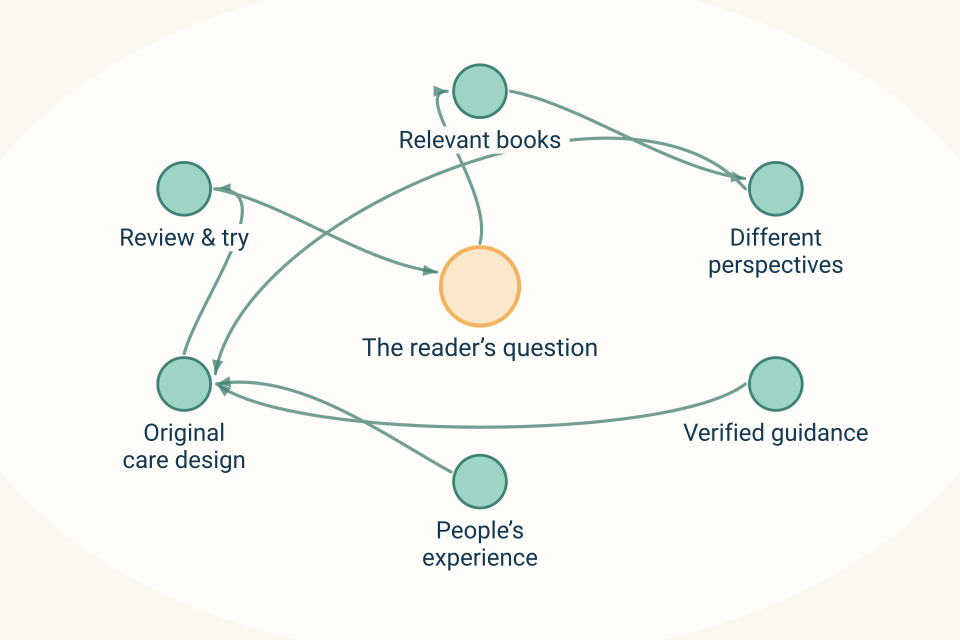
Choose relevant books for the reader’s actual question. Compare the perspectives the selected books offer rather than claiming they all agree. Those perspectives inform specific choices in an original care design. Verified organizational and professional guidance grounds that design locally. The experience of the people involved helps shape the design. Give the proposed design responsible review, resources and a way to be tried and judged. Return what is learned to the reader’s original question. A book’s argument, a research finding and a proposed application remain distinct; this diagram does not reproduce the books’ content or create clinical authority.
At a Glance
The central idea: The most useful book is not always the one with the most answers. It may be the one that helps us notice the question we have been missing.
What you’ll explore: Thirteen books offering practical guidance, lived experience, creative approaches, and organizational insight. Find a starting point for family caregiving, home care, Day Centers, clinical teams, community leadership, or content and technology design.
Read them together: Examine shared concerns and important differences: the person’s priorities, relationships, practical responsibility, understandable design, staff voice, and the purpose of technology.
Put it to work: Develop one original care experience using a small set of relevant ideas, your organization’s verified guidance, and the knowledge of the people involved.
Evidence and AI: Keep an author’s argument, a research finding, and a proposed application separate. Use approved AI assistance to prepare and compare—not to manufacture book quotations, clinical authority, or proof that an approach works.
“But everyone is a designer at times…”
— Don Norman, design researcher, “Design as Communication.”125
In context
In Context — Which book would help?
This is a fictional reference exercise, separate from Pat and Ellen’s continuing story. The dialogue and later care example are original illustrations, not passages from the books.
A care organization is selecting books for its team and family resource collection.
“Which one should we all read?” the manager asks.
A family caregiver looks at the proposed shelf.
“I need help with what happens when we get home.”
A volunteer has another question.
“I want to know how to spend time with someone without making every conversation about their condition.”
A staff member points to the work around a first visit.
“We need to stop asking the family to explain the same arrangements to three people.”
The manager puts down the list.
“Perhaps we should begin with what each book is for.”
That is the purpose of this chapter.
Not to assign everyone the same reading.
To help useful knowledge reach the situation where it can make a difference.
R4.1 — Choose a Book for the Question in Front of You
“Best” depends on the reader’s need
A practical handbook, a memoir, and a leadership book should not compete on one score. They offer different kinds of help.
A handbook can help someone locate a topic. A memoir lets a particular person describe an experience. A research-informed argument connects ideas and evidence. A design book helps a team reconsider the experience it creates.
These reading shelves bring family and first-person accounts alongside professional, organizational, and design resources. Select a book for the question it helps you examine, not as a substitute for the care or evidence your situation requires.
Choose for the question—not for the prestige of the title.
The selection is strongest in adult caregiving, aging, dementia, home-based support, and service design. It is not a complete library for every disability, condition, culture, or jurisdiction. Use relevant specialist and local guidance alongside it.
Nor should reading become a test of commitment. An exhausted caregiver does not owe the organization a completed book. A team asked to learn needs appropriate time, access, and support.
What these profiles can tell you
These are source-linked reading profiles, not thirteen cover-to-cover reviews. They draw on verified publisher and author descriptions, available contents and selected public excerpts, and the project’s behavioral research. Source access is described in R4.8 and the accompanying ledger.
The book descriptions explain the contribution supported by those materials. Reading pairings and CarePhysics applications are our editorial proposals, not interventions the authors jointly designed or evidence that their books validate this framework.
R1 remains the place to examine selected research findings. R2 explains models and methods in more detail. R3 addresses learning about the person before adapting the approach.
R4.2 — The Reading Shelves
The shelves below are entry points, not restrictions on who may benefit. A hospital leader can learn from a family memoir; a caregiver may find a design question unexpectedly useful.
Start with this need | Books profiled below |
|---|---|
Practical family care and difficult decisions | The 36-Hour Day; The Soul of Care; Being Mortal |
Care in the home | A Guide for Caregiving: What’s Next?; Handbook of Home Health Standards |
Participation, creativity, and the person’s perspective | Creative Care; Somebody I Used to Know |
Reliable and humane organizations | The Checklist Manifesto; Compassionomics; The Fearless Organization |
Understandable experiences and purposeful technology | The Design of Everyday Things; The Power of Moments; Deep Medicine |
Family caregiving, personal home support, skilled home health, and hospice-related work should remain distinct when choosing a reference. Sharing a location does not make the responsibilities interchangeable.
R4.3 — What Each Book Offers
The profile numbers are navigation aids, not a ranking.
1. The 36-Hour Day
Nancy L. Mace and Peter V. Rabins
Practical family reference; eighth edition, 2025.
The question: Where can we begin when dementia care brings more questions than we can hold at once?
What it offers. The book organizes a broad range of dementia-care concerns: obtaining medical help, everyday care, changes in behavior, outside assistance, family relationships, caregiver needs, and longer-term arrangements. Its contents give readers several entry points rather than requiring a continuous narrative reading. The eighth edition also updates discussion of diagnosis, treatment, and research.126
Its distinctive contribution. Practical breadth. Start here when the immediate need is to locate and understand a care topic. Read it alongside The Soul of Care for a different kind of attention to the lived work of caregiving.
A CarePhysics application. A social worker could help a family select one relevant topic and prepare questions for the appropriate professional. The organization can attach its own verified contact and assistance route rather than handing over a large reference and assuming support has been delivered.
The book should not become an independent treatment plan. Do not use a chapter title as proof that an intervention prevents decline or that a particular arrangement suits every family.
Question to carry into practice: After we offer information, who helps the family use it?
Related chapters: 1, 2, 5, and 11.
2. The Soul of Care: The Moral Education of a Husband and a Doctor
Arthur Kleinman
Memoir and reflection; 2019.
The question: What does caregiving require that professional expertise alone does not capture?
What it offers. Kleinman writes about caring for his wife, Joan, after her Alzheimer’s diagnosis, bringing his medical experience into contact with the practical, emotional, and moral work of being her husband and caregiver. The book considers presence, ordinary tasks, relationships, and the place of caring within medicine and society.127
Its distinctive contribution. A professional becomes a family caregiver. That perspective makes it a useful companion to a procedural handbook: not another set of instructions, but an account of what instructions cannot fully describe.
A CarePhysics application. Before revising a family-support process, invite caregivers to describe one recent part of the day. Listen for the work of arranging, noticing, explaining, and adapting—not only the task recorded by the service. Select something the organization can change and return with an answer.
This is one person’s account, not a measure of what every family experiences. Do not use its moral seriousness to make unlimited self-sacrifice the standard of love.
Read alongside: The 36-Hour Day for practical reference, or Somebody I Used to Know to place a person’s own account beside a caregiver’s.
Question to carry into practice: What work are we depending on without recognizing or supporting it?
Related chapters: 1, 4, and 11.
3. Being Mortal: Medicine and What Matters in the End
Atul Gawande
Narrative inquiry into medicine, aging, and serious illness; 2014.
The question: What should care help someone preserve when medical treatment cannot settle everything?
What it offers. Gawande examines the limits of a medical approach focused on fixing problems or extending life without sufficient attention to how a person wants to live. His account considers institutional routines, autonomy, dependence, difficult conversations, and approaches to care near the end of life. The published opening explicitly asks how medicine responds to what it cannot repair.128
Its distinctive contribution. It brings goals and trade-offs into the center of the discussion. Start here when a family or organization needs to reconsider what a successful plan is intended to accomplish.
A CarePhysics application. Add a conversation about priorities before assuming the objective of a pathway. Ask what the person wants protected and what concerns them about the available options. The appropriate clinicians explain medical implications; the person’s values help shape the decision.
Do not turn the book into a general instruction to avoid treatment or accept risk. An individual decision still requires current information and appropriate professional support.
Read alongside: The Checklist Manifesto. One helps question the purpose of the plan; the other prompts attention to dependable execution.
Question to carry into practice: Are we delivering the plan well—and is it a plan the person wants?
Related chapters: 1, 7, and 11.
4. A Guide for Caregiving: What’s Next?
Tina Marrelli
Practical guidance for family and friend caregivers at home.
The question: How do professional instructions become something a household can understand and organize?
What it offers. Marrelli’s guide covers advocacy, records, a care notebook, home-care safety, healthcare terminology, and information concerning several long-term conditions and end-of-life care. Its intended reader is the family or friend caregiver rather than only the licensed professional. The author’s description explicitly includes both the person receiving care and the caregiver.129
Its distinctive contribution. It connects everyday organization with the unfamiliar administrative and clinical language families encounter. Its scope is broader than dementia alone.
A CarePhysics application. Help a household create a short, current contact-and-question page using the guidance relevant to its situation. Let adults accept bounded responsibilities for maintaining different parts. Provide a person who can clarify instructions; do not transfer the organization’s entire recordkeeping burden to the caregiver.
Reading about a consequential task does not establish that someone can perform it safely. Required instruction, supported practice, and professional assessment remain separate. Check clinical and service information against current guidance.
Read alongside: The Soul of Care for the experience behind the organizing work.
Question to carry into practice: Does our information help the household—or make it responsible for another system?
Related chapters: 2, 7, and 11.
5. Handbook of Home Health Standards: Quality, Documentation, and Reimbursement
Tina M. Marrelli
Professional home-health reference; sixth-edition description reviewed.
The question: How do home-health professionals connect assessment, care planning, documentation, and service responsibilities?
What it offers. This is the professional counterpart to the family guide, not a longer version of the same book. The sixth-edition description covers assessment, interdisciplinary care planning, documentation, patient and caregiver considerations, and coverage and reimbursement topics. It identifies nurses, therapists, supervisors, managers, and related operational roles as intended users.130
Its distinctive contribution. Operational specificity. It is a reference to consult for professional work, not the first book to hand a family seeking reassurance.
A CarePhysics application. A home-health team could review one approved care-planning workflow, checking whether relevant information is accurate, accessible to the responsible professionals, and unnecessarily entered more than once. The service lead owns the process; clinical and compliance reviewers approve their respective parts.
This entry does not establish the sixth edition as a current reimbursement authority. Verify the applicable edition and check present clinical, documentation, and payer requirements before using operational material. A handbook does not promise payment or expand anyone’s scope of practice.
Read alongside: Being Mortal to keep personal goals visible within professional processes.
Question to carry into practice: Does the record support the care being provided, or has completing the record become the apparent purpose?
Related chapters: 7, 8, 10, and 11.
6. Creative Care: A Revolutionary Approach to Dementia and Elder Care
Anne Basting
Creative practice and narrative; originally published in 2020.
The question: How can people connect without making accurate recall the price of participation?
What it offers. Basting brings theater, improvisation, storytelling, and listening into care. Her approach includes open imaginative invitations and making room for contributions without requiring correct remembered details. The author presents the book as an account of finding, developing, and applying creative care within relationships and care settings.131
Its distinctive contribution. Something people can explore together in the present. It is a useful starting point for activity teams, volunteers, and families seeking interaction rather than another discussion of symptoms.
A CarePhysics application. Offer a chosen picture or story and an optional invitation to comment, imagine, read, or listen. Provide appropriate assistance and let the person stop. A pleasant exchange need not end with a quiz, score, or required memory.
That is an original design application, not a formal reproduction of Basting’s program. Do not convert a publisher’s promotional claim into evidence that an activity improves cognition or slows dementia. R1 examines related activity research separately.
Read alongside: Somebody I Used to Know, keeping the person’s perspective beside the activity designer’s intention.
Question to carry into practice: What contribution is the person choosing—and have we left room simply to enjoy being here?
Related chapters: 5, 6, and 11.
7. Somebody I Used to Know
Wendy Mitchell, written with Anna Wharton
First-person memoir; 2018.
The question: What do we miss when we speak about a condition without hearing from someone living with it?
What it offers. Mitchell describes her experience of young-onset Alzheimer’s, changing daily routines, identity, and efforts to continue living meaningfully. The memoir places her perspective at the center rather than presenting only a caregiver’s or professional’s interpretation. Anna Wharton’s coauthor contribution is documented separately from publisher pages that feature Mitchell’s name alone.132
Its distinctive contribution. A voice from inside one life. Read it not to acquire a standard profile of dementia, but to make more room for the person who may otherwise be discussed in the third person.
A CarePhysics application. Review a fictional meeting summary. Can the reader identify the person’s stated preferences separately from relatives’ concerns and staff observations? Where the person’s perspective is missing, improve the process for hearing it rather than asking AI to fill the gap.
One memoir cannot represent every stage, condition, or person. Do not use the author’s adaptations as a benchmark that another person must meet.
Read alongside: The Soul of Care. The two perspectives can deepen inquiry without either becoming the final account of a different household.
Question to carry into practice: Whose account has become authoritative because it was the easiest one for us to obtain?
Related chapters: 1, 4, and 6; Reference Chapter R3.
8. The Checklist Manifesto: How to Get Things Right
Atul Gawande
Narrative and organizational inquiry into reliability.
The question: How can capable people make essential actions less dependent on memory and circumstance?
What it offers. Gawande explores checklists as supports for complex work, drawing examples from medicine and other fields. The book connects preparation and essential steps with teamwork; its subject is not simply creating longer lists. The publisher provides both a description and an opening excerpt that show its focus on the difficulty of executing complex care.133
Its distinctive contribution. A practical way to examine omissions without assuming that more individual expertise solves every coordination problem.
A CarePhysics application. Design a brief first-visit check around a few necessary confirmations: the person understands the purpose, relevant assistance is arranged, the receiving worker knows what has been accepted, and changes have a responder. Test it with staff before expanding it.
That local check is not a validated clinical checklist. Preserve established safety procedures and involve the appropriate professionals. A completed box is not proof that the intended service happened.
Read alongside: The Fearless Organization. Invite the team to examine both the process and whether someone can point out a missing or unsuitable step.
Question to carry into practice: What must not be forgotten—and who is able to say that it has been?
Related chapters: 7, 10, 12, and 15.
9. Compassionomics: The Revolutionary Scientific Evidence That Caring Makes a Difference
Stephen Trzeciak and Anthony Mazzarelli
Research-based argument for the importance of compassion in healthcare; 2019.
The question: Why should compassion belong in decisions about care quality rather than be treated as an optional courtesy?
What it offers. Trzeciak and Mazzarelli assemble research and clinical stories to argue that compassion matters to patients, professionals, and organizations. The publisher’s description addresses patient outcomes, organizational costs, and professional well-being. These are the authors’ arguments to examine, not one universally transferable result.134
Its distinctive contribution. It brings the human encounter into discussions that might otherwise focus only on technical performance or finances.
A CarePhysics application. Choose one recurring encounter and ask the people receiving care whether their concern was recognized and addressed. Support staff with preparation time, useful language, and a route to help. Examine what changed alongside workload and unresolved needs.
Trace any quantitative claim to the underlying study before using it in a proposal. Do not promise that a brief phrase saves a life, reduces costs, or prevents burnout. Compassion is not a replacement for clinical skill, adequate staffing, or available services.
Read alongside: The Fearless Organization, connecting the intended quality of the encounter with the conditions in which staff work.
Question to carry into practice: Where does our commitment to compassion become an observable response?
Related chapters: 4, 10, and 11.
10. The Fearless Organization: Creating Psychological Safety in the Workplace for Learning, Innovation, and Growth
Amy C. Edmondson
Organizational learning and leadership; 2018.
The question: Can people say what the team needs to hear?
What it offers. Edmondson examines the interpersonal conditions under which people can ask questions, raise concerns, contribute unfinished ideas, and acknowledge mistakes. The book connects psychological safety with learning and offers practical approaches to establishing it, alongside accountability and organizational goals.135
Its distinctive contribution. It looks behind the instruction to “speak up” and toward the response people encounter when they do.
A CarePhysics application. Invite a staff member, volunteer, participant, or caregiver to identify a difficulty in one workflow. Record who will consider it, what action was accepted, and when the contributor will hear the result. Provide a private route where appropriate. An AI assistant may organize feedback; it should not secretly turn contributions into individual performance rankings.
Treat this as a leadership and learning resource, not a certificate that a workplace has become safe. Open conversation does not eliminate clinical standards, professional responsibilities, or the need to address harmful conduct.
Read alongside: The Checklist Manifesto. A process can be examined and improved only if concerns about it are heard.
Question to carry into practice: What happened the last time someone told us our design was making the work harder?
Related chapters: 10, 11, 13, and 14.
11. The Design of Everyday Things
Don Norman
Human-centered design; revised and expanded edition, 2013.
The question: Is the person struggling—or have we made the task unnecessarily difficult to understand?
What it offers. Norman examines how visible cues, feedback, and conceptual models help people understand what they can do and what happened after they acted. The revised edition also considers human error, real development constraints, and the pressures surrounding product design. The author’s published preface explains those additions.136
Its distinctive contribution. A way to look at an ordinary failure and investigate the design before blaming the person. It is relevant to a screen, a printed invitation, or the route through a service.
A CarePhysics application. Ask an intended user to find the right contact or distinguish a requested visit from a confirmed one, with their usual assistance available. Observe where the design obscures the answer. Change the instruction, control, or feedback and try again.
The unfamiliar-remote analogy belongs here: knowing the purpose does not make unfamiliar controls obvious. The book is not a substitute for current accessibility requirements or testing with the people served.
Read alongside: Deep Medicine, examining the whole experience around any proposed automation.
Question to carry into practice: What are we asking the person to remember that the design could make clear?
Related chapters: 2, 6, and 8.
12. The Power of Moments: Why Certain Experiences Have Extraordinary Impact
Chip Heath and Dan Heath
Experience design through research interpretation and stories; 2017.
The question: Which moments deserve deliberate attention rather than being left to chance?
What it offers. The Heath brothers organize memorable positive experiences around elevation, insight, pride, and connection. Their account examines how people might create meaningful moments in education, work, services, and personal life. The publisher’s available opening explains that interest in both understanding such experiences and designing them.137
Its distinctive contribution. It directs attention to beginnings, transitions, recognition, and shared experiences that could otherwise become routine transactions.
A CarePhysics application. Plan a first welcome so a person encounters someone prepared to meet them, a clear explanation, and an activity they may choose. Ask what would feel comfortable. A quiet introduction may fit better than public recognition or a surprise.
Do not infer that a memorable event guarantees a lasting health benefit. For a person living with dementia, the value of an enjoyable moment need not depend on later recall. Nor can a special welcome compensate for repeated missed services.
Read alongside: Creative Care for participation and The Checklist Manifesto for the dependable arrangements around it.
Question to carry into practice: Which ordinary transition could become more respectful or meaningful without becoming a performance?
Related chapters: 5, 6, and 13.
13. Deep Medicine: How Artificial Intelligence Can Make Healthcare Human Again
Eric Topol
Medical technology and human-centered care; 2019.
The question: What should assistance make possible for the relationship between the person receiving care and the professional?
What it offers. Topol argues that AI could take on work that competes with human attention and thereby make more room for listening and connection. The book considers a broad range of medical applications; its human-centered ambition is distinct from the performance of any particular system.138
Its distinctive contribution. A purpose against which to examine technological progress: not merely whether a tool is capable, but what its use could make possible for people.
A CarePhysics application. Test one bounded drafting task using approved sources. Name the reviewer, measure preparation and correction time, and ask whether the final material helps the next conversation. Keep decisions and accountable care with the appropriate people.
Read the 2019 discussion in its historical context. It is not an inventory of currently available products or evidence that every modern assistant saves time, improves diagnosis, or reduces costs. R1.4 examines selected task-specific research separately.
Read alongside: The Design of Everyday Things and Being Mortal, combining usability with the question of whose goal the technology serves.
Question to carry into practice: What human attention will we protect if the tool does reduce some of the work?
Related chapters: 8, 9, 10, and 13.
Further readings that connect directly with R2
Motivational Interviewing: Helping People Change and Grow — William R. Miller and Stephen Rollnick, fourth edition, 2023. A practice-oriented text with demonstrations and cases organized around engaging, focusing, evoking, and planning. Choose it for developing a collaborative communication practice, not collecting persuasive phrases. Pair it with supervised learning and appropriate evaluation; reading alone is not demonstrated competence.112
The Behaviour Change Wheel: A Guide to Designing Interventions — Susan Michie, Lou Atkins, and Robert West, 2014. A structured guide moving from understanding a behavior to selecting intervention and implementation options. Choose it when a team needs a disciplined alternative to assuming every problem requires more education. R2 explains COM-B and the distinction between a framework and the effectiveness of an intervention designed with it.139
Social Physics — Alex Pentland, 2014. A perspective on how ideas move through relationships and become part of collective behavior. Pair it with The Fearless Organization to ask both how knowledge travels and whether people feel able to contribute. Our commissioned review grades the broader perspective Emerging-to-moderate, with important limits on transfer to care and on claims that more interaction is always beneficial.140
The wider behavioral collection includes Ryan and Deci’s Self-Determination Theory, Rogers’ Diffusion of Innovations, Milkman’s How to Change, Thaler and Sunstein’s Nudge, Centola’s Change, Cialdini’s Influence, and Fogg’s Tiny Habits. Its original ranking belongs to that research commission; it is not a universal ranking against the books in this chapter.
The Goal: A Process of Ongoing Improvement — Eliyahu M. Goldratt and Jeff Cox, third edition, 2004. This management novel follows a plant manager confronting a threatened closure and introduces TOC through a story about interconnected work. The authors and edition are confirmed by the publisher’s public description.141
Our reading suggestion: pair it with The Checklist Manifesto and The Fearless Organization. Ask where local efficiency fails to improve the whole service, then hear from the people affected before choosing a change. R2.5 offers a bounded care adaptation. This is a supplementary reading profile, not a cover-to-cover review, a clinical study, or a reason to judge people by production targets.
R4.4 — What These Books Have in Common
The shared questions are more useful than a claim of complete agreement
The following is our synthesis of the documented perspectives, not a joint position endorsed by the authors. Not every book addresses every theme.
The person’s life is larger than the care task. Read Gawande’s concern with goals, Kleinman’s account of caregiving, and Mitchell’s first-person perspective together. They invite different kinds of attention to what matters beyond a diagnosis or completed intervention.128
For CarePhysics, the design question is what the person wants the support to protect: a relationship, a chosen activity, privacy, independence, or something else they name.
Relationships need a place inside the work. The Soul of Care, Creative Care, and Compassionomics approach the human encounter through memoir, creative practice, and an argument about research. Their genres differ, but each gives the relationship substantive attention.127
Our application is to make that attention visible: address the person, pause for the answer, respond to the concern, and make an honest commitment. A warmer sentence without the corresponding action is not enough.
Good intentions need a workable arrangement. The practical caregiver guides and The Checklist Manifesto offer different ways into preparing and organizing care.126
Ask who accepts the task, what they need, and what happens when the arrangement changes. Do not turn the primary caregiver into the coordinator of every offer. A resource recommendation becomes useful only when it connects with something the person can actually do or receive.
Difficulty can expose a design problem. Norman directs attention to the interaction between people and the things designed for them. The Behaviour Change Wheel adds a structured inquiry into what needs to change before an action can occur.136
Together they give us reason to ask about unclear instructions, unsuitable timing, unavailable support, and unnecessary steps before reaching for a label about the person’s motivation.
People need a way to contribute what they know. Edmondson’s focus on speaking up and Pentland’s interest in idea flow support different questions about knowledge within a group. Neither is permission to harvest private conversations or turn staff interaction into surveillance.135
Our proposed practice is to welcome ideas from patients, participants, caregivers, volunteers, and frontline teams; review them; credit contributors appropriately; and show what changed.
Tools should be judged by the human purpose they serve. Read Topol’s aspiration for assistance alongside Norman’s attention to usable design. That pairing invites scrutiny of the full experience, not only an impressive function.138
Purpose, love, trust, compassion, and community are not additional performance indicators to infer from a dashboard. In CarePhysics, they guide what we choose to ask, provide, protect, and review.
R4.5 — Important Differences Make the Shelf Stronger
These pairings raise useful questions; they are not claims that the authors disagree with one another.
Read together | The question created by the pairing |
|---|---|
Being Mortal + The Checklist Manifesto | Which safety and coordination steps need consistency, and which goals must remain the person’s own? |
The Soul of Care + A Guide for Caregiving | How do we recognize the meaning of caregiving while making its practical demands more manageable? |
Creative Care + The Power of Moments | Can the encounter have value now without requiring durable recall, public participation, or a dramatic event? |
The Fearless Organization + Handbook of Home Health Standards | How can professionals question the process and still uphold the standards and responsibilities relevant to their work? |
Deep Medicine + The Design of Everyday Things | Does automation improve the whole task, or move difficulty into checking, correction, sign-in, or follow-up? |
The pairing is useful when it prevents a one-sided application.
Do not make a checklist so rigid that it prevents someone stating a preference. Do not make personalization so improvised that nobody confirms essential information. Do not use compassion to excuse unsafe practice or use formal documentation to dismiss a person’s experience.
A family’s cultural practices, beliefs, resources, and relationships should shape the local application through conversation. Books help prepare questions; they do not authorize assumptions about the next person. That is the distinction developed in R3 and the project’s cultural-humility guidance.
The books also have different emotional demands. A person may welcome a reflective account at one time and need a brief practical answer at another. Offer reading as an option, with an appropriate human route alongside it.
R4.6 — Short Reading Routes
These are editorial starting combinations, not tested interventions or required courses. Begin with one useful selection rather than assigning the whole shelf.
Reader or team | Start here; then add another perspective | One question for discussion |
|---|---|---|
Family caregiver dealing with dementia | The 36-Hour Day; then The Soul of Care | What information is useful now, and what practical support is still missing? |
Family or friend providing care at home across conditions | A Guide for Caregiving; then selected Being Mortal material | What needs organizing, and whose priorities should shape it? |
Skilled home-health team | A professionally reviewed, applicable edition of the Handbook; then The Fearless Organization | Where can someone question a process that is not working? |
Day Center team or volunteer | Creative Care; then Somebody I Used to Know | Does the person have a real way to choose, contribute, listen, or stop? |
Health-system leader | The Checklist Manifesto; then Compassionomics or The Fearless Organization | What conditions make both reliable work and a humane encounter possible? |
Community or state partnership | The Soul of Care; then Social Physics | Which lived need should guide the network, and who helps knowledge become usable support? |
Content or technology team | The Design of Everyday Things; then Deep Medicine | Which task should become easier, and what human work must remain visible? |
Provide legitimate access to the chosen material and protected time for staff learning. Check the actual availability and suitability of audio, print, translated, or accessible versions before promising them. A discussion can begin with a permitted short excerpt or a team’s original source-linked notes.
Do not use completion as a measure of compassion. Ask what the reader noticed and whether it suggests a worthwhile change.
R4.7 — From Reading to a Better Encounter
Begin with the person’s question
In context
In Context — Before the first home-support visit
This standalone fictional example demonstrates our synthesis. It is not an event from any listed book, a clinical protocol, or an addition to the established family’s chronology.
Amelia has agreed to explore support at home. The coordinator is preparing the first visit with her and, with permission, her daughter.
“I know you’ve talked about the tasks,” Amelia says. “What I don’t know is what happens when somebody comes through the door.”
Her daughter asks a different question.
“If the usual worker can’t come, do I start calling people?”
The draft welcome pack explains the organization but answers neither question clearly.
The team does not need to tell Amelia which books it has been reading. It needs to use the ideas to improve what she encounters.
Turn perspectives into specific choices
The lived-experience books suggest a question for the design meeting: have we included the person’s account, or only the family’s and the service’s?
The practical guides prompt review of the arrangements. The design books prompt a test of the explanation. The reliability and team-learning books prompt attention to accepted responsibilities and corrections.
Those are our applications of the profiles—not a combined intervention validated by the authors.
The team prepares an original first-visit page:
Your first visit
We will confirm who is coming, when they are expected, and the agreed purpose of the visit.
The worker will introduce themselves and discuss the planned assistance with you before beginning. You can explain a preference, ask a question, or raise something that does not fit.
The service will explain which tasks it can provide, which need another professional, and how a change can be requested.
Before the visit ends, you should know what has been agreed and whom to contact. If the arrangement changes, the service uses the contact route you chose.
We will confirm the actual contact details and response expectations with you. Urgent concerns follow the appropriate urgent-care route, not an ordinary feedback message.
The page cannot go into use until the organization can provide what it promises. A named service lead verifies staffing and coverage; relevant professionals verify task boundaries and instructions.
A short video can show the introduction and an appropriate question. An article explains details people can revisit. An optional survey or interactive question asks what would help prepare the visit and identifies who reads the answer. A message confirms actual arrangements. A telephone call, virtual meeting, or planned encounter deals with what the standard material cannot answer.
A tile can collect related material; a pathway connects it to people and actions. Use the same recognizable design functions—purpose, main idea, demonstration, chosen next step, questions or connection, and follow-through—without making every medium identical. Urgency overrides that pattern; validated instruments retain required wording and scoring.
Use AI to help prepare—not to make the promise
An approved assistant could work from the team’s original reading notes, appropriately usable source material, and verified local procedures:
Compare these ideas for the first-visit task. Distinguish the author’s argument, the research behind it, and our proposed application. Draft options that preserve the person’s choices and the service’s actual limits. Identify missing information, the responsible reviewer, and a way to test usefulness. Do not invent book quotations, clinical instructions, service availability, or family preferences.
The knowledge collection should keep research, design guidance, local facts, fiction, and private context distinct. Retain sources, authors, review dates, approved uses, and corrections. The workflow is retrieve → add local context → prepare options → human review → test → revise. A book upload is not model training or proof that an assistant will follow the material reliably.
Properly applied, this assistance can be a gift: less repetitive assembly and more room to ask what Amelia needs. Count review and correction work before claiming time saved.
Where an organization has approved and tested the function, an assistant may help people revisit routine information or prepare questions at any hour. It must distinguish that availability from human service hours and offer a real route to a person. Clinical decisions, urgent assessment, and accountable care remain with the appropriate people.
Optional live assistance or post-visit reflection can help bring forward an unanswered question or an idea. Explain the recording and sharing arrangements, allow decline, and preserve disagreements. A patient, participant, caregiver, volunteer, or frontline worker may supply the useful change; AI should not take credit for it or become a hidden evaluator.
These are proposed roles. The dated Day Center export documents some related educational, feedback, and practice features, but also states that family education delivery is not evidence of completion and partner follow-through is not automatic. No claim of universal deployment follows from this example.
Give the improvement resources and a way to be judged
Plan staffing, preparation, interpretation, accessibility, privacy, training, costs, and absence coverage. A volunteer or family member should not inherit a professional responsibility because a reading exercise identified a gap.
For one first-visit process, establish a baseline and a defined review period. Examine whether people can identify the purpose, contact, and next step; whether questions receive substantive responses; and whether agreed support is actually delivered.
Report the denominator: everyone offered the revised process, not only people who returned a favorable survey. Include nondigital routes and people who declined the optional activity. Count staff time, family coordination, corrections, and unresolved needs. A named leader must be able to change or pause the process.
Keep reach, understanding, first action, adoption, useful participation, outcomes, and attributable impact separate. Willingness to recommend, actual referrals, and received services are separate too. Those distinctions are part of the research review informing this book, not something a book recommendation can bypass.
Genus supplies technology. Partners retain their care, staffing, programs, professional decisions, relationships, and voice. A useful reading group should make the service better—not imply that the service belongs to the technology provider.
R4.8 — Sources, Editions, and What to Keep Current
Know what was actually reviewed
For this draft, the profiles rely mainly on author and publisher descriptions and contents. Selected text was also examined: the published openings of Being Mortal and The Checklist Manifesto, the opening of The Power of Moments, and Norman’s published revised-edition preface and design essay. The behavioral-book entries also draw on the evidence reviewed here-graded research and primary book descriptions.
No claim is made that all thirteen complete books were read for this chapter. Detailed claims beyond the accessible material, specific quotations, and page references require the relevant text before publication. Publisher praise is not independent evidence of efficacy.
The underlying studies belong in the evidence register. Do not give a whole memoir or popular book a clinical evidence grade. Preserve grades from the source reviews for the particular conclusions they assess, and use R1 to examine findings and limits.
Preserve the edition and its limits
Record the author credits, full title, publisher, edition, and ISBN of the copy actually used. A new printing, paperback, or format date does not necessarily mean that its clinical or operational content has been updated.
The eighth edition of The 36-Hour Day was published in September 2025. The home-health handbook source examined here describes the sixth edition; it is not established here as a current operational authority. These are different source situations and should remain visible.126
Before using a book’s clinical, legal, funding, accessibility, or technology material in a service, obtain appropriate current review. A classic can remain useful for a design question while particular examples or requirements need updating.
A reading recommendation does not itself establish permission to upload, adapt, or redistribute a complete commercial work. Use legitimate copies and material authorized for the intended purpose. Attribution and permission are separate questions.
The original 2023 list remains part of the manuscript’s history. This selection does not silently confirm uncertain entries in that earlier bibliography or assign its claims to newly selected books.
One thing to try
Choose two books that approach your current problem differently: a practical guide and a firsthand account, or a reliability book and a design book.
Prepare one source-linked idea from each. Ask someone receiving the service and someone providing it what those ideas miss about the actual situation.
Agree on one original change, the person responsible, the support required, and how you will examine the result. Credit the contribution that makes the design better, whether it came from a book, a caregiver, a participant, a volunteer, or a colleague.
Your team’s question is:
What did this reading help us notice—and what are we prepared to do differently because of it?
The book is a beginning, not the last word
Return to the manager choosing a book for everyone.
The team now has more than a reading list. It has different routes into the work: one source for a practical question, another for an overlooked perspective, another for the conditions around a reliable encounter.
The family caregiver does not need to finish the shelf before asking for help. The volunteer does not need to become a clinician to offer appropriate companionship. The organization still has to provide the people and resources behind its promises.
A good book can change what we see.
The next responsibility is to bring that understanding back to the people in front of us—and listen to what they add.
Notes
Miller WR, Rollnick S (2023). Motivational Interviewing: Helping People Change and Grow. Fourth edition. Guilford Press. Source (opens a new tab)
Norman DA. Design as Communication. Don Norman’s JND.org. Author’s essay. Source (opens a new tab)
Mace NL, Rabins PV (2025). The 36-Hour Day: A Family Guide to Caring for People Who Have Alzheimer Disease and Other Dementias. Eighth edition. Johns Hopkins University Press. Source (opens a new tab)
Kleinman A (2019). The Soul of Care: The Moral Education of a Husband and a Doctor. Viking. Publisher’s description. Source (opens a new tab)
Gawande A (2014). Being Mortal: Medicine and What Matters in the End. Metropolitan Books. Publisher’s description. Source (opens a new tab)
Marrelli TM. A Guide for Caregiving: What’s Next? Planning for Safety, Quality, and Compassionate Care for Your Loved One and Yourself. Author’s description. Source (opens a new tab)
Marrelli TM. The Handbook of Home Health Standards: Quality, Documentation, and Reimbursement. Sixth edition. Author’s description of the professional reference. Source (opens a new tab)
Basting A (2020). Creative Care: A Revolutionary Approach to Dementia and Elder Care. HarperOne. Publisher’s description. Source (opens a new tab)
Mitchell W, with Wharton A (2018). Somebody I Used to Know. Bloomsbury. Publisher’s description. Source (opens a new tab)
Gawande A (2009). The Checklist Manifesto: How to Get Things Right. Metropolitan Books. Publisher’s description. Source (opens a new tab)
Trzeciak S, Mazzarelli A (2019). Compassionomics: The Revolutionary Scientific Evidence That Caring Makes a Difference. Studer Group. Book description and bibliographic listing. Source (opens a new tab)
Edmondson AC (2019). The Fearless Organization: Creating Psychological Safety in the Workplace for Learning, Innovation, and Growth. Wiley. Publisher’s description. Source (opens a new tab)
Norman DA (2013). The Design of Everyday Things. Revised and expanded edition. Basic Books. Publisher’s description. Source (opens a new tab)
Heath C, Heath D (2017). The Power of Moments: Why Certain Experiences Have Extraordinary Impact. Simon & Schuster. Publisher’s description. Source (opens a new tab)
Topol E (2019). Deep Medicine: How Artificial Intelligence Can Make Healthcare Human Again. Basic Books. Publisher’s description. Source (opens a new tab)
Michie S, Atkins L, West R (2014). The Behaviour Change Wheel: A Guide to Designing Interventions. Silverback Publishing. Author/publisher description. Source (opens a new tab)
Pentland A (2014). Social Physics: How Good Ideas Spread—The Lessons from a New Science. Penguin Press. Publisher’s description; later editions use the subtitle How Social Networks Can Make Us Smarter. Source (opens a new tab)
Goldratt EM, Cox J (2004). The Goal: A Process of Ongoing Improvement. Third edition. Routledge. ISBN 9780566086656. Publisher’s description. Source (opens a new tab)