Using This Book
Start with one meaningful need
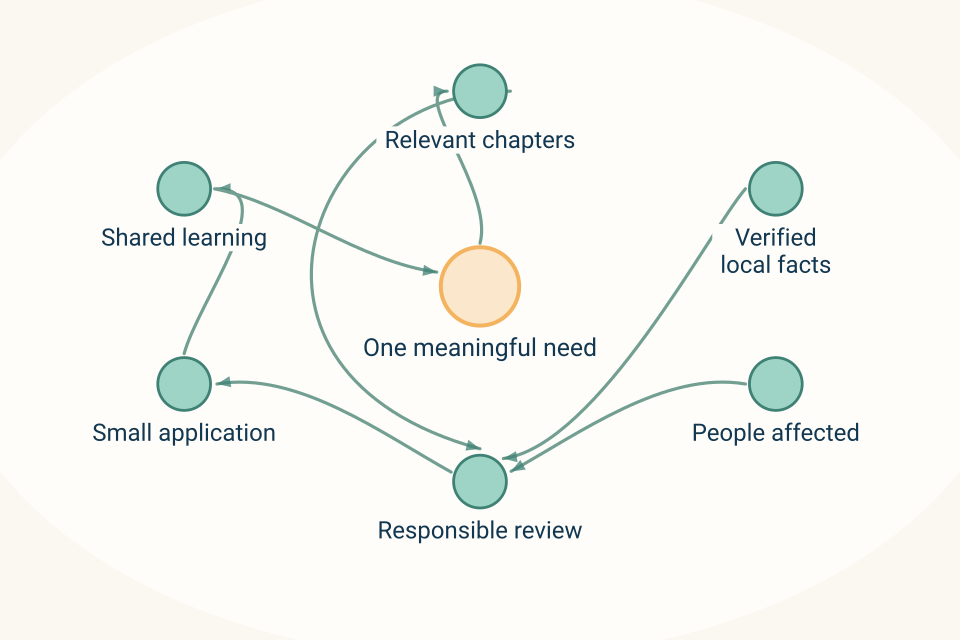
Choose relevant chapters for one meaningful need. Bring the relevant book guidance into responsible review. Add verified local guidance, service facts and capacity to the review. People receiving and providing support help review the proposed response. Responsible review prepares an appropriate small application. Trying the application produces experience to discuss and examine. Return the learning to the original need and revise the response. An application needs an owner, resources and a review point; completing a form is not the aim.
Your organization brings knowledge this book cannot supply: its mission, professional guidance, services, staff expertise, community relationships, and current capacity. The people you serve bring their own account of what matters and what it is like to use the support.
Choose one situation before choosing tools. It may be an unanswered question, an introductory visit, a handoff, or a recurring task that creates avoidable work. Read the relevant chapters with the people receiving and providing that support. Notice what already helps; identify what needs to change.
Keep research, local service facts, professional instructions, fictional examples, and private personal information distinguishable. When sources conflict, the responsible reviewer resolves the conflict. Select only the material and personal context needed for the task.
In context
In Context — A new partner prepares its first family introduction
This is a hypothetical example of applying the guide, not a report of a particular deployment.
A Day Center team is preparing to introduce its program to participants and families. The team knows its staffing, activities, eligibility, fees, and transport arrangements. Families have questions about what an ordinary day involves and how to decide whether the program fits.
The partner and implementation team begin with that situation—not a tour of every feature.
An approved assistant helps draw together relevant CarePhysics material, the partner’s guidance, and its verified service facts. It prepares a planning brief, a staff practice exercise, a video outline, a companion article, and an optional question for the family.
People with the relevant responsibilities review the work. The program lead checks the offer. Appropriate professionals review clinical material. Intended users help examine language, accessibility, and practical fit. The team confirms who answers requests and what happens if the usual responder is unavailable.
The software has a defined job: make the approved information and chosen response route easy to find. A request for a callback is recorded as a request until the receiving person accepts it. A referral is not described as completed care merely because information was sent.
The material lets someone ask a question, involve a chosen supporter, or explore an alternative without being pressed to enroll. A telephone or printed route is part of the plan where needed.
The same human purpose is recognizable in the planning, the training, the content, and the experience.
That is what it means to use the book operationally. A health-system department, home-care provider, or community organization could begin with a different need and use the same discipline to develop its own response.
Make the next version a shared piece of work
A useful working sequence is: retrieve relevant material, add verified local context, prepare options, review with responsible people, try an appropriate application, and revise from what is learned. Give the change an owner, resources, and a review point. Credit contributors and return with the result, including when an idea could not be used or did not help.
A configured assistant may help prepare resources or explain approved routine information between conversations. Its task, access, review requirements, and route to human help must be defined. Uploading the book does not train the underlying model or prove that the assistant will apply it reliably. Availability of information is not continuous professional coverage.1
Use Appendix D to plan a pathway, F to examine benefits and burdens, and H to review content. The other tools are available when the task calls for them. A completed worksheet is not the purpose; a more understandable choice or dependable piece of support is.
Continue the conversation
The CarePhysics website is an entry point to the framework and related resources.11
Our companion vision includes podcast conversations, appropriately scoped assistants, and downloadable knowledge resources for use alongside an organization’s own guidance. Check the website for what has been released and its intended use. Share what helped, what did not, and what the next version should understand. Participation is an invitation, not a condition of receiving support.
Read what is useful. Bring one question to the people involved. Then change something because of what you learn.
Notes
World Health Organization (2024). WHO releases AI ethics and governance guidance for large multi-modal models. January 18. Source (opens a new tab)
Genus. CarePhysics: Bringing Out the Best in Care. Public framework resource. Source (opens a new tab)